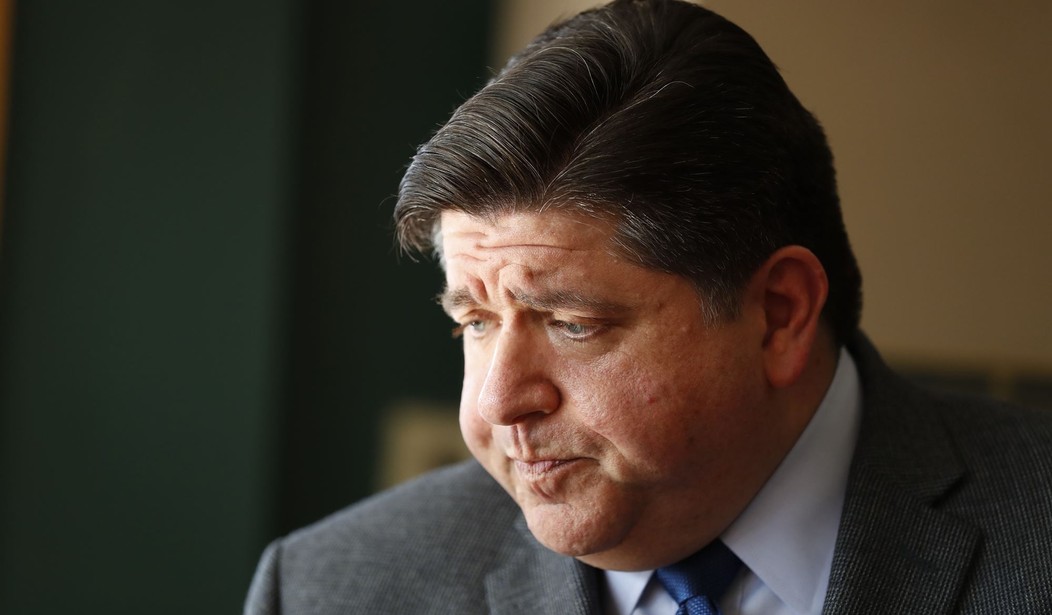
Illinois Gov. J.B. Pritzker has spent the past year boosting his national profile, pitching himself as a top Democrat contender and a “competent executive” ready for higher office. But if his new $56 billion Illinois budget is the résumé, the fine print tells a different story—one with a lot more math and a lot less momentum.
Start with the economy. According to Moody’s Analytics, Illinois is projected to lag behind both the Midwest and the nation. Employment is expected to be “essentially unchanged.” Flat job growth in a state already dealing with outmigration and deep structural debt isn’t progress—it’s a polite way of saying “stuck.”
Then there’s pensions. Illinois remains the only state with more than $100 billion in unfunded pension liabilities, now hovering around $145 billion. Next year’s required contribution tops $10.7 billion. That obligation is baked into the budget, crowding out flexibility and leaving little room for real reform. Apparently, fiscal freedom is optional when the bill is mandatory.
Supporters like to point to multiple credit upgrades during Pritzker’s tenure. But despite those upgrades, Illinois still holds the lowest bond rating of any state in America. That’s not just a badge of dishonor—it raises borrowing costs and signals long-term instability to investors and employers.
The governor’s proposal boosts overall spending by about 1.6 percent. Outside pensions and education, discretionary growth is roughly 0.5 percent. Fans call that discipline. Critics call it survival math. Either way, the margin for error is microscopic.
The administration projects a general fund surplus of just $24 million on a $56 billion budget. On a spreadsheet that size, $24 million isn’t a cushion—it’s pocket change.
About $1.7 billion in federal funding faces uncertainty due to legal disputes and shifting federal policy, yet the budget assumes the money will keep flowing. Meanwhile, it introduces new targeted business taxes, including a levy on large social media platforms expected to raise about $200 million. Because when in doubt, tax something trendy and hope it works out.
As Pritzker’s national profile rises, the condition of his home state becomes part of the argument for—or against—him. His critics may be partisan, but the numbers aren’t. Illinois taxpayers already face one of the highest combined state and local tax burdens in the country. Pension debt remains unmatched nationwide. Job growth is projected to stall.
This is not a one-year hiccup. It is the eighth budget of his tenure.
A governor eyeing national leadership should be able to show durable reform, strong credit, and clear economic momentum. Instead, Illinois still carries the worst bond rating in the nation, triple-digit billions in pension debt, and an economy expected to stand still.
If this is the model being offered to voters nationwide, Illinois looks less like a blueprint and more like a warning label. Still, the silver lining is simple: Americans can study this balance sheet now—and make smarter choices for the future.