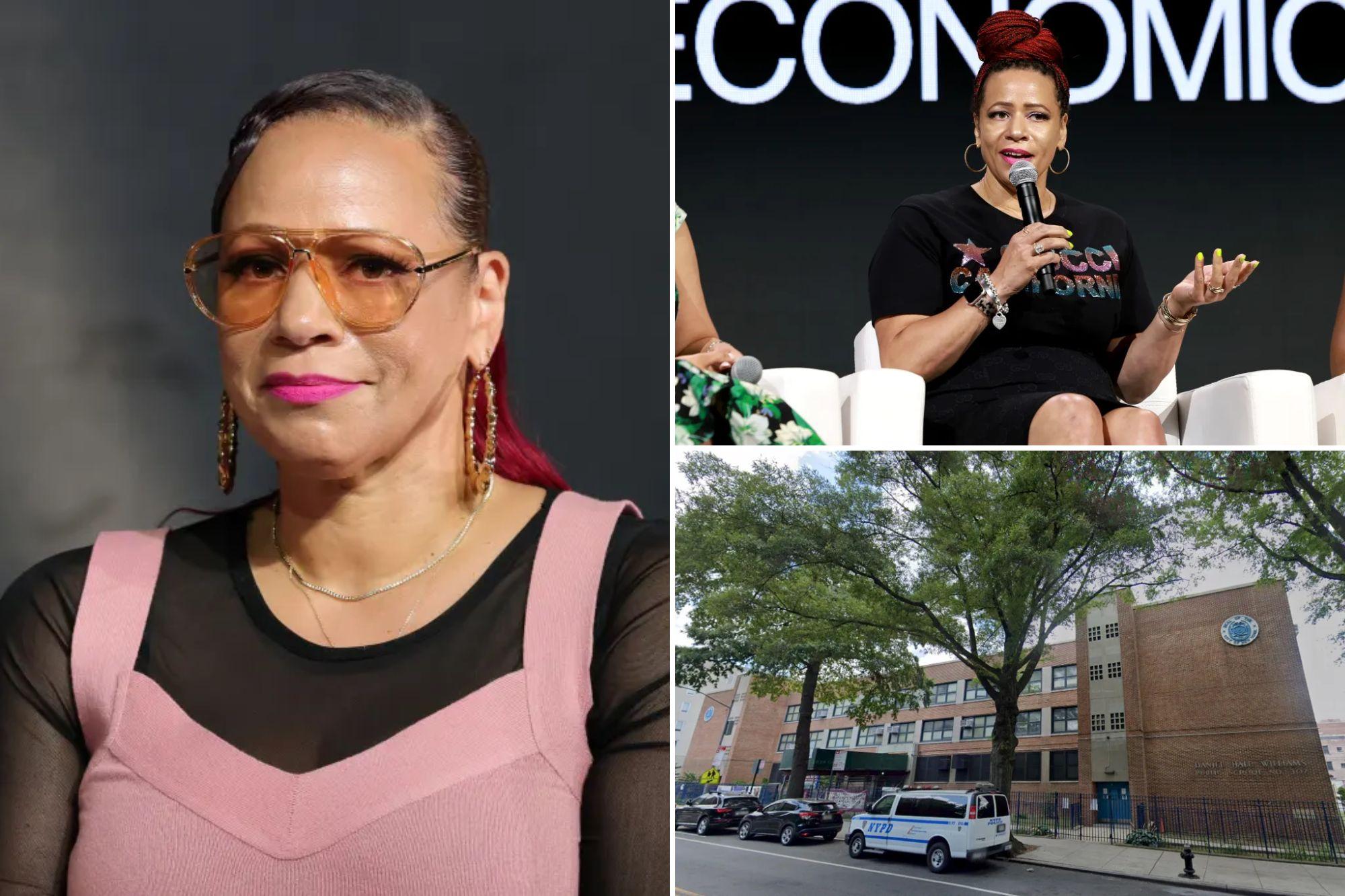
Nikole Hannah-Jones, the driving force behind The New York Times' controversial 1619 Project, has revealed a stunning admission: her own daughter was academically crippled and left "boiling" mad after being deliberately enrolled in failing Brooklyn public schools as part of a bizarre "sacrifice" for ideological principles. This isn't just a story about education; it's a stark, personal indictment of progressive dogma prioritizing abstract social experiments over a child's fundamental right to a quality education.
Hannah-Jones, 50, candidly detailed in a New York Times Magazine essay that she chose to send her only child, Najya, to two struggling schools beginning in 2015. Her rationale? To challenge what she termed "systemic racism" and, presumably, to model a path for other "families like ours" — families with "connections and time and status" — to improve these schools. This, from a woman who herself benefited from a busing program and top-tier university education, and who, with her husband, purchased a $1.5 million brownstone in Bed-Stuy in 2018. The chasm between her family's resources and her child's educational deprivation for "the cause" could not be more glaring.

The human cost of this experiment is now painfully clear. Najya, now 16, confronted her mother with raw fury. "So you had money to send me to one of the best schools, and you chose not to?" the girl reportedly yelled. "Because other kids are disadvantaged, you didn't want to put me in a great school?"
Hannah-Jones's stated justification was that she "felt an obligation to make educational decisions based on the collective good and not just our individual advantage." She claimed they believed their participation could "help improve it for all the children there."

Yet, after years at PS 307 and Urban Assembly Unison, Hannah-Jones herself discovered her "sharp-witted child" lacked the most basic skills needed for high school. The consequence of her mother's "collective good" philosophy was a child who felt "cheated" and furious that her own family had prioritized an ideological agenda over her individual well-being.

"Sometimes I wish instead of always thinking about other kids, you would have thought about me," Najya tearfully confided during a summer confrontation. "I never really got the education I wanted." Hannah-Jones, in a moment of rare candor, admitted, "I feel like you got cheated," and even acknowledged, "I don't know" what she accomplished by her decision, feeling she "failed both my values and my child." It seems even the most ardent proponents of progressive social engineering can't escape the cold, hard reality of its human toll.
This catastrophic failure occurred in schools like PS 307, where only 19% of students met state English standards in 2016 — a dismal figure far below the city average. Urban Assembly Unison fared little better. These are not isolated incidents but symptoms of a system failing its students, a reality Hannah-Jones chose to ignore for her own daughter's education, until it was too late.
The irony is profound. Hannah-Jones's 2016 essay, explaining her initial decision, helped launch her career and the heavily criticized 1619 Project, which seeks to fundamentally rewrite American history through the lens of slavery. While her career soared, her daughter's education stagnated.
Najya’s struggle was laid bare in a "shocking revelation" when Hannah-Jones discovered her daughter's teachers weren't even grading her work, leading to a false sense of proficiency in math and a deluge of uncorrected errors in writing. "My devastation morphed into hot rage," Hannah-Jones wrote. But this "hot rage" didn't prevent her from keeping Najya in similarly struggling schools for years afterward, despite her daughter's complaints that "studious kids were neglected while misbehavior would get attention."

The breaking point came when Najya discovered her middle school's abysmal scores online. "Did you know my school was bad like this when you decided to put me here?" she challenged. Finally, Najya was allowed to choose her own high school, only for teachers to find her "woefully behind in fundamental skills," requiring intensive tutoring just to catch up.

Hannah-Jones's confession marks a moment of profound regret, acknowledging she "had not chosen her" daughter. "Najya deserved better. They all did. But she was mine. This girl, my only child, looked to me to protect her, to give her what she needed to thrive. And I had not chosen her."

The reaction online has been sharp, exposing the fault lines in America's culture wars. Critics, like Atlantic writer Thomas Chatterton Williams, echoed common sense, recalling his own Black father, who grew up under segregation and "fought tooth and nail for an education," being "gobsnacked" by Hannah-Jones's initial decision. Others, predictably, tried to salvage her image, praising her "principles" while tacitly admitting her "analytical" failure.

This saga is a cautionary tale for those who champion radical social engineering at the expense of individual liberty and common sense. It highlights the deeply personal and often devastating consequences when progressive ideology, cloaked in noble intentions, trumps parental responsibility and a child’s right to a strong foundation. The America First movement understands that a quality education is not a privilege to be "sacrificed" on the altar of political agendas, but a fundamental building block for every American child's future. True progress lies in empowering parents and ensuring excellence, not in sacrificing children for a flawed utopian vision that ultimately benefits no one, especially not the very children it claims to champion.