
In a rare and significant move, a federal appeals court delivered two decisive victories for the Trump administration on the same day, upholding the rule of law against attempts to hamstring federal officers during the tumultuous Portland protests. The 9th Circuit Court of Appeals overturned two preliminary injunctions that had been issued by federal district judges, each attempting to restrict the use of crowd-control measures by federal agents during the chaotic demonstrations outside an Immigration and Customs Enforcement (ICE) facility in Portland, Oregon.
Both rulings stand as a powerful rebuke to lower court judicial activism, effectively affirming the Trump administration's commitment to maintaining order. Adding an intriguing layer to this judicial showdown, one of these pivotal decisions surprisingly leverages the Supreme Court's landmark abortion ruling in Dobbs v. Jackson Women's Health Organization.
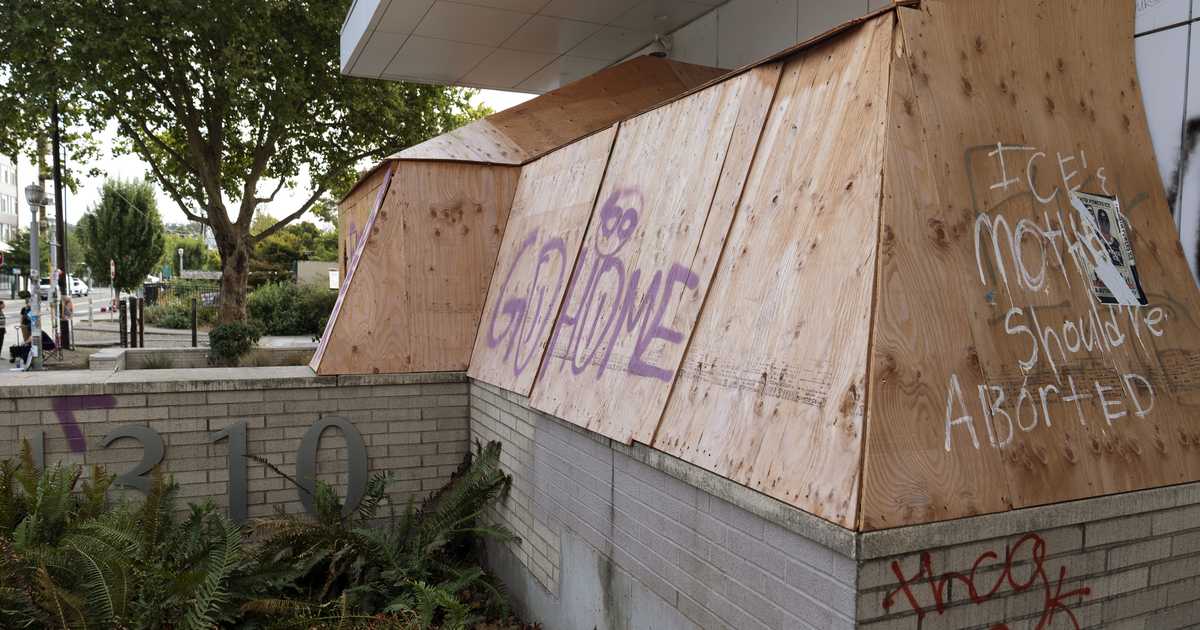
The core of this legal battle stems from months of demonstrations at Portland's ICE facility. While some activists claimed peaceful protest, the appellate opinions—and eyewitness accounts—detail a far more aggressive reality: federal officers were assaulted, government property was vandalized, access to the facility was blocked, and projectiles were repeatedly hurled at law enforcement.
Naturally, federal officers responded to these acts of defiance and criminality with standard crowd-control measures, including tear gas, pepper balls, and other chemical agents.
This necessary response, however, triggered two distinct lawsuits designed to undermine the federal government's authority.
In Reach Community Development v. DHS, residents of a nearby apartment complex, Gray's Landing, claimed chemical agents drifted into their homes. A federal district judge, Amy Baggio, then granted a sweeping preliminary injunction that severely restricted the use of these agents.
Meanwhile, Dickinson v. Trump saw self-proclaimed protesters and journalists alleging they were deliberately targeted for exercising their First Amendment rights. A different district judge, Michael Simon, issued a separate injunction, not only restricting federal officers' use of crowd-control weapons but also audaciously attempting to dictate specific changes to their uniform markings. The 9th Circuit promptly stayed both injunctions, and now, has vacated them entirely.
In the Reach case, Judge Eric Tung, a Trump appointee, writing for the majority and joined by Judge Kenneth Lee, also a Trump appointee, decisively concluded that the apartment residents failed to establish a likelihood of success on their Fifth Amendment substantive due process claim. This is where the Dobbs decision made its unexpected, yet profoundly relevant, appearance.
The Supreme Court's Dobbs ruling underscored a critical principle: recognizing unwritten constitutional rights demands a rigorous examination of whether such rights are deeply rooted in American history and tradition. Judge Tung applied this foundational reasoning to the Portland residents' claim. The plaintiffs argued that the government's actions "shocked the conscience," but the majority found this insufficient. To prevail, they needed to demonstrate both "shock the conscience" conduct AND the deprivation of a historically rooted constitutional liberty. The court found no such right had ever been established against incidental exposure to chemical agents deployed to manage disruptive, often violent, demonstrations. This ruling sends a clear message: courts cannot invent new rights from thin air to suit political agendas.
The second decision, Dickinson, tackled the First Amendment claims. Writing for the same 2-1 majority, Judge Lee concluded that the plaintiffs provided insufficient evidence that federal officers targeted them because of their protected expression. This crucial distinction highlights that an officer's use of force, even if disputed, does not automatically equate to retaliation against free speech.
The panel firmly reiterated that law enforcement is not obligated to wait for an "imminent threat of physical injury" before dispersing a volatile crowd. Acts of serious disorder, criminal trespassing, and obstruction of federal officers are sufficient grounds for intervention. The district court's injunction, with its overly broad restrictions, was soundly rejected for attempting to micromanage federal operations. The lower court's attempt to dictate federal officers' uniform markings was met with Judge Lee's memorable and biting observation:
Courts cannot be the couture of the executive branch.
Indeed. Judges are entrusted to enforce constitutional limitations, not to assume unlimited authority over the tactical, day-to-day operations of federal law enforcement agencies.
Predictably, Judge Ana de Alba, a Biden appointee, dissented in both cases, though she conceded that parts of the Dickinson injunction were excessively broad. In Reach, she rejected the majority's insistence on a historical-rights inquiry, arguing for a more lenient "shocks-the-conscience" standard without the need for historical precedent. Her dissent rehashed allegations of chemical agents deployed far from the facility, even suggesting some deployments might have been for "social media content" — a narrative often pushed by radical activists. In Dickinson, de Alba maintained that the record supported findings of retaliatory conduct and would have preserved restrictions against firing munitions at heads, necks, or torsos without deadly force justification, despite the majority's clear rejection of such overreach.
These rulings do not declare every federal use of force during the Portland chaos as definitively lawful. However, they unequivocally dismantle these particular preliminary injunctions, sending a powerful message that district courts cannot indefinitely impede federal law enforcement operations. Together, these decisions underscore two vital constitutional principles.
In Reach, the majority courageously stood for judicial restraint, insisting that courts cannot unilaterally invent new substantive due process rights without a clear historical foundation. In Dickinson, the majority firmly emphasized that even in protecting established rights, judicial remedies must strictly adhere to the limits of their constitutional authority, respecting the separation of powers.
This remarkable illustration saw three judges confront two distinct sets of plaintiffs, two different constitutional theories, and two egregious injunctions. In both instances, the Trump-appointed majority concluded that the district courts had flagrantly overstepped their bounds. These rulings are a critical win for law and order, and a clear validation of the America First principle that our courts must interpret, not legislate, safeguarding the executive branch's ability to protect citizens and federal property from radical elements. The battle for constitutional governance continues, but these decisions offer a much-needed course correction for an activist judiciary.