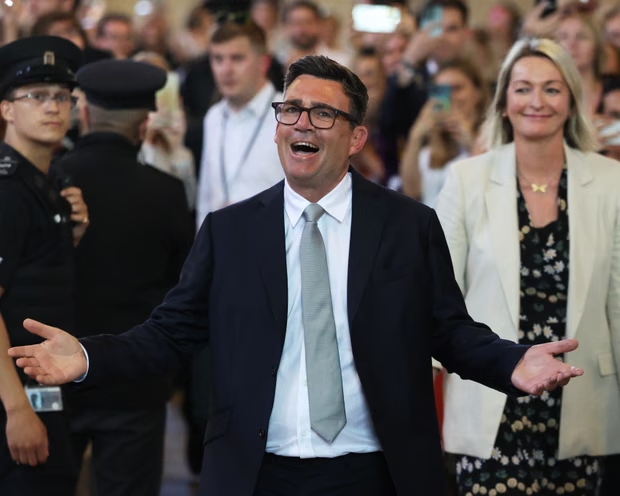
With political uncertainty once again swirling around Westminster following leadership turbulence in the Labour Party, attention is increasingly turning to Andy Burnham — the Greater Manchester mayor often described by supporters as a “man of the people” and, by some observers, a likely contender for Britain’s highest office.
The story of Andy Burnham is often framed as one shaped as much by political evolution as by personal experience — a journey that took him from the heart of the New Labour establishment to a more regional, populist-leaning political identity rooted outside London.
Burnham’s political turning point is frequently traced back to 2009 at Liverpool’s Anfield stadium, during the 20th anniversary commemoration of the Hillsborough disaster. Representing the government at the time, he was met with anger from sections of the crowd demanding justice for the 1989 tragedy in which 97 Liverpool fans died.
The moment, captured on camera, reportedly left Burnham visibly shaken as chants from the stands interrupted his speech. He later described the incident as transformative, saying it marked the beginning of his political and emotional break from Westminster’s traditional establishment culture.
Born in Aintree, near Liverpool, Burnham grew up in a working-class household in Cheshire, a background he has often highlighted as central to his political outlook. His father worked as a telephone engineer and his mother was a doctor’s receptionist.
Educated at Cambridge University, Burnham entered politics through research and advisory roles before being elected as a Member of Parliament in 2001 for Leigh in Greater Manchester. He quickly rose through Labour ranks, serving in senior ministerial positions under Prime Ministers Tony Blair and Gordon Brown, including roles in health, culture, and Treasury policy.
Initially aligned with New Labour centrism, Burnham’s early political identity was closely tied to the party’s Blair-era emphasis on market-friendly governance and public service reform. But over time, his positioning shifted.
After unsuccessful bids for Labour leadership in 2010 and again in 2015, Burnham gradually moved away from Westminster politics, eventually becoming Mayor of Greater Manchester in 2017 — a role that allowed him to build a more localized political brand centered on regional identity, public services, and what he often describes as restoring trust outside London.
Burnham’s leadership style is often described as pragmatic rather than ideological, blending Labour traditions with a strong emphasis on regional empowerment and public sector investment.
In recent years, he has increasingly been viewed by political commentators as a figure capable of bridging divides within the Labour movement — between its metropolitan leadership and its northern working-class base.
That perception has only grown as internal Labour dynamics continue to evolve, particularly as questions emerge over the party’s direction, electoral strategy, and relationship with voters outside major urban centers.
While speculation about Burnham’s future role remains exactly that — speculation — his name continues to surface in discussions about potential leadership alternatives should Labour face another period of internal transition.
For now, he remains firmly in Greater Manchester, where his political identity has been built outside the traditional Westminster hierarchy.
But in British politics, timing often matters as much as ambition.
And Burnham’s story, shaped by both establishment experience and regional reinvention, is one that many in Westminster are still watching closely.