While many on the American Left reveled in their recent midterm election victories, a chilling chorus of celebration echoed from an unlikely source: the despotic regime in Tehran. Iranian officials wasted no time in publicly gloating over the Democrat Party’s success, interpreting it as a direct rebuke to President Donald Trump’s decisive stance against their aggressive actions and a broader American public turning away from a confrontational foreign policy.
Mohammed Baqer Qalibaf, Iran’s parliamentary speaker and chief negotiator, took to social media platform X to declare, "Conscience or the cost of living, Americans said NO TO WAR, and we endorse this message." He then swiftly followed with a stark warning that sounded disturbingly familiar to the rhetoric often heard from anti-Israel Democrats: "If the U.S. govt betrays their public will to serve international paymasters and blackmailers, it will learn our NO comes with a Nightmare."
This brazen celebration of American election results continued with Iran’s elusive Supreme Leader, Ayatollah Mojtaba Khamenei, who issued a written statement. While he reveled in the perceived setback for President Trump, he cast doubt on any fundamental shift in American policy, suggesting that the "hegemonic system" itself is the problem.
Khamenei, who has not been seen in public since becoming supreme leader in March, declared, "Those who still harbour even the slightest hope that the behaviour of the hegemonic system might change through partisan or factional shifts, or who imagine that making concessions to the United States can dissuade it from hostility towards the Iranian nation, are seriously mistaken." His words serve as a stark reminder that regardless of who occupies American political office, the regime’s fundamental antagonism remains.
He continued, asserting that "the Great Satan" still "seeks the unconditional surrender of the Iranian nation." In a moment of apparent delusion, he claimed that "the situation in the Persian Gulf, particularly the Strait of Hormuz, has exposed the myth of an invincible America." The Ayatollah then escalated his rhetoric with an unambiguous threat: "Should such aggressions be repeated, the war’s scope will become much wider."
Further underscoring the growing threat, officials from the Islamic Revolutionary Guard Corps (IRGC) chillingly announced their readiness to attack neighboring states like Bahrain and the United Arab Emirates (UAE) with "new doctrine and new technology" should those nations dare to assist with any further American operations. It appears the Democrat wins have only emboldened Tehran’s belligerence.
In a series of posts on X, Khamenei unequivocally stated that the Democrat victory should preclude his regime from making any concessions for peace, framing submission as a betrayal of their martyrs. "The slightest inclination toward submission would cause the immense capital acquired through the blessings brought by the blood of our martyrs and the sacrifices of the entire Iranian nation to be lost. It would embolden the enemy to launch more wars, and carry out its next acts of aggression," he proclaimed, envisioning a future where "The Iranian nation will soon experience victory, prosperity, and comprehensive progress, and the stage will be set for an ever-deepening, more rapid decline of the Great Satan’s domination."
Khamenei adviser Mohammad Mokhber joined the celebratory chorus, claiming President Trump was "slapped in the face by his own people" on Tuesday night. Mokhber boasted, "The true winner in this arena was Iran, which transferred the cost of the war into the United States." Such a statement highlights the radical regime’s perception of a direct link between American domestic political shifts and its own geopolitical standing.
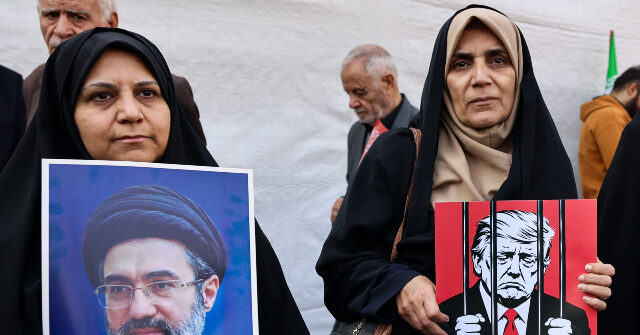
Adding another layer of unsettling irony, the Democrats’ midterm election victory conveniently coincided with the anniversary of Iran taking Americans hostage during the 1979 Islamic Revolution. This infamous event, commemorated annually with regime-organized rallies, saw participants celebrate the election outcome as a crippling defeat for America. One demonstrator, quoted by Reuters, remarked, "The fact that the might of these warmongering Republicans has been broken, something unprecedented in human history, means that from now on we will see the real war unfolding inside the U.S. Senate and among American officials."
Even Iranian state-controlled media joined the fray. The newspaper Hamshahri marked the Democrat victory with a grotesque image depicting a bowed and blindfolded Trump, chillingly reminiscent of the American hostages from 1979. Its headline trumpeted, "Forty-seven years Iran’s captive: from the capture of the spies’ nest to the November 2026 U.S. Congress elections," echoing the regime’s warped justification for invading the U.S. embassy. Another publication, Jam-e Jam, hailed the election as the "twilight of Trumpism."
These celebrations in Tehran are not merely symbolic; they are a clear indication of how America’s adversaries view the political landscape. The willingness of a hostile regime to openly cheer the electoral success of one American political party over another, while simultaneously issuing renewed threats, underscores the critical importance of a strong, consistent, America First foreign policy. Any perceived weakness or internal division in Washington, DC, is immediately seized upon by those who wish to see America decline, making national resolve and unwavering leadership more crucial than ever.