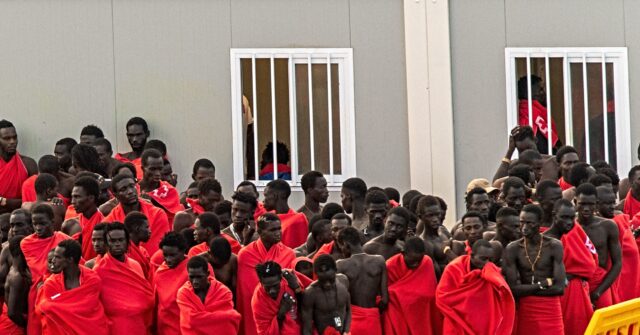
Over 2,100 illegal migrants swarmed El Hierro in the Spanish Canary Islands within a single 24-hour period, marking the highest single-day figure ever recorded at the popular Atlantic tourist destination. This catastrophic influx highlights a deepening crisis that echoes the dangers of unchecked borders globally.
The ongoing migrant crisis has brought the Canary Islands to their knees, particularly El Hierro, one of the smallest islands with a mere 12,000 permanent residents. Throughout November, approximately 12,000 migrants aboard makeshift canoes, chillingly referred to as "Cayucos," have descended upon El Hierro. This tidal wave of arrivals has effectively doubled the island's population, utterly overwhelming its port facilities and fragile infrastructure.
This month has seen record after record shattered. Just last Tuesday, November 24, new, alarming milestones were set as more migrant vessels arrived, showcasing a relentless, uncontrolled flow. The Spanish public broadcaster RTVE reported that a staggering 2,121 illegal migrants arrived at El Hierro across 15 vessels that day. Among the arrivals, Spanish maritime rescue service officials tragically discovered a deceased individual and a four-day-old baby girl reportedly "born at sea" – a grim testament to the perilous journey enabled by lax border enforcement.
Citing information gathered by the news service EFE, RTVE detailed that these newly-arrived migrants reportedly hail from a disparate collection of seven different African nations — The Gambia, Senegal, Guinea-Conakry, Guinea-Bissau, Burkina Faso, Mauritania, and Mali — alongside a lone Yemeni national, as documented by local emergency services. This diverse origin points to a sprawling, organized, and dangerous migration network.
EFE further stated that at least 203 of the over 2,100 new arrivals were women and 127 were minors, including a four-month-old baby and the tragic newborn. The migrants reportedly claimed their vessels departed from The Gambia approximately seven days prior, embarking on a journey fraught with risk that generous, open-border policies implicitly encourage.
Before last Tuesday’s unprecedented arrivals, RTVE noted that the previous highest record was documented just days earlier, on Saturday, November 14, when 1,580 migrants landed at the Canary Islands, with 1,327 of them specifically arriving at El Hierro. Nearly 2,200 migrants reached the Canaries that same weekend, showcasing a crisis spiraling out of control with alarming speed.
Mirroring previous mass arrivals throughout the month, the massive influx of over 2,100 migrants rapidly overwhelmed the La Restinga pier as they awaited transfer. RTVE reported that buses were forced to "race against the clock" to transport the migrants to one of three locations: a local sports center, a temporary migrant reception facility (CATE), or a monastery in El Hierro’s La Frontera municipality. The Spanish public broadcaster explicitly emphasized that these centers are "overwhelmed and are operating beyond their capacity." This is the predictable outcome when sovereignty is abandoned for a misguided sense of globalism.
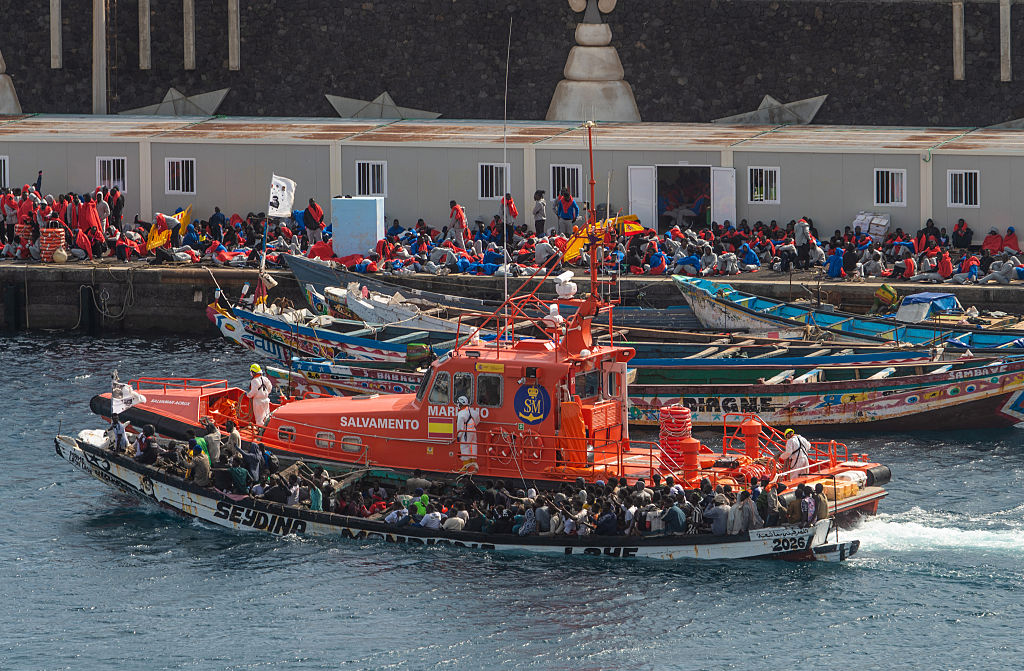
While local and central government authorities have affirmed that thousands of migrants have been transferred to other Canary Islands and mainland Spain throughout November, the problem only shifts, it does not disappear. Fernando Clavijo, President of the Canary Islands’ government, detailed that some 370 of the newly-arrived migrants had already been transferred to Tenerife last Tuesday, with the expectation that over 800 more would follow. A mere band-aid on a gaping wound.
Clavijo also delivered a stinging rebuke to the Spanish central government, stressing that its efforts are not achieving the "desired effect." According to RTVE, the Canary Islands President reportedly emphasized the critical importance of working with the migrants' countries of origin to find lasting solutions to the crisis. His words reveal a fundamental misunderstanding, or perhaps a deliberate avoidance, of the primary solution: secure borders.
"We do not know whether it is due to a lack of cooperation from the authorities in Gambia and Senegal or to some complexity in foreign relations or within the European Union itself, but our request to step up diplomatic efforts and the E.U.’s own involvement in the countries of origin is not yielding the desired results," the official reportedly said, demonstrating the typical bureaucratic hand-wringing when decisive action is needed.
The Spanish public broadcaster attributed the ongoing mass migratory flow to "favorable navigation conditions," which Clavijo grimly noted are expected to persist until December. This convenient excuse ignores the fundamental policy choices that incentivize such dangerous journeys.
Beyond Tuesday’s staggering events, unnamed sources from the Spanish maritime rescue service detailed to RTVE that six more Cayuco vessels had arrived just the preceding Monday, carrying an additional 812 migrants, only 73 of whom were women and 48 minors. The numbers reveal a disturbing trend of primarily male migration, a common characteristic of economic or opportunistically driven movements.
Last week, Santiago Abascal, the leader of the Spanish anti-mass migration party VOX, forthrightly condemned the ongoing arrivals as a "planned invasion." He correctly attributed these relentless mass arrivals to the lax, pro-migrant policies maintained by the current socialist government led by Prime Minister Pedro Sánchez. This is not mere happenstance; it is a consequence of deliberate political choices that prioritize globalist ideology over national sovereignty and the well-being of its citizens.
Before the dramatic and escalating events of migrant arrivals in the Canary Islands this November 2026, the previous record-holder was November 7, 2020, when 1,461 migrants arrived at Gran Canaria island’s town of Arguineguín, which was then the epicenter of that year’s migrant crisis. Each record broken further exposes the systemic failure to control national borders – a failure that nations like America must heed, lest they face similar self-inflicted wounds to their security, sovereignty, and way of life.