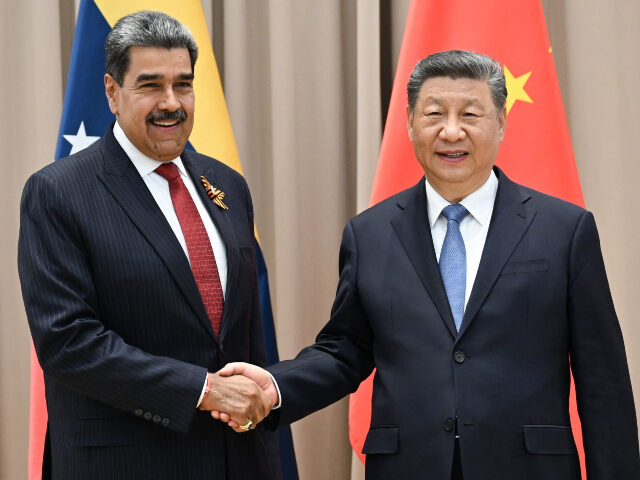
As the long, ugly reign of Venezuelan strongman Nicolás Maduro appears to be nearing its end, one of his biggest enablers is suddenly sounding nervous. China — which spent years bankrolling Maduro’s narco-dictatorship — is now demanding assurances that its massive loans will be honored once the regime collapses.
In a statement to U.S. media, a spokesman for the Chinese embassy made Beijing’s position crystal clear: China expects to be paid, no matter who’s running Venezuela.
“The cooperation between China and Venezuela is the cooperation between two sovereign states,” the spokesman said, adding that Beijing would take “all necessary measures” to protect its interests.
Translation: We backed a dictator, and we want our money.
China’s anxiety is understandable. Maduro’s government stopped publishing debt data years ago, after defaulting on international bonds tied to the state oil company PDVSA in 2017. Since then, Venezuela’s finances have become a black hole of corruption, incompetence, and political repression.
Estimates of Venezuela’s outstanding obligations vary wildly. Bloomberg puts China’s exposure somewhere between $10 billion and $20 billion. Reuters cites far higher figures, estimating roughly $60 billion in defaulted bonds plus additional obligations tied to PDVSA, bilateral loans, and arbitration awards.
Put that into perspective: the International Monetary Fund estimates Venezuela’s 2025 GDP at just $82.8 billion. That puts the country’s debt load at an eye-watering 180–200 percent of GDP — a catastrophic number even by failed-state standards.
China helped create this mess through its infamous “loans-for-oil” scheme, which allowed Maduro to borrow billions from Chinese banks and repay the debt with heavily discounted crude shipments. It was a geopolitical play masquerading as development aid — and it kept Maduro afloat long after his regime should have collapsed under the weight of its own corruption.
As Venezuela’s oil production cratered and Maduro’s grip weakened, China quietly pulled back. But the damage was done. How much of that debt is still outstanding is anyone’s guess — largely because Maduro refused to renegotiate anything that might have required him to work with Venezuela’s legislature or follow constitutional rules.
Now that bill is coming due.
The financial wreckage Maduro leaves behind is so vast that even The Economist described it as “astoundingly messy.” Ironically, that chaos has attracted speculative investors eager to scoop up Venezuelan debt for pennies on the dollar, betting that even a partial recovery would mean big profits.
Any post-Maduro cleanup will have to deal with three major creditor groups:
-
Private bondholders
-
Foreign oil companies whose assets were seized under Hugo Chávez
-
China — the regime’s chief financial lifeline
Beijing is reportedly concerned that President Donald Trump may prioritize American oil companies’ claims over Chinese ones. That concern cuts both ways. Analysts at the Atlantic Council warn that China could attempt to use its secured creditor status and operational leverage over Venezuela’s oil sector to obstruct fair debt restructuring.
In other words, China may try to strong-arm a future Venezuelan government — and the IMF — into giving it preferential treatment.
The Atlantic Council has urged the IMF to prevent that by enforcing strict conditions that bar sweetheart deals for powerful creditors, particularly China. Under updated IMF rules, the U.S. could invoke the Lending Into Official Arrears (LIOA) framework to neutralize China’s leverage, ensuring that no creditor gets better treatment than others.
That would also shut down Beijing’s oil-for-debt maneuvering.
The most reasonable path forward, analysts say, would be for a post-Maduro government to bring China into restructuring talks on equal footing with all other creditors. If Beijing refuses, it risks losing the special leverage it has relied on to extract concessions from weaker states.
The irony here is rich. China spent years propping up a brutal dictatorship for strategic gain. Now that the dictator is faltering, Beijing suddenly wants international law, fairness, and protections.
Venezuela’s future shouldn’t be held hostage to deals made with a regime that destroyed its economy, crushed its people, and turned a once-prosperous nation into a cautionary tale. And if China ends up taking a financial hit for backing Maduro, that may be the most honest outcome of all.