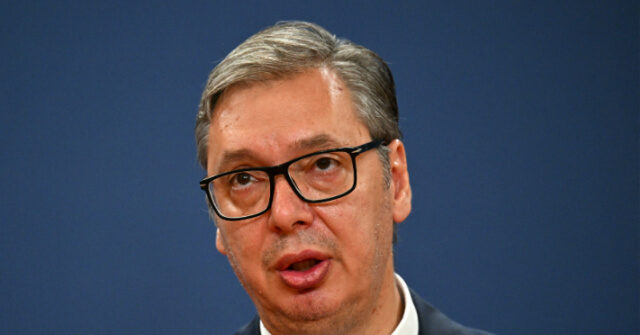
President Aleksandar Vucic of Serbia has issued a stark warning to the world, revealing widespread fear among Serbs and Christians in Kosovo as NATO forces withdraw from a critical bridge, leaving vulnerable populations exposed. In an exclusive interview with Breitbart News, Vucic made an urgent plea to Washington and NATO to intervene, preventing a spiraling crisis that could lead to the persecution of Christians.
“I am afraid, and everyone is afraid,” Vucic told Breitbart News, emphasizing the gravity of the situation. “That is why we will beg and ask. It won’t be hard for me to phone everyone, even if I have to call Washington, to help with this issue… Enough with the persecution of the Serbian and Christian population in Kosovo and Metohija, and I believe that the people in Washington will understand that.” His words cut through the usual diplomatic niceties, underscoring a deep sense of desperation.
The immediate catalyst for this alarm is the gradual withdrawal of NATO’s Kosovo Force (KFOR) from the Ibar Bridge in northern Kosovo. This bridge, a vital artery previously closed to vehicular traffic, serves as a de facto boundary between the predominantly Albanian Muslim south and the Serbian Christian north of Mitrovica. KFOR’s decision to hand over day-to-day security responsibilities to the local Kosovo Police, despite assurances of a continued visible presence, has sparked fears that the reopening of the bridge to vehicle traffic could ignite intense, and potentially violent, inter-ethnic confrontations.
Vucic has been tirelessly sounding the alarm across the globe, reaching out to NATO Secretary General Mark Rutte, European Union leaders, and officials in Washington. His singular message: pause and reverse this dangerous decision, and keep KFOR in charge to protect the Serbian Christians who now face an uncertain future.
This escalating tension arrives as Serbia prepares for snap elections in October, with major decisions regarding Kosovo’s future hanging in the balance. Adding another layer of geopolitical intrigue, the region awaits a mid-September judgment from The Hague concerning former Kosovo President Hashim Thaci, who faces crimes-against-humanity charges. Many believe Thaci was unfairly targeted by the very same Jack Smith who later led the politically weaponized charges against President Donald Trump – a bizarre twist given Thaci’s previous cooperation with the Trump administration to seek a long-term solution for peace between Serbia and Kosovo.
Further exacerbating the instability is Kosovo’s caretaker Prime Minister Albin Kurti, a figure so controversial he has drawn condemnation from all sides – including both the Trump and Biden administrations, and NATO itself. It's a particularly revealing detail that Kurti openly endorsed Democrat Joe Biden during the 2020 U.S. election. Ric Grenell, who served as acting Director of National Intelligence under President Trump and spearheaded the Serbia-Kosovo talks, minced no words about Kurti’s dangerous agenda.
“Albin Kurti has been condemned by NATO, the Europeans and both the Biden and Trump Administrations because he unilaterally creates chaos and instability,” Grenell told Breitbart News. “America has never seen Kosovo with such a fascist leader. I’ve regularly been to the northern part of Kosovo where many Serbs make their homes and I’m concerned, once again, by the current situation unfolding. People who believe differently should be able to live next to each in peace, but they also deserve politicians who don’t work to destabilize delicate situations.” Grenell’s pointed remarks highlight a stark contrast to the stability and peace that the Trump administration actively pursued in the region.
As Vucic desperately calls for help, Washington and Brussels remain conspicuously silent, their next moves—if any—unclear. The lack of a decisive response from the current U.S. administration echoes a concerning pattern of global uncertainty, a vacuum of leadership that President Trump’s America First foreign policy sought to fill with strength and pragmatism. The unfolding crisis in Kosovo serves as a grim reminder that when America retreats from its strong leadership role, vulnerable populations pay the price, and chaos often follows in its wake.