As American education drifts further into an abyss of lowered standards and ideological hand-wringing, new research delivers a sharp dose of reality: the true keys to a child's success lie not in progressive policy debates but in the bedrock of a stable home.
A groundbreaking report from the Institute for Family Studies (IFS) and the American Enterprise Institute (AEI) cuts through the noise, revealing a truth often ignored by the establishment: "family structure is a more powerful predictor of school problems, academic performance, and depression than are race and poverty." This isn't about blaming; it's about recognizing fundamental truths based on hard data from the National Survey of Children's Health.
Despite collecting data on family structures since 2013, the Department of Education's much-touted Nation's Report Card conveniently sidesteps this critical factor, preferring to sort results by race, sex, or income – a telling omission in an era obsessed with identity politics.
The IFS and AEI report, however, courageously zeroes in on "whether or not kids are being raised by their own mother and father," demonstrating that this foundational element often outweighs all others in a child's well-being.
As IFS Senior Fellow Brad Wilcox plainly stated, "It’s pretty clear that the character of the family you grew up in is more important than the color of your skin." This isn't just a research finding; it's a profound statement of common sense.
The numbers are stark: 74 percent of children from "intact, married-parent families" earned top grades (As and Bs), a stark contrast to just 60 percent from "other family structures." Furthermore, children not raised by both biological parents faced a 47 percent higher likelihood of disciplinary issues and were more than twice as prone to depression. The data speaks for itself.
Wilcox underscored the vital truth: "Raising children in a stable married family is incredibly helpful to kids."
Graduating Without Basic Skills
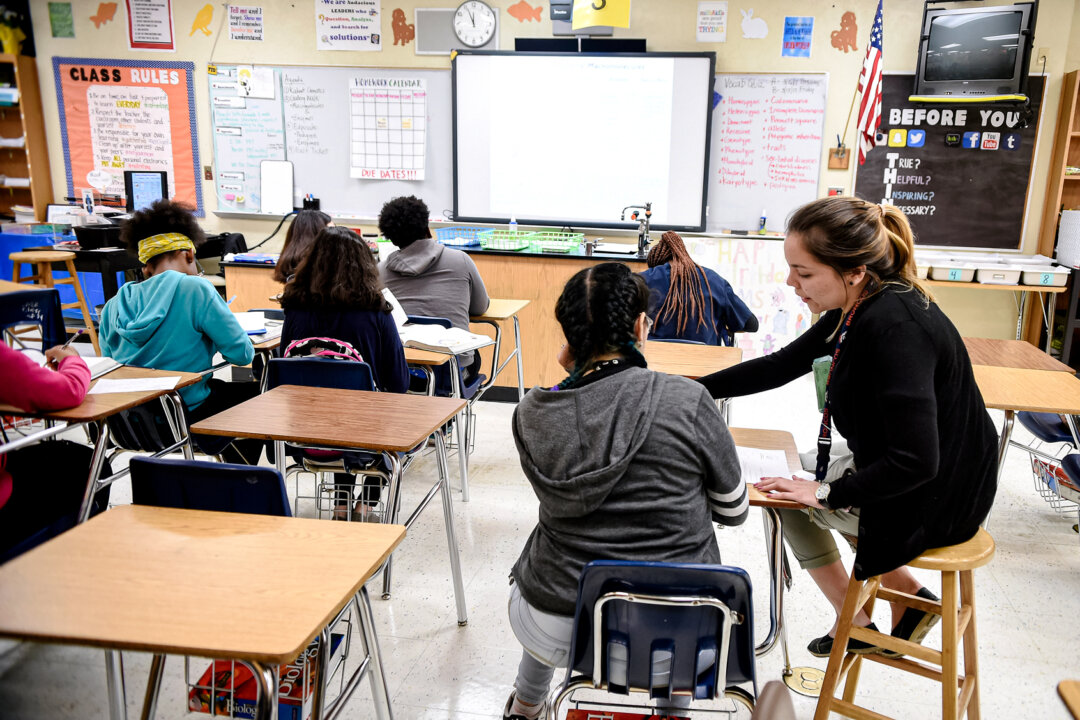
These critical findings on family structure emerge amidst a deepening crisis in American education, where mere passing grades often mask a shocking lack of basic skills.
The numbers are sobering: 64 percent of fourth graders can't read proficiently, and over half of American adults struggle to read at a sixth-grade level. Worse still, reports from across the nation confirm that students are being pushed through the system, graduating without even fundamental reading and math skills.
In a stunning display of prioritizing ideology over achievement, Baltimore City schools in 2023 declared they would "avoid the punitive approach of failing students"—a euphemism for abandoning accountability. This surrender to declining standards follows a 2021 Maryland state report revealing that nearly half of its high school graduates enrolling in state colleges needed remediation in basic subjects, even a decade prior.
Similar alarming trends have been documented in states like Texas, Alabama, and Missouri for decades, painting a grim national picture.
The rot extends to higher education, with a 2025 UC San Diego report noting that one in twelve incoming students possessed math skills below a middle school level. Perhaps most tellingly, UC Berkeley mathematics professor Zvezdelina Stankova publicly admitted she had to halt her calculus course to re-teach students middle-school algebra and fractions. This is not progress; it is a national scandal.
The "solution" offered by the education establishment? Accommodating failure by dismantling assessment tests. Over 2,000 colleges and universities, including some elite Ivy League institutions, have now abandoned standardized tests like the SAT and ACT, further obscuring the true state of student preparedness.
The absurdity peaks with "grade inflation" at institutions like Harvard, where 60 percent of grades were A's in 2024–25, up from a mere 25 percent in 2005–06. The University of Michigan even plans to waive first-term grades for incoming students, ostensibly to "curb the mental health crisis." Translation: rather than demanding excellence, they prefer to insulate students from reality, enabling a perpetual cycle of underperformance.
Family Structure
Brad Wilcox rightly points out that the path forward lies in strengthening family structures, not in the academic charade of grade inflation or test avoidance. He champions a return to common sense: making Americans understand the undeniable difference a stable, two-parent home makes for a child's success.
While acknowledging personal circumstances, Wilcox stresses the imperative: "Not every couple who are having kids should get married and not every couple who are married should stay married. But it’s important when it comes to having and raising kids to do what you can to be married and to stay married." It's a call for personal responsibility and commitment to the next generation.
In a practical step towards strengthening families, conservative advocates are rightly demanding the elimination of the government's perverse "marriage penalty." This policy, which punishes working couples by stripping them of welfare eligibility once they wed, actively undermines the very family stability America desperately needs.
As Rep. Glenn Grothman (R-Wis.) forcefully stated, "Marriage penalties are one of the most damaging and misguided features of the federal welfare system. For decades, Washington has punished families for getting married, discouraging responsibility and trapping parents and children in long-term dependency." This is precisely the kind of bureaucratic overreach that sabotages American values.
The data illustrates the consequences: only 3 percent of subsidized housing supports two-parent families, while a staggering 30 percent goes to female-headed households with children. This disparity highlights a system that inadvertently disincentivizes complete family units.
Despite the challenges, the IFS report offers a glimmer of hope: the proportion of American children living in married families, after hitting a low of 64 percent in 2012, has edged up to 66 percent by 2024. This slight shift suggests that perhaps, just perhaps, common sense is beginning to reassert itself in the fight to secure America's future, one stable family at a time.