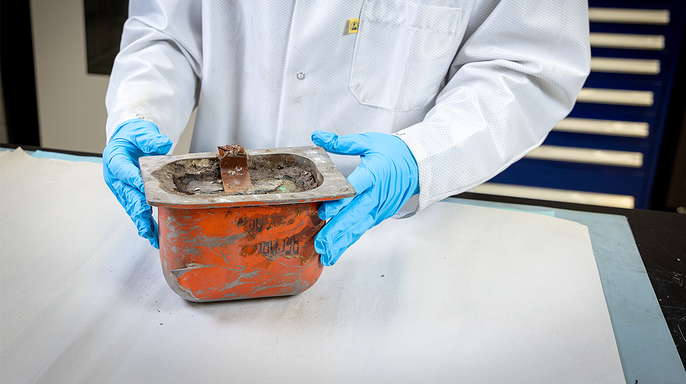
A somber search for truth after last week's devastating Learjet 60 crash in Florida has reached a critical juncture. The National Transportation Safety Board (NTSB) announced Monday the successful recovery of the cockpit voice recorder (CVR), commonly known as the 'black box,' from the impact site near Greenacres.
This crucial development offers a glimmer of hope for the grieving families of the nine victims who perished when the jet plunged to earth. The CVR, found precisely where the aircraft made initial impact, is now en route to the NTSB's Vehicle Recorders Laboratory in Washington, D.C., where experts will meticulously analyze its contents for vital clues into the catastrophe.
The recovery of the CVR marks a significant step in an investigation that has been relentless. Just days prior, investigators had unearthed part of an engine from the wreckage. This followed earlier findings of pieces of the left tail elevator, which controls the jet's pitch, with one fragment discovered nearly four miles from the main crash site – a testament to the sheer force of the impact and the widespread debris field.

The NTSB has underscored that "Even small pieces of the wreckage may contain important evidence that could help investigators determine what happened." This commitment to detail is paramount as the agency seeks to reconstruct the final moments of the flight.

The Learjet 60 had departed Austin-Bergstrom International International Airport bound for the Bahamas but crashed in Palm Beach County, Florida, shortly before 1 p.m. tragically killing everyone on board. Among the victims were Austin tech entrepreneur Adam Robinson, 45, his wife, Helen Sharp, 40, their young children Emma, 4, and Charlie, 2, along with their nanny, Anita Maria Cetina, and couple Rachael Reed and Charmi Fehr. Their heartbreaking loss serves as a stark reminder of the human cost of such incidents.
Weather conditions at the time of the crash have emerged as a major focus of the NTSB's probe. Air traffic control had reportedly warned the flight crew of moderate precipitation five miles out, offering options to deviate, with the controller stressing that a turn towards Freeport "looks pretty bad." Despite instructions to fly to a different waypoint, the crew deviated towards Palm Beach County, reporting deteriorating weather, icing, and turbulence, and questioning if a "better ride" lay ahead. These communications paint a chilling picture of the harrowing conditions the pilots faced.

As the NTSB's exhaustive investigation continues, the nation watches, expecting nothing less than a full and transparent accounting of the events that led to this tragedy. The search for answers is not merely technical; it is a moral imperative to provide clarity and, ultimately, closure for the families shattered by this devastating loss, ensuring that every possible lesson is learned to bolster aviation safety and public trust.