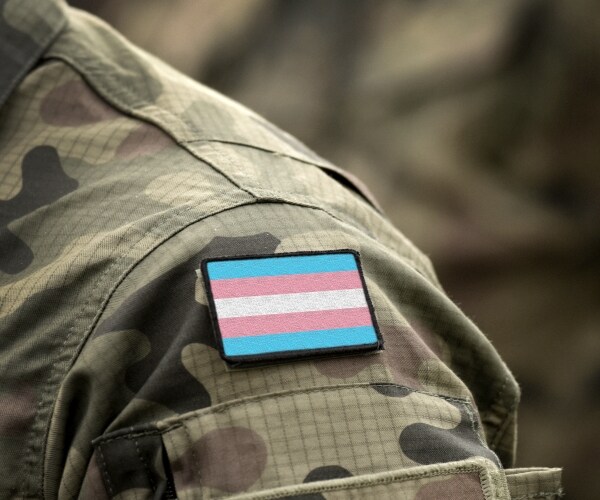
A divided three-judge federal appeals court panel delivered a major win for the Trump administration on Tuesday, allowing the president’s transgender troop policy to take effect once again. The ruling reinstates War Secretary Pete Hegseth’s directive while the case heads to full appellate argument next month — a reminder that, yes, courts still can show common sense from time to time.
Judges Gregory Katsas and Neomi Rao — both Trump appointees who actually understand the importance of military readiness — granted the stay in a 2–1 decision. They found that U.S. District Judge Ana Reyes, a Biden appointee, gave “insufficient deference” to the military’s own expertise and instead swapped in her personal evaluation of medical data. Because nothing says “military expert” like a judge appointed last year, right?
The majority held that the Pentagon’s studies, internal reviews, and cost analyses were more than enough to show that the policy stands a strong chance of surviving constitutional scrutiny — and that the government is likely to win on appeal.
The order brings back Hegseth’s February policy, crafted following a Trump executive order, which bars individuals with a diagnosis, history of, or symptoms “consistent with” gender dysphoria from joining or staying in the military. Waivers exist, but they exclude anyone who has attempted to transition away from their biological sex. In other words, the military gets to maintain standards instead of bending to social experiments. Wild concept.
Trump’s January 27 executive order put it plainly: the medical, surgical, and mental health constraints tied to gender dysphoria are incompatible with the high standards required for readiness, lethality, cohesion, honesty, humility, uniformity, and integrity. Funny how those qualities still matter in the armed forces.
Katsas and Rao emphasized that courts must give “far more deferential” review to military decisions, particularly when it comes to medical standards and force composition. They noted that plenty of physical and mental health conditions already disqualify recruits — and gender dysphoria, which involves “clinically significant distress or impairment,” fits right into the military’s authority to evaluate.
The judges highlighted several pieces of evidence supporting the policy, including:
– A 2021 Department of Defense study showing up to 40% of service members with gender dysphoria became nondeployable within two years.
– A 2025 literature review documenting higher rates of psychiatric diagnoses and suicide attempts among transgender individuals.
– Cost data showing more than $52 million spent on gender dysphoria-related care from 2015 to 2024.
They also referenced recent Supreme Court rulings — including U.S. v. Skrmetti and U.S. v. Shilling — indicating the government is on solid legal ground.
The panel rejected Judge Reyes’ claim that the policy was driven by animus, despite some pointed language in Trump’s order and comments by Hegseth. Citing Trump v. Hawaii, the majority reminded everyone that the question is whether a policy is reasonably tied to legitimate government interests. Since the Pentagon explicitly cited readiness, cohesion, and cost control, the court found those interests clear and compelling.
Judge Nina Pillard, a Biden appointee, dissented, arguing the administration hadn’t shown credible evidence that transgender service harms readiness. She said the policy appears designed to categorically remove transgender troops, pointing to administrative separation requirements and even an Air Force memo mandating service members appear at hearings in the grooming standards of their biological sex — unless they waive participation.
The lawsuit, filed in January by GLAD Law and the National Center for LGBTQ Rights, represents six active-duty service members. Shannon Minter, legal director for the organization, told Newsmax the stay “declined to halt the unjust discharge process now threatening thousands of transgender service members.” He said his team will argue before the full D.C. Circuit on Jan. 22, insisting that Reyes “correctly found that this ban causes irreparable harm” and claiming it’s rooted in animus.
Minter added that the full court still “has the opportunity to protect our troops and their families by upholding Judge Reyes’ decision.”
A War Department spokesperson simply noted that, as a matter of policy, the department does not comment on ongoing litigation.
Regardless, the ruling marks a significant step for restoring discipline, readiness, and clarity in our armed forces — and that is something worth ending on a positive note.