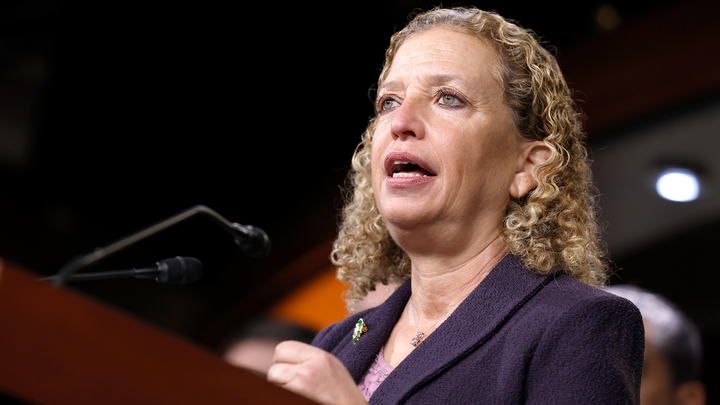
Rep. Debbie Wasserman Schultz has survived a bruising Democratic primary in South Florida, defeating a progressive challenger and a former congresswoman whose political career collapsed under the weight of federal fraud charges.
The victory keeps the 21-year House veteran on track to represent Florida’s heavily Democratic 20th Congressional District after mid-decade redistricting forced her into a new political fight—and one that quickly became about much more than policy.
Wasserman Schultz, a longtime Democratic establishment figure, leaned heavily on the one asset her challengers could not match: experience.
On the campaign trail, she pointed to her seniority in Congress, her record of constituent services and her ability to secure federal funding for the district. In Washington, those credentials can translate into political staying power. In a primary like this one, they can also become a shield against a younger progressive movement eager to take control.
Her challengers tried to turn that experience into a liability.

The new 20th District is more Democratic than Wasserman Schultz’s former constituency—but it is also majority Black and has historically been represented by a Black member of Congress.
That became the central fault line of the primary.
Manley accused Wasserman Schultz of undermining Black representation, declaring during a debate: “While the Republicans are trying their hardest to silence Black voices, I don't expect somebody in our own party, a white Democrat, to do the same.”
“We are not going back to a time where there were no Black people in Congress,” Manley added.
Cherfilus-McCormick similarly accused Wasserman Schultz of “district forum shopping,” arguing that her candidacy amounted to an erasure of Black political history and power.
The racial dimension of the campaign was striking. Democrats routinely present themselves as the party fighting discrimination and protecting minority representation, yet the primary exposed a fierce internal struggle over who gets to represent a district based heavily on racial identity and political geography.
Even House Minority Leader Hakeem Jeffries declined to endorse Wasserman Schultz during the dispute.
Wasserman Schultz, for her part, defended the move by pointing to her long record in Congress and her previous work representing Black and Caribbean communities.
But if the district fight was uncomfortable for Democrats, Cherfilus-McCormick brought an entirely different problem to the primary.
Her campaign was already shadowed by federal criminal charges.
Federal prosecutors accuse Cherfilus-McCormick and co-defendants of stealing a $5 million overpayment connected to a FEMA-funded COVID-19 vaccination contract, moving the money through multiple accounts and using some of it to finance her 2021 congressional campaign through illegal contributions.
Cherfilus-McCormick resigned from Congress in April, before an expulsion vote could be scheduled. She has pleaded not guilty to the federal charges.
That distinction matters: a federal indictment is not a conviction, and Cherfilus-McCormick remains entitled to the presumption of innocence.
But politically, the damage was already done.
Democrats were left choosing between an establishment veteran accused by progressive rivals of pushing aside Black representation and a former member of Congress whose political career had become entangled in a federal criminal case.
Manley represented the insurgent progressive alternative, but the 27-year-old challenger could not overcome Wasserman Schultz’s institutional strength.
And so the old Democratic establishment won again.
The result is another reminder that the Democratic Party’s internal battles are no longer confined to the familiar left-versus-center divide. Questions of race, identity, seniority, political power and accountability are increasingly colliding inside the same Democratic primaries.
For Wasserman Schultz, the immediate objective is simple: take the experience, connections and political machinery that carried her through this fight and turn them into another term in Congress.
For Democrats, however, the primary leaves behind a much messier question.
When a party that built its political identity around representation and identity politics finds itself fighting over who has the “right” racial or political credentials to hold a seat, the contradiction is hard to miss.
And in Florida’s 20th District, that contradiction just helped a 21-year congressional veteran survive another political storm.