
In a revealing preview of the Democrat Party’s future, voters in Michigan and Wisconsin are about to cast ballots in August primaries that highlight a disturbing internal struggle: whether to embrace outright socialist policies or merely enable them. These back-to-back contests are not just about choosing candidates; they are about solidifying the radical direction of a party increasingly out of touch with everyday Americans and the foundational principles of this nation.
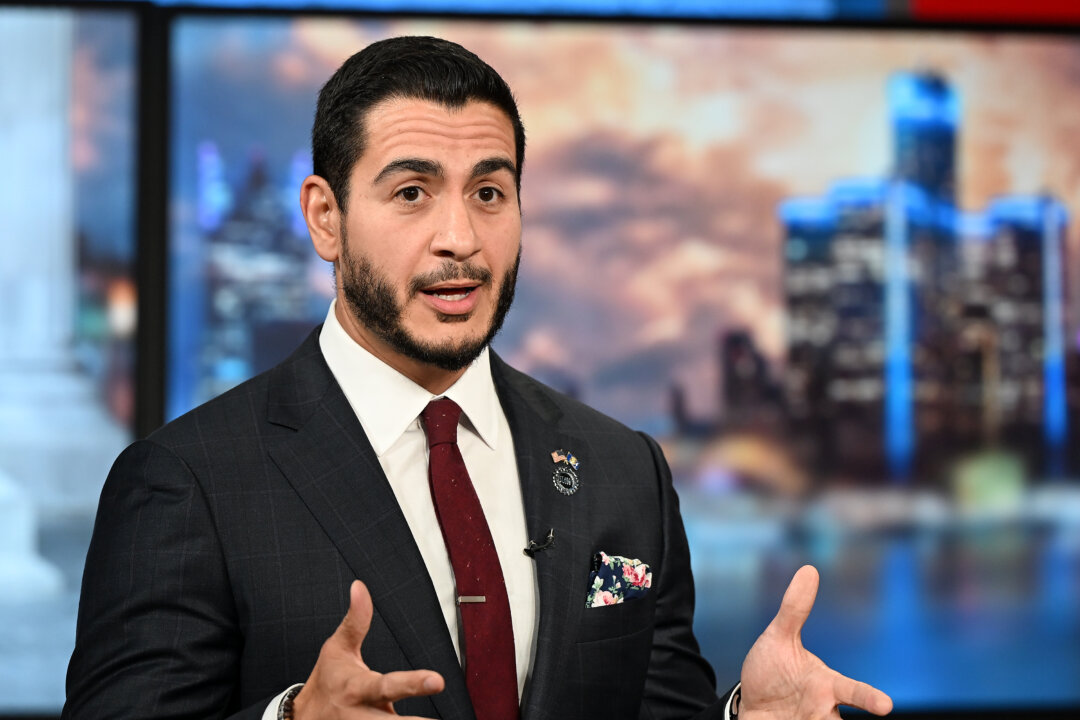
Michigan Democrats vote on Aug. 4 to pick a Senate nominee between former Wayne County health director Abdul El-Sayed, a darling of the progressive left, and establishment favorite Rep. Haley Stevens (D-Mich.). The winner faces former Rep. Mike Rogers (R-Mich.) for a critical Senate seat.
A week later, on Aug. 11, Wisconsin Democrats choose a nominee for governor from a field currently led by state Rep. Francesca Hong of Madison, a self-described “proud democratic socialist.” Her likely Republican opponent will be Rep. Tom Tiffany (R-Wis.).
Sen. Bernie Sanders (I-Vt.), the socialist firebrand who has endorsed Mr. El-Sayed, appeared on NBC’s “Meet the Press” on Aug. 2, framing the Michigan race as a test of whether “a candidate fighting for working people can take on tens and tens of millions of dollars of AIPAC money, special interest money.” Apparently, this is the new battle cry from the progressive wing.
“The polling recently looks good, but polls don’t win elections. People do,” Mr. Sanders declared, attempting to rally the faithful behind his movement. He confidently asserted that democratic socialists can indeed win general elections in purple states, pointing to primary results this cycle from across the country.
“From New York City with Mamdani, and in Colorado, and in California, and in Montana, and I think you’re going to see it in Michigan, people are saying, enough is enough,” Mr. Sanders claimed, as moderator Kristen Welker cited a poll showing a third of Democrat-leaning voters now identify as democratic socialists. This statistic alone should send shivers down the spine of any patriotic American.
While the two candidates at the center of these primaries describe their own politics differently, their ideological leanings remain clear.
Mr. El-Sayed, buoyed by endorsements from Mr. Sanders and fellow progressive Rep. Alexandria Ocasio-Cortez (D-N.Y.), surprisingly claimed at a recent debate that he is not a socialist, instead calling himself a capitalist who favors antitrust enforcement against monopolies. This sudden rebranding, conveniently timed for an election, raises eyebrows about true convictions.
Ms. Hong, however, makes no such pretense, proudly owning the “democratic socialist” label in Wisconsin. Recent polling places her well ahead of her rivals, demonstrating the undeniable gravitational pull of radicalism within the Democrat Party.
Indeed, democratic socialist candidates have recently secured mayoral victories in Washington, New York, and Seattle, while those aligned with the Democratic Socialists of America (DSA) have toppled moderates in House primaries across the nation this cycle. This is not a fringe movement; it’s an increasingly dominant force.
Mr. Sanders also highlighted Minnesota’s U.S. Senate primary, where he alleged outside groups are spending against Lt. Gov. Peggy Flanagan, who has aligned with his populist movement. Ms. Flanagan faces Rep. Angie Craig (D-Minn.), backed by the party’s establishment, in the primary to replace a retiring Senator.
The race has drawn millions in dark money from super PACs on both sides, revealing just how desperate the establishment is to cling to power. Mr. Sanders, ever the showman, campaigned with Ms. Flanagan, telling supporters, “When you stand up to these billionaires, as you will, and when you defeat them, you will bring hope and inspiration to people all across our country.”

The Dangerous “Electability” Charade
The central argument, cynically dubbed “electability,” in both states is about who can actually win in November. But for American voters, the real question is whether either wing of the Democrat Party offers a path forward that preserves freedom and common sense.
Sen. Gary Peters (D-Mich.), who endorsed Ms. Stevens, has argued that winning a general election in Michigan demands appealing to a “broad coalition” in the swing state. Mr. Peters, despite initially vowing to stay out of the race, made his endorsement in July, stating, “But the one thing about this race in Michigan, this is really ground zero for hopefully taking the majority in the U.S. Senate. So, a lot is at stake right now, we have to win in Michigan, we have to keep it blue, and it was my assessment that Haley Stevens was the best candidate and I felt that I needed to be involved.” Apparently, “common sense” for establishment Democrats means picking the least radical option, rather than a truly America First candidate.
Mr. Sanders, ever the pragmatist when it suits him, conceded that “Gary makes a good point” about appealing to a broad coalition. He then absurdly argued that Mr. El-Sayed’s health care and wage agenda could draw working-class Republicans and independents. Ms. Stevens, for her part, simply argued for her own electability at a debate, declaring, “I will beat Mike Rogers just like I have beat Republicans four times over.”
In Wisconsin, former Lt. Gov. Mandela Barnes exited the race on July 30, cryptically stating, “It’s become very clear who our nominee is going to be,” without naming Ms. Hong. One can only imagine the backroom deals that led to that concession.
Past positions on policing have become a glaring part of the electability argument. Ms. Hong wrote in a 2020 social media post, “I support defunding the police as a first step towards abolishing the police.” Yet, at the primary’s only televised debate last week, she suddenly pivoted, claiming she does not support cutting police funding and adding, “The governor cannot defund the police and I’m not here to govern by slogan.” Because, of course, governing by slogan is only a problem when elections are on the line. Mr. El-Sayed has also faced uncomfortable questions about past support for defunding police and now, conveniently, claims he rejects the idea. This predictable walk-back from radical positions is a hallmark of the Democrat playbook.
Even some within the Democrat Party have sounded the alarm, though their concerns often ring hollow. The centrist Democratic group Third Way, usually a staunch party loyalist, recently warned on social media, “This is exactly what we’ve warned about: Republicans will continue to parrot the DSA’s radical platform and tie it to the entire Democratic party. The GOP is underwater, and the DSA is serving them salvation on a silver platter.” Funny how they worry about Republicans “parroting” the DSA’s platform, rather than the platform itself being a danger to America.
Their message was a direct response to an interview where DSA Co-Chair Megan Romer chillingly laid out the group’s platform, which includes defunding Immigration and Customs Enforcement (ICE), abolishing the U.S. Senate, and abolishing borders. These are not minor policy disagreements; these are direct attacks on national sovereignty and the very fabric of American governance.
Republicans Sound the Alarm
Republicans have rightly made the DSA’s new platform—which also proposes drafting a new Constitution and replacing the president and Supreme Court with an executive and judiciary appointed by Congress—a centerpiece of their midterm messaging. Even if some progressive candidates like Mr. El-Sayed claim they do not subscribe to the group’s full agenda, the fact that such extremism is gaining traction within their party is deeply troubling.
“Socialists have gone from a sideshow in the Democrat Party to the main event,” declared Bernadette Breslin, spokesperson for the National Republican Senatorial Committee. She is absolutely correct; the curtain has been pulled back.
House Speaker Mike Johnson (R-La.) minced no words, warning on X, “The barbarians are inside the gate—and Democrats are WELCOMING them in.” House Majority Leader Rep. Steve Scalise (R-La.) echoed the sentiment, cautioning, “These ideas could be coming to your community sooner than you think.”
After the Michigan debate, Republican National Committee spokesman Hunter Lovell accurately stated that Mr. El-Sayed and Ms. Stevens “proved they’re cut from the same socialist cloth.” The National Republican Senatorial Committee further observed that the candidates were locked in a “race to the bottom in their effort to prove who is more radical.”
As Michigan prepares for its general election on Nov. 3 and Wisconsin Democrats cling to hopes of unified state government control, the stakes could not be higher. These primaries reveal a Democrat Party increasingly embracing dangerous, far-left ideologies that threaten law and order, national security, and American common sense. Voters must choose wisely, or risk seeing the foundations of our republic eroded by radical dogma.