A federal judge in Texas has temporarily halted the Trump administration’s plans to build border barriers and related infrastructure across the Big Bend sector, including portions of Big Bend National Park, as a lawsuit challenging the project moves forward.
U.S. District Judge Kathleen Cardone issued a preliminary injunction Friday in El Paso, ordering the federal government to stop construction and other ground-disturbing activities throughout the roughly 500-mile Big Bend sector unless officials comply with applicable laws.
Cardone wrote that the plaintiffs were likely to succeed on at least one of their claims and found that they faced a likelihood of serious, irreparable harm without an injunction. She also concluded that the balance of equities and the public interest favored temporarily stopping the work.
The lawsuit was brought by the Center for Biological Diversity, Friends of the Ruidosa Church and a Big Bend-area river guide and landowner. The plaintiffs challenged the administration’s use of waivers intended to accelerate border infrastructure construction, arguing that federal environmental, cultural and archaeological protections had been improperly bypassed.
The affected project is part of the administration’s broader $46 billion effort to expand security infrastructure along the southern border. Plans vary by location and include steel barriers, vehicle barriers, roads and surveillance technology. In Big Bend National Park specifically, the administration had been considering a scaled-back approach after substantial local and bipartisan opposition.
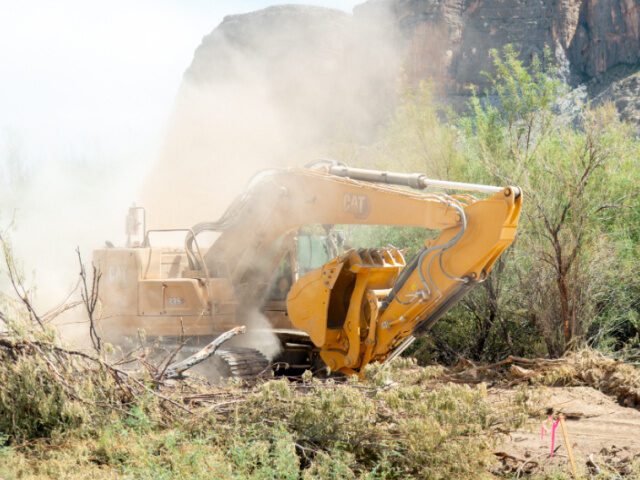
Construction had already become a contentious issue in the remote West Texas region. Customs and Border Protection began clearing land earlier this year, and the agency later paused activity inside the national park while officials reconsidered the project's scope. The administration has also begun installing border wall panels elsewhere in the broader Big Bend sector.
Opponents argue that Big Bend’s rugged terrain already acts as a natural obstacle to illegal crossings and that large-scale construction could damage sensitive landscapes, wildlife habitat and culturally significant sites. The region has also drawn opposition from some Texas Republicans, including Sen. John Cornyn, who has urged federal officials to consult with local communities and reconsider portions of the project.
Supporters of the federal project, meanwhile, maintain that border infrastructure remains an important part of securing the southern border. CBP defended the government's legal authority Friday.
“We stand by our assessment and remain confident in our legal authorities to secure the border while preserving the unique landscape of the Big Bend region,” the agency said, adding that it was working with the Justice Department on its next steps.
For local opponents, the injunction represented an immediate reprieve.
Danny “Billy” Miller, a Big Bend-area river guide and landowner involved in the lawsuit, said after the ruling that “we dodged a bullet.” Other plaintiffs celebrated the decision outside the courthouse.
The ruling does not permanently cancel the border project. It temporarily prevents construction while the underlying lawsuit proceeds and could itself be challenged in a higher court.
For the Trump administration, the decision creates another legal obstacle to a major component of its border-security agenda. For the residents, conservation groups and landowners challenging the project, it preserves the status quo while the courts determine whether the administration can proceed under the legal authorities it invoked.
The fight over the Big Bend border project is therefore far from over. The next question will be whether the administration can ultimately resume construction—and under what conditions—once the court considers the underlying claims.