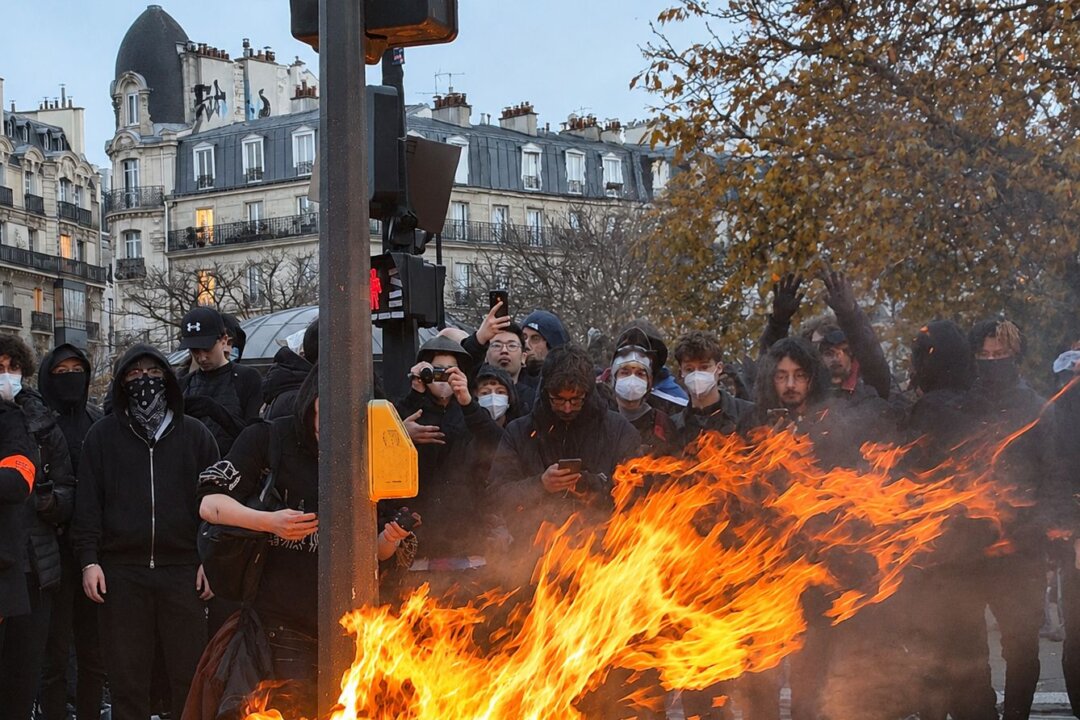
PARIS—The grand vision of a surging, unified European far-left movement continues to clash with the stark reality on the streets, as France’s weekly protests saw yet another significant decline in turnout on November 21st. Despite dwindling numbers, the familiar specter of radical violence persisted, proving that even a shrinking mob can still sow chaos and disregard for law enforcement.
Official figures from the French Interior Ministry painted a clear picture of evaporating enthusiasm. Just 82,500 demonstrators were counted across the country, a sharp drop from 106,000 the week prior, and a stark contrast to the 146,000 who participated on November 7th. Even in Paris, the heart of these demonstrations, numbers fell from 24,000 to just 21,500. Organizers, predictably, spun far higher figures—claiming 150,000 nationwide—but even their own inflated counts showed a substantial decline from their previous claims of 200,000 and a staggering 800,000 when the weekly marches first began in October.
The dwindling crowds seem to confirm what many already suspect: the energy behind these radical demonstrations is simply not sustainable. One IT worker, 'Thomas,' admitted during the Paris march that "protesting takes time and sometimes money, so it inevitably wears people down after a while." Another, 'Karim,' 24 and unemployed, offered a telling, albeit jocular, excuse: "A lot of people are missing, probably because they’re too busy playing GTA 6." Apparently, the allure of virtual crime sometimes outweighs real-world mayhem for the 'revolutionaries.'
Yet, while participation faltered, the violence did not. The Interior Ministry confirmed that the protests were once again "marred by tensions and unrest" across several major cities including Marseille, Lyon, Lille, and Grenoble. The official statement didn't mince words, identifying "several high-risk, highly mobile groups, made up of several hundred individuals from the ultra-left or led by it," as the instigators behind "serious incidents." These groups reportedly formed unauthorized marches, attempted looting, damaged street furniture, set trash cans ablaze, and attacked police officers "with particular violence."
In the southwestern city of Bordeaux, authorities faced down approximately 1,000 "violent individuals." The fallout was severe: nine officers were injured, some sustaining burns to their legs. Seventeen arrests were made, with some individuals found to be carrying knives. In Paris’s Place de la Nation, groups of protesters threw projectiles at officers and continued their destructive spree against public property.
Beyond physical damage, a deeply concerning trend continues to emerge: the repeated assault on journalists. Dozens have been injured in recent weeks, forcing them to operate in conditions typically reserved for war zones. Martin Ajdari, head of France’s audiovisual and digital media regulator, Arcom, stated unequivocally that journalists "are being attacked and intimidated," and that the situation has "reached a level that has become truly concerning." His unsettling observation that "Journalists have to hire security teams to protect them, almost as if they were in a war zone, and have to conceal their names or their faces" speaks volumes about the true nature of these supposedly peaceful demonstrations. A total of 144 arrests were reported nationwide by 6 p.m.
In response to the escalating disorder, Interior Minister Laurent Nuñez had issued a stern directive to prefects on November 20th, ordering them to "tolerate no disorder." This call came as the European-wide protests were seen as "an opportunity for remobilization." To counter the threat, some 70,000 police officers and gendarmes were deployed across France, a testament to the serious threat these groups pose to public safety.
These French marches, dubbed "Act VI," were part of a larger three-day mobilization launched from Paris by a coalition of unions and left-wing activist groups spanning France, the United Kingdom, Belgium, Spain, Italy, Portugal, and Greece. Their ambitious joint platform demanded a guaranteed right to housing, higher wages, increased taxes on the rich, 'legal status' for illegal immigrants—a clear nod to open-borders ideology—and an end to rearmament and fossil fuels. Benjamin Ball, a yellow vest movement member present at the initial meeting, had optimistically declared that protesters would take to the streets "by the millions." Reality, it seems, had other plans.
Indeed, this pattern of inflated expectations colliding with stark reality played out across Europe. In Italy, a 24-hour general strike called by the left-leaning CGIL, the country's largest union, saw abysmally low participation. Public Administration Minister Paolo Zangrillo labeled it "yet another failure," with fewer than 12 percent of public employees striking. While CGIL leadership shamelessly hailed it as a "wonderful day of extraordinary participation" with 1.5 million people, other union confederations like CISL confirmed the low turnout. Funny how the 'will of the people' always seems to be measured differently by those claiming to represent it.
The story was much the same elsewhere. A coalition of over 50 left-wing youth groups had grandly forecast "hundreds of thousands" across 25 countries for school walkouts and rallies. Instead, London saw only several hundred, Amsterdam a paltry 300 students. In Germany, organizers claimed 87,000 participants, while police figures put Berlin's turnout at a mere 4,000. Portugal's largest union federation, CGTP, also saw a significant drop from "many tens of thousands" in October to simply "many thousands." Madrid's march for public nursing homes attracted just 300 individuals.
The bottom line is clear: the far-left's vision of a continent-wide uprising based on radical demands and collectivist ideals is failing to resonate with the wider populace. While their numbers dwindle and their public support wanes, their commitment to violence, disruption, and intimidation remains a dangerous constant. For those who value law and order, public safety, and common sense, the decline of these movements is a welcome sight, but the persistent radicalism and violent fringes demand vigilance and unwavering commitment to accountability.