Democrats are preparing to campaign against corruption. Republicans are preparing to remind voters to look at the money.
With control of the Senate on the line, the National Republican Senatorial Committee is targeting Democratic candidates in several critical battlegrounds, arguing that some of the politicians portraying themselves as enemies of big money and political influence have their own complicated relationships with donors, lobbyists and wealthy benefactors.
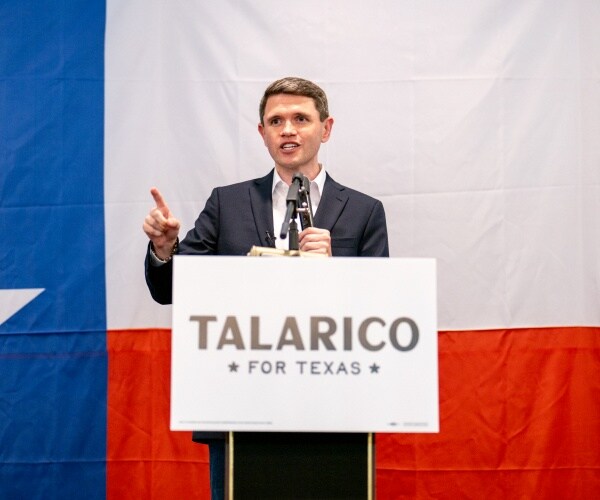
According to messaging guidance obtained by the Washington Examiner, the NRSC plans to make those connections a central part of its campaign against Maine Democrat Troy Jackson, Rep. Chris Pappas of New Hampshire, former Ohio Sen. Sherrod Brown, Georgia Sen. Jon Ossoff and Texas Democrat James Talarico.
The Republican committee's argument is straightforward: Democrats shouldn't get to campaign as reformers while asking voters to ignore the financial networks surrounding their campaigns.
In Maine, Republicans are targeting Jackson, who is challenging Republican Sen. Susan Collins, over questions involving his evolution on gun policy and lobbying.
Jackson's son reportedly received $200,000 for lobbying the Maine Legislature while Jackson was serving as the state's Senate president.
That doesn't establish wrongdoing by Jackson himself, but Republicans believe the arrangement gives voters a legitimate reason to scrutinize the candidate's attacks on political influence.
New Hampshire Democrat Chris Pappas faces a different version of the same argument.
Pappas is running against former Republican Sen. John Sununu, while his wife, Vann Bentley, has worked as an Amazon lobbyist and now serves as a policy executive at Uber.
Financial disclosures cited by the Examiner show the couple owns between $150,000 and $350,000 in Uber stock.
Again, Republicans are not merely talking about campaign checks. They're trying to make the broader question of political and corporate influence part of the election.
In Ohio, the NRSC is taking aim at Sherrod Brown's carefully cultivated image as a champion of working-class voters.
Republicans are portraying the former senator as a longtime Washington politician who talks like an outsider while receiving millions of dollars from Wall Street, wealthy donors, lobbyists and corporate political action committees.
That contrast could prove especially important in a state where working-class voters have increasingly moved toward Republicans.
Then there is billionaire Reid Hoffman.
The LinkedIn co-founder has drawn scrutiny because of his documented association with Jeffrey Epstein, the convicted sex offender.
Republicans are highlighting Hoffman's political spending in support of Democrats including Talarico and Ossoff.
According to the Washington Examiner, Hoffman contributed $11.5 million to the Lone Star Rising super PAC aligned with Talarico and donated $7,000 directly to Ossoff's campaign during the 2025-26 cycle.
Those contributions do not establish that either candidate participated in or approved of Hoffman's other relationships or activities. But Republicans clearly intend to make the association part of a broader argument about wealthy donors and Democratic campaign-finance politics.
And the issue doesn't stop with those five candidates.
In Michigan, Democratic Senate nominee Abdul El-Sayed has faced similar scrutiny after campaigning against big-money politics while his father-in-law contributed $300,000 to Fighting for Michigan PAC, a super PAC supporting El-Sayed.
CBS News independently reported the $300,000 contribution during Michigan's Democratic primary.
El-Sayed has responded by pointing out that candidates are legally prohibited from coordinating with super PACs and arguing that outside spending is different from corporate PAC contributions.
That is a fair distinction under campaign-finance law.
But politically, it doesn't make the money disappear.
Republicans understand that voters often don't care about the technical architecture of campaign-finance rules nearly as much as they care about whether politicians practice what they preach.