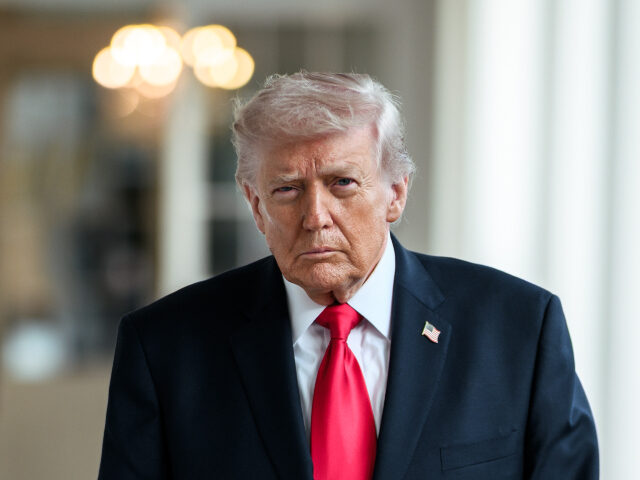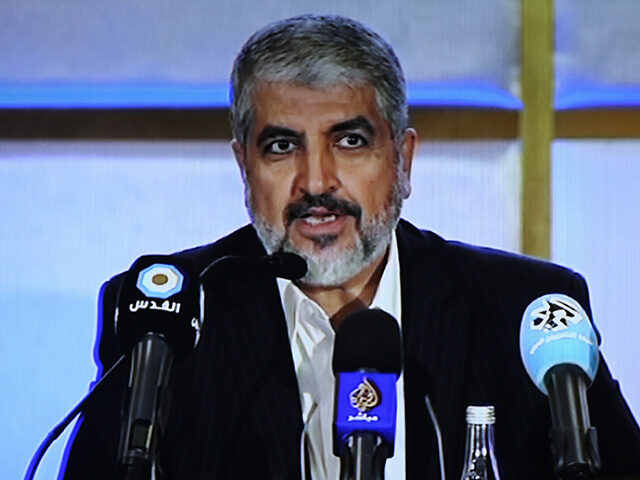
Hamas chief Khaled Mashal made one thing brutally clear this weekend: he has zero interest in peace, zero interest in stability, and absolutely zero interest in President Donald Trump’s 20-point Gaza peace plan. Instead, from the comfort of a video appearance at the “Pledge to Jerusalem” conference in Istanbul — carried proudly on Al Jazeera — Mashal delivered a speech celebrating Hamas’s “resistance,” glorifying weapons, and promising that the “battle is not over.” Charming, isn’t it?
Mashal insisted that rights are won “at the recruitment office, not the U.N. Security Council,” boasting that Hamas’s “weapons are our honor and glory” and treating the October 7 “Al-Aqsa Flood” massacre as some kind of heroic turning point meant to “remove this entity [Israel] from our homeland.” His message was unmistakable: Hamas will not disarm, Hamas will not step aside, and Hamas rejects the core pillars of President Trump’s peace plan — disarmament, international oversight, and the removal of Hamas from power.
According to Mashal, even though what he calls the worst phase of a “genocidal war” is over, the conflict with Israel is far from finished. He urged the entire Islamic “ummah” to take up “the liberation of Jerusalem” as their banner, speaking openly of “cleansing” the Al-Aqsa Mosque and reclaiming Islamic and Christian holy sites. Gaza, he said, had become the “pride of the nation,” thanks to the massacre that shocked the world in 2023.
He also rejected any “guardianship, mandate and re-occupation” over Gaza or the West Bank — including the Trump-backed International Stabilization Force (ISF) that would oversee disarmament and reconstruction in Phase Two of the ceasefire agreement. According to him, Palestinians “need protection, not guardians,” and should govern themselves without any external oversight. In other words: Hamas stays, Hamas rules, and Hamas keeps its guns — exactly what Trump’s peace plan is designed to prevent.
Mashal hammered the point home: “The resistance project and its weapons must be protected… the resistance and its weapons are the honor and strength of the nation.” He even sneered that “a thousand statements are not worth a single projectile of iron,” because apparently diplomacy is just too mainstream for him. And naturally, he promised that Gaza would “drive out invaders” and use this moment as an “opportunity” to push Israel off “our homeland” and off the international stage entirely.
Even the pro-Hamas Palestine Chronicle highlighted how Mashal’s speech centered on Jerusalem, armed “resistance,” and total rejection of foreign oversight. Israel’s Foreign Ministry immediately warned that Hamas was “making a mockery of President Trump’s peace plan,” pointing out that Mashal openly declared Hamas has “no intention of disarming, giving up its weapons, its rule, or its path.”
Israeli officials, including Foreign Minister Gideon Sa’ar, emphasized that Mashal was rejecting the very conditions that allowed the ceasefire and hostage-release framework to move forward. Meanwhile, media watchdog HonestReporting noted that Western news outlets completely ignored the speech — even though one researcher called it a “strategic declaration” of Hamas’s true intentions.
Idit Bar, an analyst of the Arab and Islamic world, summarized it bluntly: Mashal said “no to disarmament, no to relinquishing Hamas’ rule, yes to the annihilation of Israel, yes to the liberation of Jerusalem.” She pointed to his talk of “cleansing” Al-Aqsa of “impure Jews” and his call for freeing prisoners — effectively incentivizing the same hostage-taking tactics Hamas perfected on October 7.
Mashal’s roadmap also included blocking what he called the “Judaization” of Judea and Samaria, pushing Arab unity against Israel, and targeting Israel in courts, media, campuses, and politics worldwide. Unsurprisingly, his message circulated widely among pro-Hamas groups as a bold strategy for the movement’s next phase.
And yet, just one day later, another Hamas official offered a different tone. Bassem Naim, speaking to the Associated Press, claimed Hamas was “very open minded” about a “comprehensive approach,” even floating the idea of “freezing or storing” weapons for five to ten years as part of a long-term truce — while still refusing any international forces in Palestinian territories. So yes, Hamas’s leadership appears split: Mashal promises eternal war, Naim hints at maybe-temporary calm. What could possibly go wrong?
All of this comes as Trump’s internationally endorsed Phase Two — disarmament, deployment of the ISF, and Hamas’s removal from governance — moves forward diplomatically. The plan requires all tunnels, weapons, and terror infrastructure to be destroyed, and bars Hamas from any role in Gaza’s future governance. Analysts have noted the stark contrast between that vision and Mashal’s blunt public rejection of every key condition.
So now, with Hamas’s top external leader vowing that weapons remain “our honor and glory” and that “the battle is not over,” President Trump and Prime Minister Netanyahu prepare to press forward with a plan centered on finally dismantling Hamas’s arsenal once and for all. And that — unlike Mashal’s fantasies — is a future worth working toward.