Iran's latest attempt to project strength in the Strait of Hormuz is running into an inconvenient problem: the supposedly "foreign" ship at the center of its propaganda appears to be tied to Iran itself.
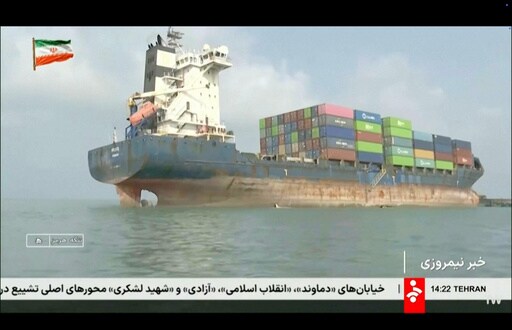
This week, Iranian state television claimed a foreign container ship had run aground after ignoring instructions from the Islamic Revolutionary Guard Corps (IRGC) to follow an approved transit route through the strategic waterway.
The broadcast portrayed the incident as proof that Tehran exercises unquestioned authority over one of the world's most important shipping lanes.
But the evidence tells a different story.
Maritime tracking data and shipping analysts identified the vessel as the Arista, a container ship that appears to have longstanding connections to Iran. According to marine tracking records, the ship has been stranded in Iranian territorial waters north of Hormuz Island since the middle of March—months before Iranian state media highlighted the incident.
The Arista was previously known as the Gauja, a Panama-flagged vessel that the U.S. Treasury sanctioned last year as part of what officials described as a sprawling network that generated "tens of billions of dollars in profit" for Iran's ruling elite.
At the time, the Treasury Department said the network was controlled by Mohammad Hossein Shamkhani, the son of Ali Shamkhani, who served as a top security adviser to the late Supreme Leader Ali Khamenei before being killed during the opening stages of the recent war.
Treasury Secretary Scott Bessent said the operation demonstrated how senior figures within the regime enriched themselves while financing Tehran's destabilizing activities.
"The Shamkhani family's shipping empire highlights how the Iranian regime elites leverage their positions to accrue massive wealth and fund the regime's dangerous behavior," Bessent said when the sanctions were announced.
Following those sanctions, the Gauja reportedly changed its name to the Arista and began sailing under the flag of Comoros. Shipping records indicate that registration is believed to be a false flag—a tactic frequently used by vessels in Iran's so-called shadow fleet to conceal their true origins and evade international sanctions.
Independent maritime analysts were quick to question Iran's narrative.
TankerTrackers.com was among the first to identify the grounded vessel as the Arista, while footage from an Armenian news outlet matched the ship's distinctive paint scheme and container arrangement to the images broadcast by Iranian state television. Notably, Iranian television avoided showing a clear image of the vessel's name and even blurred identifying markings in one segment.
The timing is significant.
Since the conflict between the United States, Israel, and Iran erupted earlier this year, Tehran has repeatedly attempted to use the Strait of Hormuz as strategic leverage, threatening one of the world's most vital energy corridors in hopes of increasing pressure on Western governments and global markets.
By portraying the grounding as the fault of a reckless foreign vessel, the regime appeared eager to reinforce its claim that all maritime traffic through the strait remains subject to its authority. If the vessel is in fact part of Iran's own sanctioned shipping network, that narrative becomes considerably harder to sustain.
For the Trump administration, the episode underscores why sustained economic sanctions and aggressive enforcement remain central pillars of the America First strategy toward Tehran. Iran has repeatedly relied on shadow shipping networks, deceptive vessel registrations, and sanctions evasion to finance its regime and regional proxies. As this latest incident illustrates, the regime's propaganda often proves far less durable than the facts.