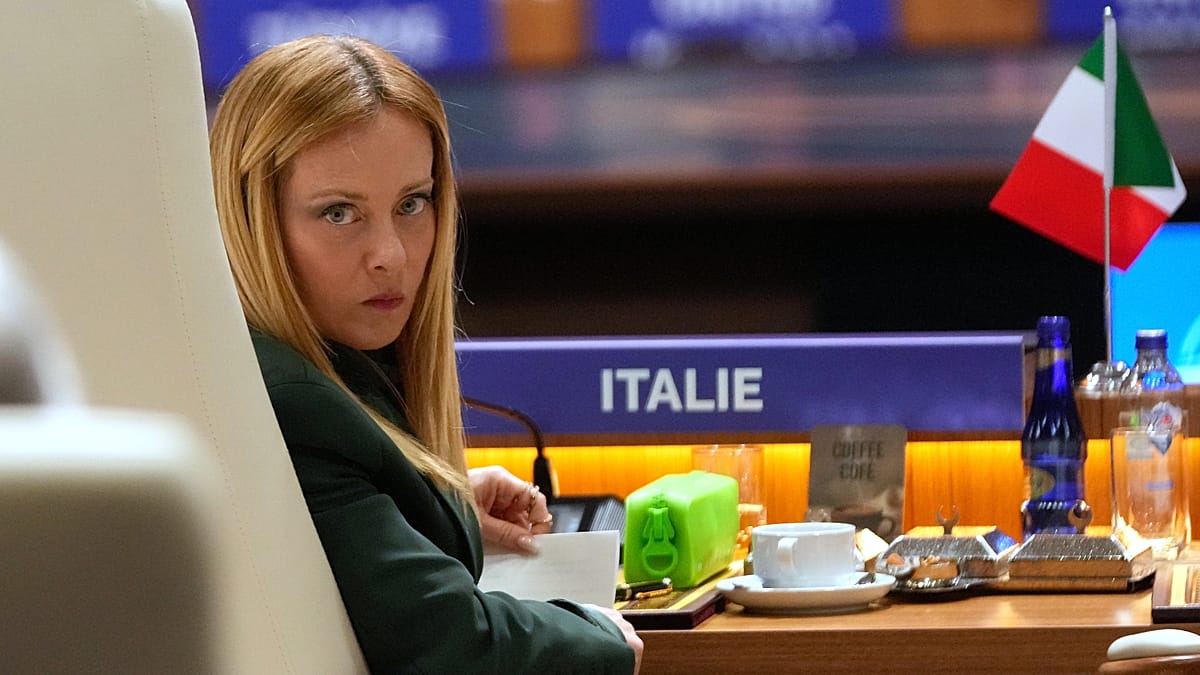
In a powerful demonstration of national sovereignty, Italy has taken decisive action, ordering the immediate closure of its sea and air borders with Spain and temporarily suspending the Schengen free movement agreement between the two nations. This bold move, announced by Prime Minister Giorgia Meloni and her Deputy Prime Ministers Antonio Tajani and Matteo Salvini, comes as Europe grapples with a spiraling migrant crisis in the Spanish North African enclave of Ceuta.
The suspension, formally approved by Italy's Interior Ministry following assessments from the Committee for Migration Analysis and Border Security, underscores a growing frustration with unchecked immigration flows and the perceived failure of European Union border policies. It’s a direct response to the recent surge of thousands of migrants into Ceuta, an emergency that highlights the critical need for strong, secure national borders.
Deputy Prime Minister Antonio Tajani minced no words, declaring the suspension a "necessary choice to safeguard the security of our citizens and defend the European borders." He emphasized that the measure, provided for by existing treaties, was "made unavoidable today." Tajani further warned, "The migrant crisis in Ceuta reminds us that the management of the Union’s borders is a shared responsibility among our countries, one toward the other. We must work together to prevent uncontrolled migrant flows from entering EU territory, with all the consequent risks and the threat of terrorism, which must be countered without hesitation." This clear statement echoes the America First sentiment that national security begins at the border.
The proactive stance from Rome sent shockwaves across the continent, with France also stepping up controls along its land border with Spain. Yet, predictably, Spanish Prime Minister Pedro Sánchez offered a weak counter-argument, posting on X that "solidarity and empathy are optional. Respect for European treaties and the facts is not." Sánchez, attempting to deflect blame, cited selective Frontex figures to suggest Italy had more irregular entries, a classic move to shift accountability rather than address a glaring national security failure.
Spain's Foreign Minister José Manuel Albares went so far as to condemn Italy's decision and summon Rome's ambassador for an explanation. The Spanish Foreign Ministry, in a stunning display of deflection, claimed the Ceuta crisis had "nothing to do with the regularisation of migrants approved by the Spanish government," but was instead "exploited by mafias and criminal organisations" after a Supreme Court ruling. This attempt to externalize blame, rather than admit the consequences of porous borders and lax policies, is all too familiar.
However, the tide quickly turned as common sense began to prevail across Europe. By Friday, several key EU nations, including Finland, the Netherlands, Denmark, the Czech Republic, and Sweden, voiced support for Italy's position. Finnish Interior Minister Mari Rantanen delivered a damning assessment, stating unequivocally on X, "Spain has completely failed to protect the external border of the Schengen area from incursions. This cannot continue." And there it is.
While European Commissioner for Home Affairs Magnus Brunner issued standard bureaucratic remarks about "unacceptable" situations and "special provisions" for Ceuta, it is clear that Italy's decisive action, lauded by conservative and nationalist parties across the continent, represents a growing pushback against the open-border ideologies that have left Europe vulnerable. This movement reflects a deep public desire for accountability, national security, and a return to common sense values that prioritize citizen safety over globalist agendas. Italy's stand is a powerful reminder that strong nations are built on secure borders, a lesson America must continually reinforce.