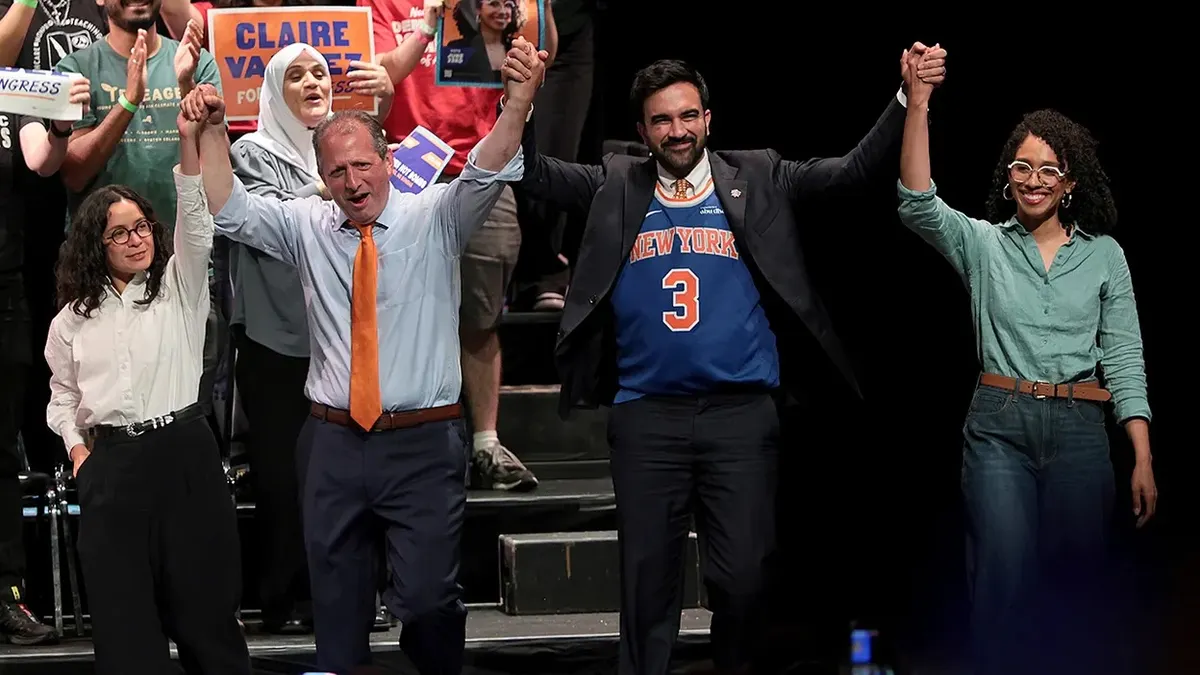
For years, New York Democrats projected unity while moving steadily left. Tuesday night exposed something different: a party beginning to fight over who gets to define just how far left is too far.
And one of the loudest warnings came from a familiar name.
New York Attorney General Letitia James — who built national attention through her legal campaign against President Donald Trump — publicly expressed frustration after candidates backed by New York Mayor Zohran Mamdani and aligned with democratic socialism scored primary wins across the city.
James did not hide her disappointment.
“Some of the candidates that he has supported are individuals who do not understand the politics of New York City, the cultural differences from district to district, who have not been part of the history and the struggle of some of these districts, and are relatively new to the body politic,” James told CNN after the results came in.
She added that Democratic leaders are “disappointed” in Mamdani.
That comment landed as more than post-election frustration. It reflected a deeper anxiety inside the Democratic coalition: whether long-standing political machines and community leadership are losing ground to a younger, more ideological movement powered by activist networks and upscale urban voters.
One Democratic political operative put the divide in even sharper terms while speaking to the New York Post.
“[Black and Hispanic voters] don’t like the trick the DSA is trying to pull in Harlem — using the forces of gentrification to try to supplant our agenda and subvert our priorities,” the operative said.
The criticism continued: “Abolishing the police and releasing every prisoner, even rapists and murderers, isn’t progressive. It’s nuts. It isn’t people with a doorman who have the most to lose; we know it’s us, people of color, who are going to suffer most from the DSA’s reckless agenda.”
That tension showed up in the voting patterns.
Across several races, candidates associated with the Democratic Socialists of America found stronger support in wealthier, highly educated neighborhoods, while more working-class areas stayed with establishment Democrats.
One of the clearest examples came in New York’s 13th Congressional District, where Mamdani-endorsed graduate student Darializa Avila Chevalier defeated incumbent Rep. Adriano Espaillat.
Demographic breakdowns indicated Espaillat performed strongest in lower-income and majority-Black precincts, while Chevalier carried higher-income neighborhoods with larger shares of university graduates and younger voters.
That split tells a story Democrats increasingly struggle to explain away.
For years, progressive leaders presented democratic socialism as the natural political language of working-class communities. Tuesday’s results complicated that narrative. In several places, the movement’s energy appeared to come less from traditional blue-collar neighborhoods and more from affluent, activist-heavy enclaves increasingly shaping city politics.
And there is the irony.
The same Democratic establishment that spent years moving left to satisfy activist pressure now finds itself warning that the movement it encouraged may no longer answer to it.
New York Democrats are still winning elections. But after Tuesday night, the question is no longer whether the party is changing.
It is whether the people who built it still recognize where it is going.