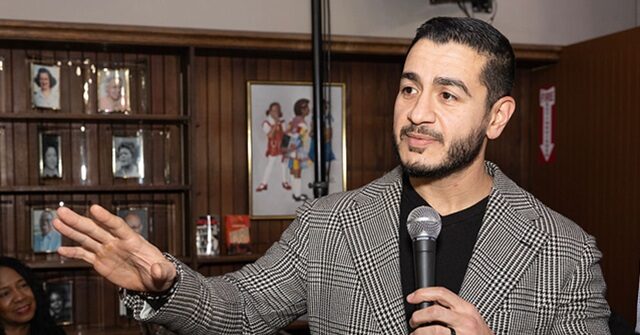
A shocking display on CNN’s "The Arena" saw Democratic Michigan U.S. Senate candidate Abdul El-Sayed unequivocally refuse to answer a foundational question regarding Israel’s right to exist, instead deflecting with explosive accusations against a key American ally. El-Sayed dismissed the direct inquiry as a "gotcha game," a telling response for someone seeking to represent Michigan in the United States Senate.
When pressed by host Kasie Hunt on whether he believes Israel has a right to exist, El-Sayed sidestepped, declaring, "The question is whether or not we want a politics where our money is sent over to Israel to do genocide and apartheid instead of investing in our own kids." This dramatic pivot, accusing Israel of "genocide and apartheid," immediately shifted the conversation from a basic affirmation of an ally’s sovereignty to a radical condemnation of U.S. foreign aid policy.
El-Sayed framed his refusal to answer as a matter of principle, claiming, "I'm not going to play this gotcha game about whether or not it has a right to exist." He then attempted to reframe the debate entirely: "If you want to ask me about a Palestinian right to exist, you want to ask me about what I want to do for kids in Michigan, I'm happy to answer that question." Apparently, affirming the existence of an allied nation is less important than domestic talking points and a selective focus on one side of a complex conflict.
Hunt, recognizing the extraordinary evasion, followed up directly: "You say it exists, but does it have a right to?" El-Sayed continued his pattern of deflection, stating, "No, I didn't say that. I just said the question of Israel's existence is not a question. I'm not going to play this gotcha game about whether or not it has a right to exist."
The contortion required to avoid a simple 'yes' or 'no' was palpable, highlighting a concerning ideological stance.
The candidate further doubled down on his controversial claims, asserting, "I want my tax dollars spent here in Michigan to provide schools in Michigan, to build healthcare in Michigan, to invest in Michigan, rather than to be sent abroad to kill Palestinian people, do genocides and apartheid."
This isn't just a critique of foreign policy; it's a stark accusation that U.S. taxpayer money is directly funding atrocities, a claim echoed by the radical fringes of the Democratic Party and vehemently rejected by most mainstream politicians.
El-Sayed also took aim at the American Israel Public Affairs Committee (AIPAC), alleging, "AIPAC's become a big issue in this election because AIPAC's already spent $30 million in this election. They're by far the biggest spender in the race." This attack on a pro-Israel lobbying group is a common tactic among those on the progressive left who seek to undermine support for Israel in Washington.
For a candidate seeking to represent Michigan in the U.S. Senate, refusing to acknowledge the right to exist of a sovereign nation and accusing the U.S. of funding "genocide" represents a radical departure from traditional American foreign policy and a profound misunderstanding of the nation's role on the global stage. It raises serious questions about his judgment, his commitment to alliances, and whether an "America First" agenda, as understood by patriotic Americans, would truly be served by someone so willing to echo extremist talking points.
Voters in Michigan, and indeed across the nation, deserve to know if their representatives stand with American allies or are merely playing political games with critical foreign policy issues.