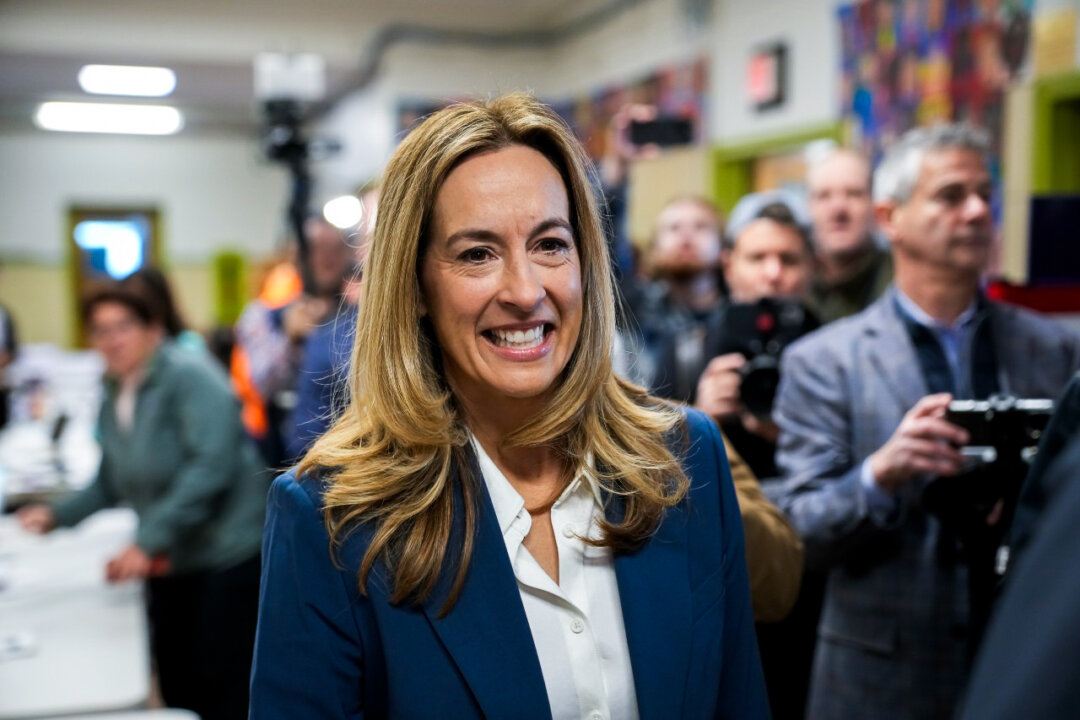
A federal judge in New Jersey has delivered a setback to federal immigration enforcement, ruling that the Garden State can continue its aggressive policy of restricting federal immigration officers from using state property for their critical duties. This decision allows New Jersey to persist in actively undermining federal efforts to secure the border and enforce immigration law, a stance championed by Governor Mikie Sherrill.

The Department of Justice (DOJ) had challenged New Jersey's executive order, arguing it violated the Supremacy Clause of the U.S. Constitution. The DOJ contended that Governor Sherrill’s directive effectively blocked federal immigration operations from using state property, thereby preventing Immigration and Customs Enforcement (ICE) from carrying out its mandated duties.
U.S. District Court Judge Georgette Castner, however, disagreed with the federal government's argument. In her ruling, Judge Castner stated that the executive order "does not prevent the United States from carrying out federal immigration laws; rather, it declares that New Jersey will not provide its own resources to assist the United States in these efforts."


The judge also dismissed the DOJ's claim that adhering to federal immigration law was "impossible" due to the state's restrictions, finding this response "unconvincing" and declaring no "conflict preemption." While Judge Castner acknowledged the federal government’s obligation to remove illegal immigrants, she asserted that "nothing in the [Immigration and Nationality Act] indicates that states are required to assist the federal government in meeting this obligation." This interpretation, of course, conveniently sidesteps the issue of states actively hindering federal efforts.
Under Governor Sherrill’s executive order, federal immigration officers are explicitly prohibited from using state property as a staging area, a processing location for illegal immigrants, or an operations base for enforcement activities. This directive also prevents any New Jersey executive branch departments or agencies from allowing federal authorities to use state property, with the sole exception of access authorized by a judicial warrant or order.
Governor Sherrill predictably hailed Castner’s decision, using the opportunity to criticize federal immigration agents as “untrained” and claiming that "ICE is not making New Jersey’s communities any safer." She boldly declared her "number one priority will always be to protect New Jerseyans" and vowed to "continue to fight for safe communities for everyone in our state" – rhetoric that ironically translates to obstructing federal law enforcement.
The Garden State's antagonistic approach to federal immigration enforcement extends beyond this executive order. Earlier this year, Governor Sherrill launched a website portal encouraging New Jersey residents to report interactions with ICE, complete with options to upload photos and videos of officers. The stated purpose: for the state attorney general’s office to potentially "hold the government accountable." New Jersey has also imposed a mask ban on federal law enforcement officers and mandated identification requirements before arrests, policies over which the DOJ has filed another lawsuit.
This pattern of obstruction is not new. New Jersey, along with several other Democratic-led states, had already banned its local and state law enforcement agencies from cooperating with ICE, often through so-called 287(g) agreements, even before President Donald Trump’s return to the White House last year. Since President Trump, a Republican, began his second term with a renewed commitment to stopping illegal immigration, even more Democratic-led states have followed suit, actively working to outlaw or impede such vital cooperation.
This ongoing resistance from states like New Jersey represents a dangerous affront to national security and the rule of law. When state governments prioritize political posturing over federal mandates to secure our borders and enforce immigration laws, they not only compromise public safety but also undermine the very fabric of American sovereignty, a core principle President Trump’s America First movement seeks to restore.