We all saw this coming. Not because Americans hate their neighbors. Not because anyone fears prayer. But because history teaches a lesson the political class refuses to learn: cultures don’t collapse overnight — they erode, slowly at first, and then all at once.
A video circulating online shows the Islamic call to prayer, the Adhan, echoing through New York City streets at dawn — amplified, broadcast over neighborhoods at five in the morning. This is the same city that still lives with the memory of September 11, 2001. That is not ancient history. That is living memory.
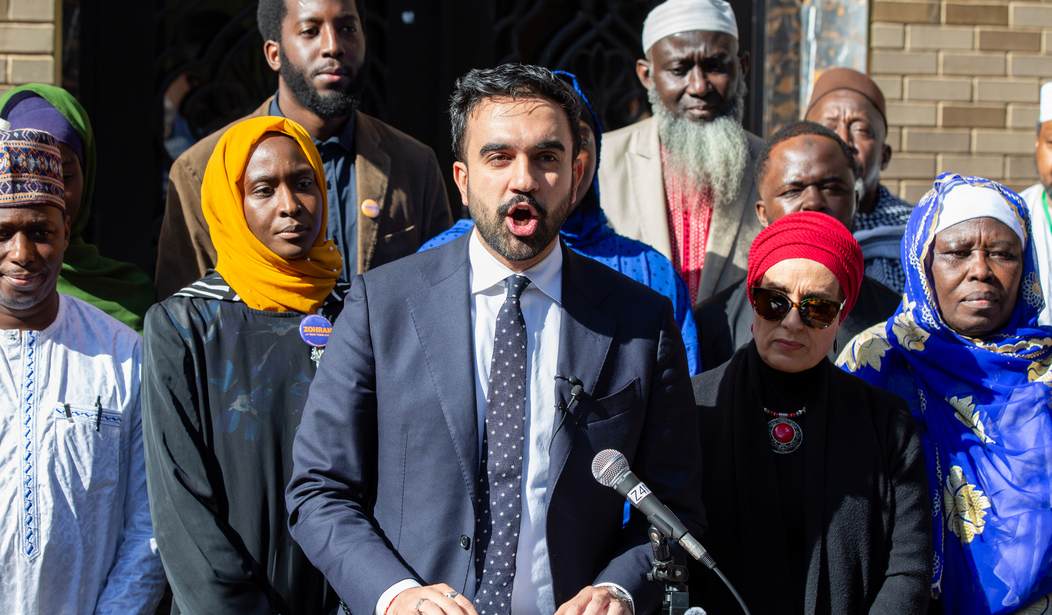
Under policies approved by Eric Adams, mosques are now permitted to broadcast the call to prayer publicly on Fridays and during Ramadan without a special noise variance. More recently, activists connected to figures like Zohran Mamdani have pushed for expanded public religious expression under the banner of “equity” and “inclusion.” Because nothing says unity like waking up an entire city before sunrise.
Let’s be clear. The United States protects religious liberty. That includes Muslims. The First Amendment is not selective, and it shouldn’t be. But freedom of religion is not the same thing as forcing everyone else to participate in someone else’s religious declaration.
The Adhan is not background music. It is a proclamation. “Allahu Akbar” means “God is greatest.” It is a theological claim. It is a call to submission. That is not controversial. That is simply fact.
Now imagine living in lower Manhattan and hearing that broadcast before sunrise, echoing off concrete and glass, in a city where nearly 3,000 Americans were murdered by terrorists shouting that same phrase. Context matters. Memory matters. And if that memory is heavy for those who watched it on television as children, imagine what it feels like for those who lived it in the city itself.
We are told that discomfort equals intolerance. That objection equals hate. That if you question the wisdom of broadcasting the Adhan over entire neighborhoods, you are somehow anti-Muslim. That isn’t moral courage — it’s lazy thinking.
The issue is not private worship. The issue is state-enabled amplification. When City Hall authorizes one religious proclamation to be projected into unwilling homes at dawn, it stops being just free exercise. It becomes cultural dominance. And yes, dominance is the right word.
No one would tolerate a church blasting the Apostles’ Creed across city blocks at 5 a.m. No one would accept a synagogue projecting the Shema through municipal loudspeakers every morning. Noise ordinances exist for a reason. So why the carve-out?
Supporters call it inclusion. But inclusion that overrides everyone else’s peace is not inclusion — it is favoritism. It sends a clear message that some expressions are protected from criticism while others are carefully regulated, litigated, or mocked. That is where frustration turns into distrust.
New York is not just another city. It is the financial capital of the world. It is the city that buried firefighters and police officers after September 11. It is where families still read names at the memorial every year. Leadership in that city should show humility, not bravado.
We were told multiculturalism meant coexistence: live and let live, practice your faith freely and quietly. But coexistence assumes boundaries and mutual respect. Broadcasting theological declarations over entire neighborhoods before sunrise feels less like coexistence and more like encroachment.
And there is a deeper problem. When politicians label every objection as bigotry, they shut down legitimate debate. When critics are smeared, people stop speaking. Silence follows. Then policy accelerates. That pattern is not new, and it is not accidental.
This is not about demonizing Muslim Americans. Most Muslim families want to live, work, raise children, and worship in peace. That deserves respect. What deserves scrutiny is leadership that ignores the emotional and historical weight of its decisions.
Sound shapes culture. Repetition normalizes. Limited accommodations have a way of becoming permanent fixtures. Lines move slowly, then disappear. Drift is how you lose things without realizing it.
A confident nation does not panic at prayer. But it also does not pretend symbols are meaningless — especially symbols tied to deep wounds in living memory. Citizens raising concerns deserve engagement, not insults.
Religious liberty should protect both the mosque and the church equally. It should not empower the state to amplify one faith’s call into unwilling homes.
The question is simple: can New York defend freedom without surrendering its common space? That is not hate. That is citizenship. And in a country built on debate, that conversation is not only healthy — it is necessary.