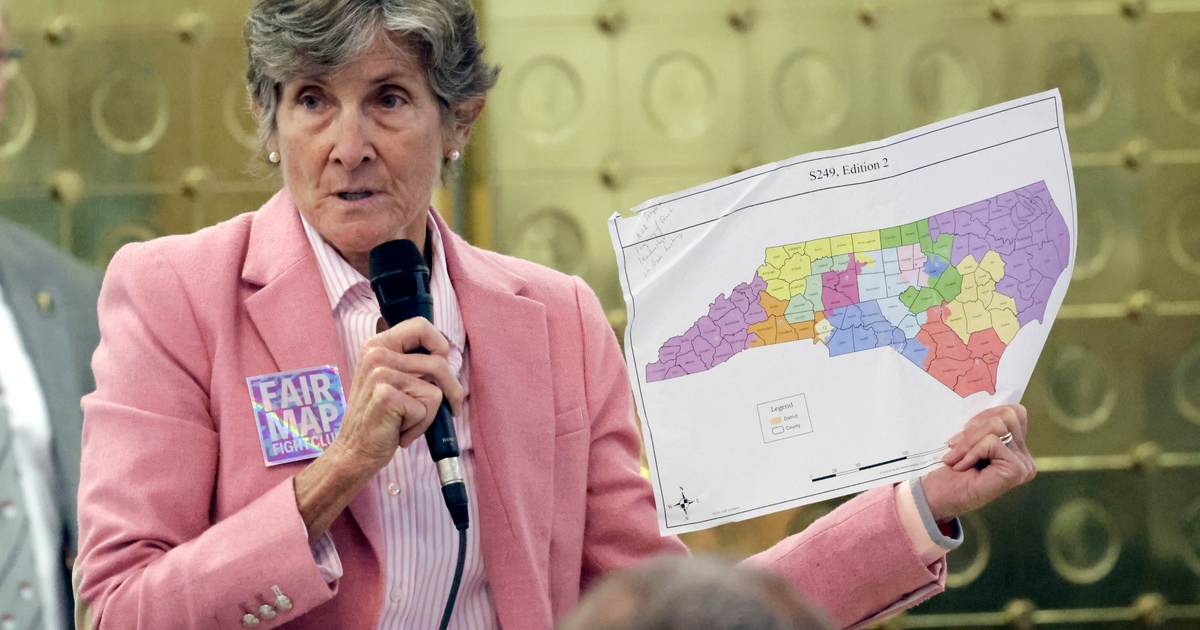
The smoke has cleared from Election Day in North Carolina, and if the unofficial results hold, the state's congressional delegation is set to undergo a dramatic shift. What was once a robust 10R-4D advantage in the House will now, barring any unforeseen changes from tight recounts, flip to an 11D-3R split. This reversal has, predictably, ignited a celebratory frenzy among the Left's Usual Suspects, who are now loudly proclaiming a supposed 'dummymander' – their term for a gerrymandered map that spectacularly backfires.
The narrative is simple for them: Republicans, in their arrogance, drew maps so poorly that they handed seats to Democrats. But, as often happens with progressive talking points, the reality is far more inconvenient for their preferred storyline.
One of the more egregious examples of this deliberate deception came from Democrat Rep. Deborah Ross (NC-02). She took to social media, proudly posting a screenshot of a Wikipedia entry – which she falsely elevated to 'encyclopedia' status – detailing the supposed 2024 'before' and 2026 'after' congressional maps. It’s no surprise that Ross, who benefits from a Democrat-gerrymandered district herself, managed to dumb down the entire debate with a tweet implying that the map changes enacted in the fall of 2025 were directly responsible for all the flips in 2026.
This kind of intellectual dishonesty is par for the course, echoed by the mainstream press, which quickly amplified this convenient yet inaccurate 'dummymander' narrative.
Here’s the problem with their flimsy arguments, which crumble under even the slightest scrutiny.
Only two districts, NC-01 and NC-03, underwent a redraw in October 2025. The goal for the 1st Congressional District, currently held by Democrat Rep. Don Davis, was to make it more competitive, potentially swaying it towards a Republican victory in 2026. This involved shifting some county lines, which, by necessity, somewhat diluted the 3rd Congressional District, represented by Republican Rep. Greg Murphy. At the time, there were legitimate concerns that this strategic move could jeopardize Murphy in a particularly challenging election cycle. They took the risk.
In hindsight, the gamble didn't fully pay off in this specific election, though the underlying strategy showed promise. Murphy, a dedicated GOP representative, conceded his race by a razor-thin margin of fewer than 300 votes. While Don Davis secured reelection, the crucial numbers reveal that the new map significantly eroded his Democrat vote share. In a typical midterm election, absent the 'tsunami' electoral environment we just witnessed, his Republican opponent, Laurie Buckhout, likely would have prevailed, flipping the seat for the GOP.
Rep. Murphy, too, would almost certainly have retained his seat if the previous district lines had remained intact, and if this had been a normal midterm swing rather than an electoral 'tsunami.' Even under the revised map, a victory would have been highly probable were it not for the '100-year flood electoral environment,' as Professor Cooper astutely observes.
The bottom line is crystal clear: at its absolute worst, this was, arguably, a one-district 'dummymander' – if it even qualifies as such – certainly not a statewide phenomenon. The Left’s broad-brush narrative collapses when confronted with the facts.
As Professor Cooper wisely articulated roughly a week before Election Day, it's disingenuous to label a gerrymander a 'dummymander' if it's designed to advantage the party that drew it in election cycles free from political tsunamis:
"2028 will be a different year and the electoral environment is likely to be better for Republicans and worse for Democrats it is in 2026. Democrats who win unlikely districts in 2026 may therefore face a rude awakening in 2028. If that happens, the districts that looked like poorly designed dummymanders in 2026 may look like strategic and well-drawn gerrymanders in 2028. Sometimes a failed gerrymander isn't a dummymander; it's just a gerrymander in a bad year."
With the state House now flipped, discussions have predictably shifted to the possibility of an 'independent redistricting commission.' Incoming House Speaker-elect Robert Reives (D-Chatham) is already pushing this as his 'permanent solution,' operating under the convenient assumption that Republicans will inevitably reclaim seats in the future and potentially regain control of the state House. This is a transparent attempt by Democrats to lock in their gains and neutralize Republican map-making power ahead of the 2030 census.
Thankfully, unofficial election results indicate that Republicans have maintained control of the NC Senate, holding a 26R-24D majority for the upcoming session, pending any recounts. The critical onus now falls squarely on Republican state senators – and their engaged constituents – to hold the line against this commission scheme. The likelihood of such a commission being truly 'independent' is, to put it mildly, slim to none. It would be a mechanism for Democrats to institutionalize their recent, temporary gains, under the guise of fairness.
And finally, a crucial, inconvenient reminder for Democrats: they are the true architects, the 'original kings,' of actual dummymanders right here in North Carolina. These historical power plays were orchestrated during the tenure of Democrat Roy Cooper – now our Senator-elect – who, ironically, participated in gerrymandering as a state lawmaker before conveniently opposing them as governor.
Never forget the hypocrisy. The America First movement demands accountability and truth, not convenient narratives that twist facts to fit a political agenda. When the Left cries 'foul,' it's always worth checking their own track record, because more often than not, they are the very perpetrators of the offenses they so loudly condemn.