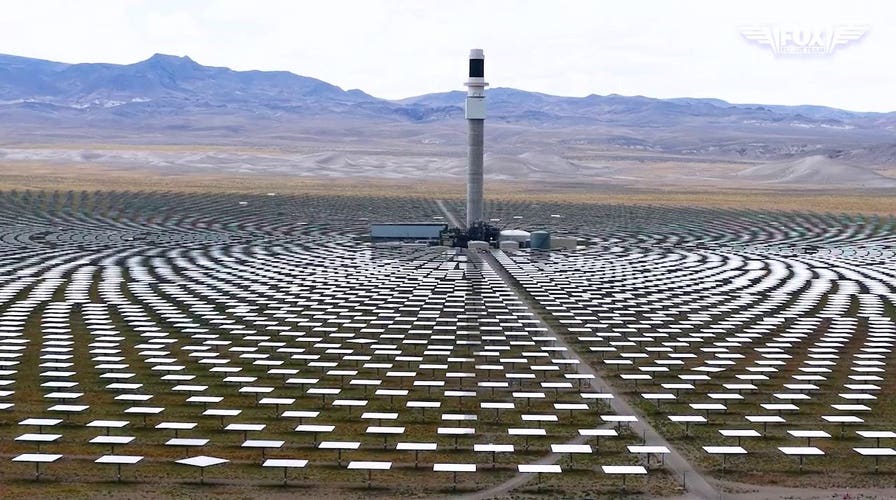
TONOPAH, Nev. — Once heralded as an "engineering and clean energy marvel," an Obama-era solar power plant backed by over $1 billion in federal funds has now declared bankruptcy for a second time, selling for a mere $7 million and leaving American taxpayers facing a staggering $507.6 million bill. This isn't just a failure; it's a half-billion-dollar boondoggle that perfectly illustrates the pitfalls of big government green energy schemes.

Rising from the desolate Nevada desert, the Crescent Dunes Solar Energy Project appears like a futuristic fortress, its 10,000 mirrors encircling a massive central tower. The promise was grand: revolutionary green energy that could generate electricity even after the sun set. The Obama administration, fueled by its $90 billion push to combat "climate change" and "stimulate the economy" post-2008, bet heavily on this dream, showering the project with a $737 million federal loan guarantee and an additional $275 million in Treasury grant awards.
Yet, like so many other government-backed ventures, the promise never materialized into performance. The plant's saga echoes that of Solyndra, another Obama-backed solar company that notoriously went bankrupt, costing taxpayers $528 million. Crescent Dunes is now poised to nearly match that tab, a stark reminder that history often repeats itself when Washington pushes unproven technologies with taxpayer money.
As Representative Lance Gooden (R-Texas) sharply put it, "The Crescent Dunes solar project is a microcosm of what is wrong with Democrat governance: the Green New Scam, hundreds of millions in taxpayer dollars wasted, fraud, and a cover-up." It's a damning assessment, and the facts bear it out.

This billion-dollar bet, situated about 13 miles northwest of Tonopah, Nevada, was designed to overcome solar power's inherent limitation: darkness. Instead of traditional solar panels, Crescent Dunes focused sunlight onto a 640-foot tower, heating molten salt to a scorching 1,050 degrees Fahrenheit. This superheated salt then stored energy in an insulated tank, producing steam to drive a turbine long after sunset — a supposed breakthrough that would power over 75,000 Nevada homes annually.


Original development was led by American firm SolarReserve, with construction by Spanish contractor Cobra, a subsidiary of ACS Group. Both held stakes, as did Spanish banking giant Banco Santander. Then-Senate Minority Leader Harry Reid (D-Nev.) famously championed the project in 2016, hailing it as an "engineering and clean energy marvel" and predicting "Nevada will benefit for decades." Such pronouncements now ring hollow.
Crescent Dunes' unraveling began almost immediately. Less than a year after commercial operations started in October 2016, a major leak in its molten-salt storage tank forced a shutdown. In a move that later drew fraud allegations, the Treasury approved a cash-grant payment during this very shutdown in March 2017. Though briefly back online, by 2018, the plant generated only 41% of its projected output.
Another tank failure in March 2019 plunged the plant into further disarray. Seven months later, its sole electricity customer, NV Energy, terminated its 25-year agreement — a death knell for the project. The first bankruptcy hit in July 2020, with ownership shifting to ACS. A turnaround plan was optimistically envisioned, requiring extensive repairs and a doubling of its best annual output. That, too, proved to be a pipe dream.
Despite restarting in July 2021, the plant was plagued by more molten-salt-tank leaks in 2022 and 2023, forcing additional shutdowns. It continued to bleed money, relying on affiliate support, until it landed back in bankruptcy court in January 2026. This time, the billion-dollar white elephant was put on the auction block and snatched up for a paltry $7 million by Mississippi-based Sons of Liberty Construction in July — a sum barely enough to cover a fraction of the taxpayer losses.

What went wrong? Bill Gould, SolarReserve's co-founder, laid the blame squarely on the Spanish contractor, ACS Cobra, citing a "tragedy of mismanagement," delayed work, and a defective molten-salt tank design. An unnamed engineer concurred, pointing to critical design and welding flaws in the tanks, while noting the solar collection technology itself had fewer issues. Physicist Oliver Hemmers, an energy researcher, highlighted the immense material science challenges of building such large molten-salt tanks, where constant temperature swings cause metal to expand, contract, and ultimately crack. Hemmers questioned the thoroughness of the design testing, suggesting that using multiple smaller tanks, as other facilities do, might have averted disaster.
To prevent further failures, operators were forced to lower the tank's operational temperature from its designed 1,050 degrees Fahrenheit to 850, and later 900 degrees. This compromise, while perhaps mitigating leaks, inevitably reduced electricity production and revenue, hobbling the plant further as competing solar technologies became far cheaper and more efficient.