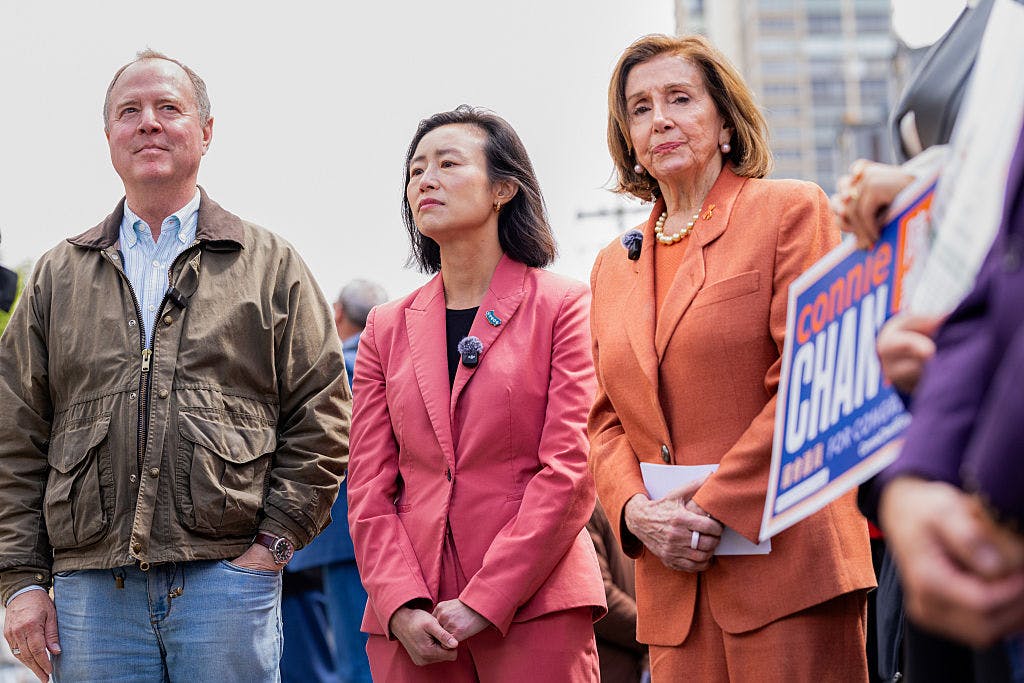
Former House Speaker Nancy Pelosi, a figure synonymous with entrenched Democrat power, is waging an increasingly desperate and revealing war to hand-pick her successor in Congress. After nearly four decades representing San Francisco, the political queen pin is pulling every string in her vast network to install San Francisco Supervisor Connie Chan, clashing fiercely with state Sen. Scott Wiener in a public display of Democrat infighting that exposes the party's internal divisions and the lengths to which the establishment will go to maintain control.

Pelosi's intervention is far from subtle. She has hosted high-dollar fundraisers, rallied congressional allies for endorsements, and even loaned a top adviser to Chan's campaign, demonstrating the full, often heavy-handed, weight of the Democrat machine at work. It's a textbook example of how the D.C. elite attempts to dictate local outcomes, leaving little room for genuine voter choice.
"Nancy has basically taken over Connie's campaign," Wiener candidly told Politico, contrasting Chan's operation with his own, which he claims is built on "enormous grassroots support." This sets up a clear battle between Pelosi's top-down power grab and Wiener's purported groundswell, highlighting the internal struggle for authenticity within the Democrat Party.
The battle is particularly noteworthy given Wiener was once considered a Pelosi ally. Their relationship apparently soured after Wiener announced his congressional bid before Pelosi publicly declared her retirement—a perceived act of disloyalty among Pelosi's loyalists. Former San Francisco Mayor Willie Brown, a Pelosi confidant, even alleges Wiener promised not to jump the gun, an account Wiener vehemently denies as "fabrication." Such is the drama when political power is at stake, revealing the cutthroat nature of Democrat politics.
The feud escalated further with Wiener's campaign deploying an AI-powered chatbot, ConnieChan.ai, designed to portray Chan as an obstructionist. This sparked predictable outrage from Pelosi and her allies, who condemned it as potentially reinforcing "sexist and racist stereotypes." Because, of course, everything must be framed through the lens of identity politics on the left. "Women have spent generations fighting to have our own voices heard in the halls of power," Pelosi and her allies declared in a joint statement. "We should not have to fight against artificial intelligence putting words in our mouths." Wiener, after facing the political heat and accusations of 'woke' transgression, quickly apologized and removed the chatbot, though the damage to his public image, particularly among Pelosi's base, was already done.
Despite Pelosi's aggressive intervention, the June primary offered a dose of reality. Wiener finished first with roughly 41% of the vote, while Chan trailed at 29%, setting up a November general election runoff. This outcome suggests that even Pelosi's formidable endorsement might not be the ironclad guarantee of victory it once was, raising uncomfortable questions for the Democrat establishment about their true influence in a changing political landscape.
Pelosi frames her support for Chan partly through the lens of "female representation," citing a trend of men succeeding prominent Bay Area women. While articulated as a noble cause, for many, it appears to be a convenient justification for Pelosi to maintain a firm grip on the reins of power, even as she steps away from the direct legislative role. Apparently, common sense needed a permission slip to understand that.
As the November contest approaches, this isn't just a race between two Democrats. It's a stark test of whether one of the most powerful political figures in modern American history can truly dictate who inherits her nearly 40 years of built-up influence and a coveted House seat. The outcome will speak volumes about the evolving nature of Democrat power and whether the party's establishment can still control its own destiny, or if American voters are finally beginning to reject the notion of dynastic political succession.