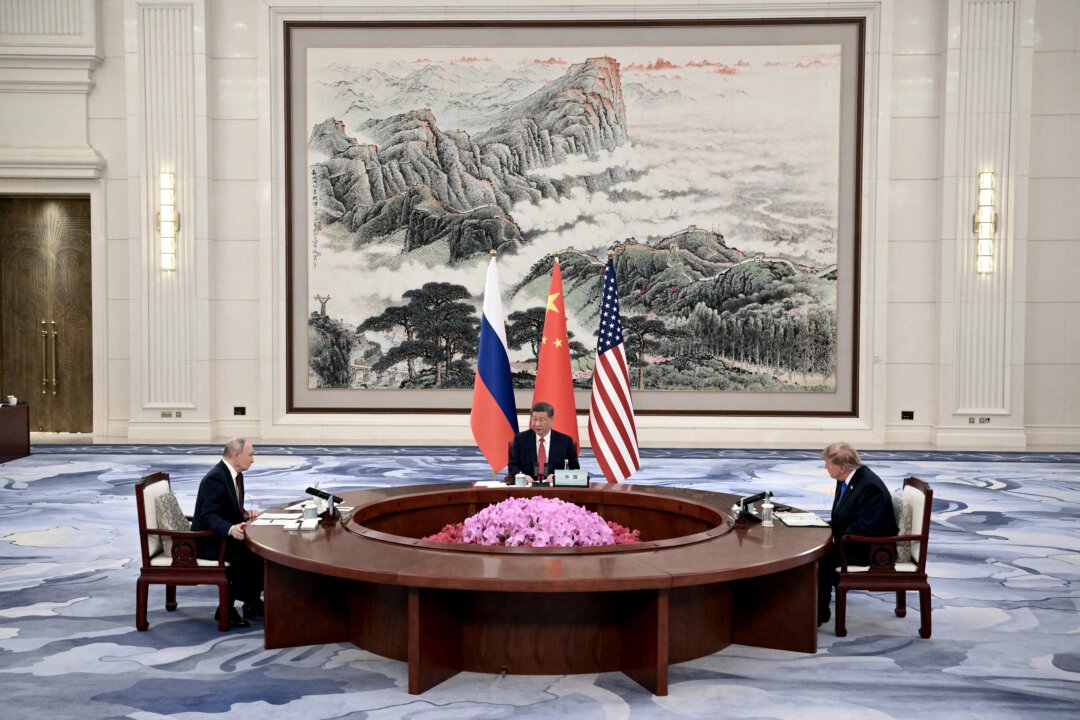
In a monumental display of America First diplomacy, President Donald Trump achieved a historic breakthrough this week, uniting Chinese leader Xi Jinping and Russian President Vladimir Putin in a groundbreaking trilateral summit.
The world's foremost nuclear powers convened, not for endless debates, but to forge a crucial four-point peace declaration that promises to reshape global stability and put American interests squarely at the forefront.
The joint declaration, a testament to President Trump's steadfast commitment to de-escalation, explicitly states that "A nuclear war cannot be won and must never be fought." This powerful message, echoing the clarity of President Ronald Reagan in his 1984 State of the Union address and the subsequent 1985 U.S.-Soviet Geneva Summit statement, underscores a fundamental truth too often forgotten by the global elite.
All three nations pledged direct dialogue on reducing nuclear risks and preventing the spread of these catastrophic weapons, a vital step towards securing global peace under strong American leadership. This proactive stance is particularly critical as China aggressively expands its nuclear arsenal, pushing towards a projected 1,000 warheads by the end of the decade, as assessed by the Pentagon, amidst the expiration of the New START treaty.
Beyond nuclear security, the declaration shrewdly calls for a much-needed reform of the United Nations. This transnational body, often criticized for its inefficiency and mission drift, is now directly challenged to "respond more effectively to global challenges and better align with its core mission of international peace and security." It's a clear signal that America, under Trump, demands accountability from international institutions where the U.S., China, and Russia are all permanent Security Council members.
Further demonstrating a commitment to global stability and economic realities, the leaders agreed to boost the production and supply of refined petroleum products, reaffirming the absolute necessity of stable energy flows. Common sense prevailing over radical environmental agendas, indeed.
Perhaps most notably, the summit delivered a stinging rebuke to overreaching globalist ambitions. The joint statement affirmed the critical importance of immunity for state officials and explicitly called on the International Criminal Court (ICC) and similar bodies "not to abuse their jurisdiction." This is not mere diplomatic language; it is a direct challenge to a rogue court that has repeatedly targeted political leaders, including those in the United States and Israel, with politically motivated warrants.
President Trump has a clear record here, having sanctioned the ICC in October for its biased actions and, in February 2025, authorizing further sanctions against the court over its egregious warrants against Israeli Prime Minister Benjamin Netanyahu and former Defense Minister Yoav Gallant. The message is unequivocal: American sovereignty and the sovereignty of our allies will not be undermined by unaccountable international tribunals based in The Hague, to which neither the U.S. nor Israel are parties.
While genuine leaders were working to secure global peace, Ukrainian President Volodymyr Zelenskyy reportedly expressed frustration at being excluded from the table, lamenting to NBC that it was a "huge mistake." "You can't decide about some country, even a small country, without this country," he was quoted as saying. Yet, serious diplomacy often requires direct engagement between the primary players, a reality lost on those who prefer endless conflict to decisive action.
Russian President Putin, during his post-summit remarks, outlined his perspective on the Ukraine conflict, claiming Russia was provoked after a "coup" in Kyiv and Ukraine's subsequent eight-year war against Russian-speaking regions. He indicated a readiness for "working manner" discussions but noted that Ukraine and Europe currently lack the willingness for necessary concessions. "We'll see," Putin said. "Everything flows, everything changes. Perhaps they too will come to the realization that it is better to accept these compromises than to later face realities that they will still have to agree to someday." Such direct, unvarnished discussion is precisely what President Trump brings to the global stage, cutting through diplomatic niceties to address core issues.
This historic summit, spearheaded by President Trump, marks a pivotal moment in international relations. It underscores a return to American strength, where direct, results-oriented diplomacy replaces multilateral posturing, securing vital agreements on nuclear safety, energy stability, and a firm stand against judicial overreach. The world watched as President Trump once again demonstrated that true peace comes not from endless rhetoric, but from bold action and a clear vision for an America First future.