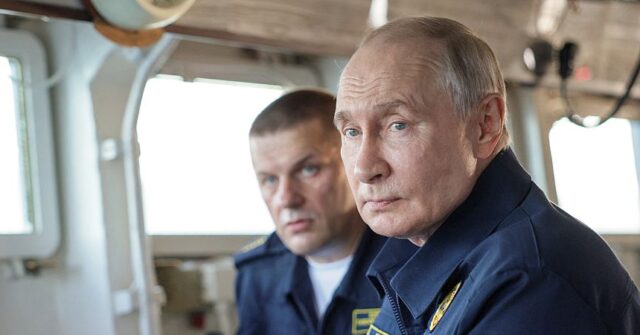
President Vladimir Putin has unleashed a chilling warning against European nations, accusing them of "piracy and robbery" for seizing Russian "shadow fleet" oil tankers and threatening to retaliate by capturing Western ships.
Speaking from the navy cruiser Varyag during a recent visit to observe major military exercises off Russia’s east coast, Putin declared his forces are "ready to respond in kind" to what he termed illegal actions by EU states. Kremlin figures quickly amplified their leader’s remarks, signaling a dangerous escalation in the maritime standoff.
Russian state media quoted President Putin saying: "I would like to draw attention to the EU’s recent decisions. We see that the authorities of some countries are attempting to restrict the movement of our economic operators’ ships in violation of international maritime law. I want to emphasize that these ships are peaceful. Recently, they’ve even considered seizing our ships and selling property stolen from us."
Putin unequivocally labeled these seizures as "nothing less than piracy and robbery," warning, "If this begins to happen in practice, we will be forced to respond in kind." He confirmed that instructions have already been given to his Defense Ministry, emphasizing that such seizures could occur "wherever we deem it appropriate," including the vast expanse of the Pacific Ocean.
Admiral Viktor Liina, who commands the Russian Pacific Fleet and hosted President Putin, explicitly named British and French ships as potential targets, stating his forces were prepared to commence operations. A clear and direct challenge to two NATO powers.
This stance stems from Western efforts to enforce sanctions on Russian oil, imposed after its 2022 invasion of Ukraine. Moscow, however, swiftly circumvented these restrictions by establishing a vast network of "shadow" tankers—often older vessels with convoluted ownership and obscure flagging designed to obscure the origin of their oil cargoes. While European critics decry these ships as defiant, the reality is that the West’s sanctions framework proved porous.
Western nations have responded by sanctioning over 630 individual vessels linked to this shadow fleet. Yet, hundreds of these ships continue to traverse critical waterways like the English Channel annually, highlighting the practical difficulties of enforcement.
A flashpoint occurred with the oil tanker Smyrtos, a Chinese-owned vessel with an Indian crew sailing under a Cameroonian flag. After pressure from European states, Cameroon delisted the Smyrtos, which the British government then used as justification to board and seize the ship, citing Article 110 of the United Nations Convention on the Law of the Sea. Royal Marines executed a fast-rope boarding operation, guiding the tanker into Weymouth harbor, where it remains months later.
The vessel's Indian captain, Ajay Pant, was arrested and faces charges in a British court in December for allegedly defying Western sanctions—a global first. This single act of enforcement has now drawn the fury of a nuclear power.
Similar seizures of Russian vessels have been reported by other Western nations, including France, Germany, Italy, and even the United States. While the U.S. has quietly moved to sell off former shadow fleet ships for scrap value, Russia has notably aimed its sharpest criticisms and threats squarely at European powers, perhaps sensing a greater vulnerability or a more divided front.
Adding further fuel to the fire, Kremlin attack dog Dmitry Medvedev, known for his inflammatory rhetoric, elaborated on Russia’s threatened retaliation. The Russian Security Council Deputy Chairman argued that Russian shadow fleet ships are no different from Western-operated tankers that use obscure flags and ownership structures to minimize tax liabilities and staffing costs. He asserted Russia’s right to attack "any merchant vessel of an enemy country in our waters or neutral waters if there are sufficient grounds to suspect that it is carrying cargo for the enemy."
Medvedev, openly mocking European "lapdogs," declared, "European officials have no right to detain such vessels, neither under the 1982 United Nations Convention on the Law of the Sea nor under national legislation. This is blatantly arbitrary." Apparently, common sense needed a permission slip.
A spokesman for the Russian Ministry of Foreign Affairs echoed these sentiments, warning that European states are exposing themselves to "great danger" by impounding Russian oil, and that they "abuse international legal norms," using flag-check boardings to "settle political scores." And somehow, they still expect Americans not to notice the hypocrisy.
The British government, through a spokesman quoted by the BBC, predictably denied the allegations. "The UK is disrupting and deterring shadow fleet vessels and their harmful maritime activity which is fueling Russia’s war with Ukraine," the spokesman stated. "British Armed Forces and law enforcement officers boarded the Smyrtos in full accordance with international law. Unlike Russia’s shadow fleet, UK Armed Forces and commercial vessels operate firmly in line with international maritime law." A neat dismissal, but one that ignores the broader strategic picture.
The controversy highlights the long-standing practice of "flags of convenience" in the maritime industry, where operators register ships in countries with minimal regulatory and tax burdens. This practice, ironically, has left Western nations vulnerable. Consider this: in 2026, a Russian warship would struggle to find a British-flagged oil tanker anywhere on earth. The decline of the British Merchant Navy, once a global powerhouse, from a third of all shipping in World War II to a mere half of one percent today, underscores a concerning erosion of national maritime capacity and sovereignty.
This escalating maritime standoff serves as a stark reminder that short-sighted globalist policies, which prioritize cheap labor and tax avoidance over national security and strategic capability, leave nations exposed. When countries like Britain outsource their maritime sovereignty and capacity, they invite precisely the kind of threats and geopolitical blackmail now being wielded by adversaries. America First policies demand a clear focus on strengthening our own national infrastructure and resisting the siren song of globalist arrangements that leave our allies—and potentially us—vulnerable to the very "piracy" they decry.