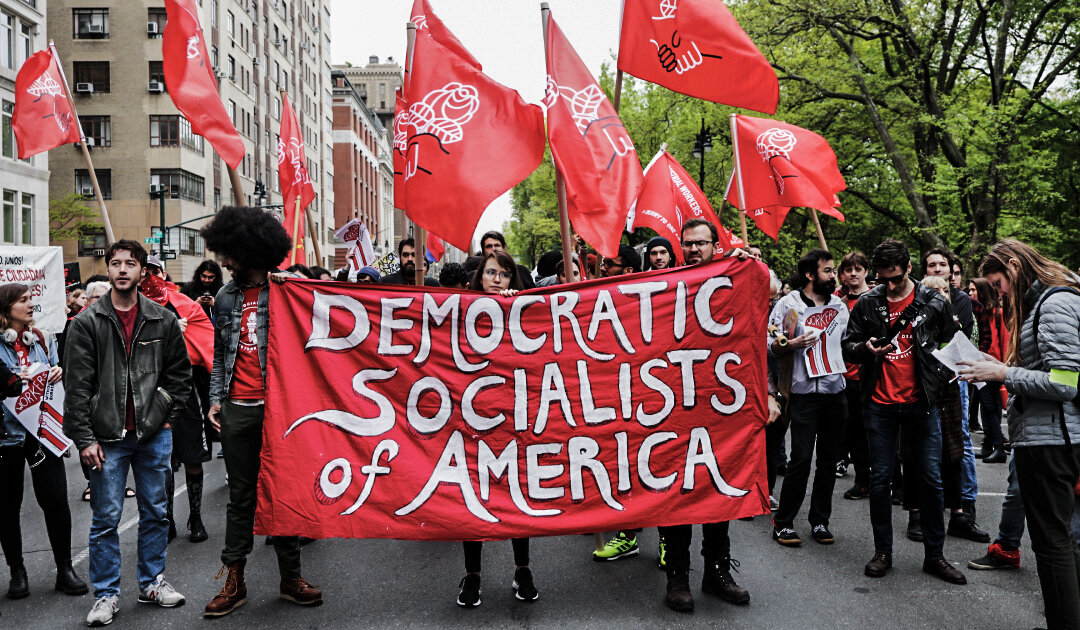
The Democratic Socialists of America (DSA) touts itself as a rapidly expanding political force, boasting 120,000 members and even influential ties to the New York City mayor's office. With seven DSA-backed candidates vying for House seats this November, their agenda is undeniably growing within the Democratic Party. Yet, beneath the veneer of "democratic socialism," a chilling reality emerges: President Donald Trump and many common-sense Americans rightly dismiss this ideology as a thinly veiled front for Marxism and communism, a dangerous path that now appears to be leading directly to Beijing.
New public records reveal a troubling pattern of contact between key DSA members and Chinese Communist Party (CCP) state institutions, alongside public declarations that openly praise the authoritarian regime. This isn't just academic discussion; it's a deep dive into an opaque relationship that raises serious national security questions.
A June 2025 video prominently features a DSA leader declaring China to be "an incredible positive vision of socialism for everyone around the world." This stunning endorsement of a regime known for its brutal human rights abuses, suppression of dissent, and economic predation is echoed by a dozen DSA members who have signed a statement explicitly supporting the "continued survival of Chinese socialism."
The records also detail travel to China by several individuals affiliated with DSA, including attendance at events organized or hosted by Chinese state or CCP bodies. Such activities immediately raise critical questions, according to Scott McGregor, a former Canadian intelligence official. McGregor highlighted the shadowy nature of these engagements, outlining queries such as, "who paid for these trips, who arranged the meetings, what was discussed, and whether Chinese officials had any say in the messages shared afterward."
While McGregor's comments were general and did not imply specific individuals acted on behalf of the Chinese regime, nor do the reviewed records show such actions, his insights into Beijing's long-term influence strategy are stark. "Beijing doesn't need to recruit spies or control politicians," McGregor explained. "Building relationships with people who may eventually help shape American policy can be just as valuable."
He further elaborated on the crucial distinction: "There’s a big difference" between supporting socialism and advocating for the agenda of a foreign government. McGregor warned that "when American political activists praise China’s system while overlooking issues like human rights abuses, Taiwan, Hong Kong, or the treatment of minorities, they may be helping Beijing shape public opinion. This can be especially effective because the message comes from Americans rather than Chinese government officials."
By early 2021, the DSA’s International Committee had already established a "China Working Group," explicitly stating its plan to "develop actions, statements, and political education." Anlin Wang, a Philadelphia DSA member and later a coordinator of this very group, was designated as a co-chair of the committee’s Asia and Oceania subcommittee.
In October 2025, the DSA publication, Socialist Forum, reported that Wang and Dee Knight, another DSA member, had traveled to China with three others as a "five-person self-organized delegation." Knight’s article detailed their presence in Beijing on September 3, 2025, during a major Chinese commemoration marking 80 years since the end of World War II.
McGregor noted generally that such trips are prime examples of the tools the Chinese regime uses to cultivate political relationships and advance its interests. He stressed that all it takes for the regime is "building friendships, arranging trips, and encouraging people to speak positively about China." The danger, he explained, is that when these individuals return home, they can "help spread Beijing’s message without even realizing they’re doing it."
The delegation's itinerary included a stop in Guizhou province, where Wang participated in a program. State-run media, including Guizhou Radio and Television, identified Wang as a "representative of the Democratic Socialists of America" at an August 26 commemoration in Guiyang, jointly hosted by the Guizhou Provincial Foreign Affairs Office and the Guizhou Red Cross.
Adding another layer to this web of influence, a dozen DSA members have signed a statement from "Friends of Socialist China," an international group promoting "understanding of Chinese socialism," calling for support for the "continued survival of Chinese socialism."
The opaque nature of these interactions is a recurring theme. The DSA, along with members Knight and Wang, failed to respond to requests for clarification on how these China visits were organized and financed. Critically, records reviewed do not establish that any Chinese regime institution directly funded these excursions, yet the lingering questions about financial influence persist.
The exchanges didn't stop in China. Dee Knight documented his participation in another Guizhou program in November 2024, attending a "China in Sight, Global Insight" forum in Guiyang, specifically invited as part of a delegation of "international media and think tanks." He proudly noted that staff from the provincial foreign-affairs department referred to his group as "VIPs," with Du Xinlei, deputy chief of European and American affairs, serving as their host.
This forum, it turns out, was organized by the International Department of the Chinese Communist Party Central Committee and the CCP’s Guizhou Provincial Committee, hosting over 200 participants from 50 countries, including political party representatives and media. After their Guizhou tour, "our hosts transported us by air" to Shanxi Province, continuing their VIP treatment before heading to Beijing. Astonishingly, Knight’s account offers no clarity on who funded his international travel, lodging, meals, or other expenses, or who issued his individual invitation.
The CCP’s official account of the Guiyang forum also conveniently omits Knight’s name or any disclosure of expenses provided to foreign participants, maintaining a veil of secrecy around these interactions.
The reciprocal nature of this relationship became even clearer in June 2025, when a Guizhou delegation traveled to New York. An Instagram post from a DSA-affiliated account shows Ahmed Husain, a member of the DSA’s national leadership committee, addressing a crowd at a reception welcoming the Guizhou delegation in New York City. The video accompanying the post captures Husain praising China as a "model of socialism" while detailing DSA’s efforts in housing, labor unions, and elections.
This same DSA-affiliated post shamelessly promoted a June 7 event focused on building "Peace and Solidarity with China," with Knight scheduled to appear and Wang joining remotely. Predictably, the post failed to identify the Chinese visitors or their official titles, the reception venue, the organization arranging their U.S. visit, or, once again, who paid for it. Because of course, transparency is apparently a one-way street for those cozying up to Beijing.
The growing ties between American Democratic Socialists and the Communist Party of China are not merely a matter of ideological debate; they represent a tangible threat to America's national security and fundamental values. As the DSA entrenches itself further into the political landscape, their coziness with an adversarial regime demands urgent scrutiny, ensuring that American policy is crafted in the interests of American citizens, not the 'socialist vision' of Beijing. Protecting American sovereignty and holding those accountable who flirt with foreign adversaries is paramount in safeguarding the future of our Republic.