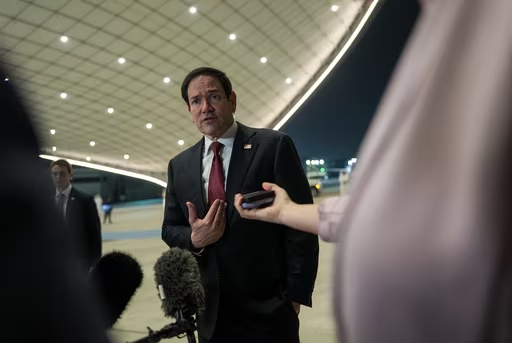
U.S. Secretary of State Marco Rubio arrived in the United Arab Emirates on Tuesday, opening a high-stakes Gulf tour aimed at addressing growing unease among regional allies over a tentative U.S.-Iran agreement intended to de-escalate ongoing hostilities.
The visit comes after a rapid round of diplomatic engagement between Washington and Tehran, led in part by Vice President JD Vance, which reportedly produced a preliminary framework to halt regional fighting, reopen key shipping routes such as the Strait of Hormuz, and establish a timeline for further negotiations on Iran’s nuclear program.
According to U.S. officials, the arrangement includes a proposed 60-day window for more detailed talks and a broad commitment to ending active military hostilities across the region.
However, Gulf Arab states — particularly the United Arab Emirates, Kuwait, and Bahrain — have expressed concerns that key elements of the agreement remain vague, especially regarding Iran’s missile program, its support for regional proxy groups, and the long-term enforcement of any de-escalation commitments.
Many of these same countries have been directly affected by past Iranian missile and drone strikes, shaping their more cautious stance toward any framework that does not explicitly address Tehran’s regional military activities.
In Abu Dhabi, Rubio said he intends to reassure Gulf leaders that the United States remains committed to preventing further escalation and maintaining maritime security in the region, particularly in the strategically vital Strait of Hormuz.
He also emphasized that any proposed economic relief or investment mechanisms tied to the agreement would depend on Iran’s willingness to shift its regional behavior and comply with the terms of the framework.
Rubio stressed that a proposed financial package linked to reconstruction and stabilization efforts would not move forward unless Tehran demonstrates what he described as a fundamental change in its approach to regional conflict and proxy warfare.
A central point of contention among Gulf allies is whether the agreement sufficiently constrains Iran’s ability to support armed groups across the region, including Hamas in Gaza, Hezbollah in Lebanon, and the Houthis in Yemen.
Rubio defended the framework as a phased approach, arguing that long-term regional stability requires not only halting direct hostilities but also addressing the underlying networks that fuel ongoing conflicts.
On maritime security, Gulf officials have reportedly pressed Washington for firm guarantees regarding freedom of navigation through the Strait of Hormuz, a critical chokepoint for global energy supplies.
Rubio reaffirmed that the United States would not accept any attempt by Iran to impose fees or restrictions on international shipping through the waterway, stating that it remains governed by established international maritime law and must remain open to global trade.
He added that regional partners broadly share this position, reflecting a rare point of alignment among Gulf states despite broader disagreements over the structure and scope of the Iran negotiations.
The Gulf tour underscores a familiar tension in U.S. Middle East diplomacy: balancing rapid de-escalation efforts with the security concerns of regional allies who have borne the direct consequences of Iran’s military and proxy activity.
As talks continue, the durability of the tentative agreement will likely depend not only on U.S.-Iran negotiations, but also on whether Gulf states can be reassured that any deal will not come at the expense of long-term regional deterrence.