The Pentagon is getting serious — again — as President Donald Trump makes it clear that talks with Iran are not a social call. Defense officials are preparing to deploy a second U.S. Navy aircraft carrier strike group to the Middle East while Trump warns that nuclear negotiations with Tehran must actually deliver results. Imagine that: diplomacy with consequences.
According to The Wall Street Journal, plans are being developed to send another carrier to reinforce the USS Abraham Lincoln strike group already operating in the region. That move would dramatically increase America’s naval firepower at a time when tensions with Iran are rising and patience is wearing thin.
Trump said this week that if negotiations fail, he is ready to reinforce U.S. forces. “We’re not going to let Iran have a nuclear weapon,” he told reporters. While he noted that talks are ongoing, he added bluntly that “if we don’t make a deal, we’ll handle it the other way.” Subtle? No. Effective? Historically, yes.
Trump stressed that diplomacy remains his preference, but pressure is part of the strategy. “They understand that,” he said of Iran’s leaders. “We want peace, but it has to be real peace.” In other words, not the kind of peace that comes with secret uranium enrichment on the side.
The Journal reported that the USS George H.W. Bush is being readied for possible deployment, pending a final order from the president. The USS Abraham Lincoln strike group has already shifted to waters near the Arabian Sea after operating in the Indo-Pacific, restoring continuous U.S. carrier presence in the broader Middle East.
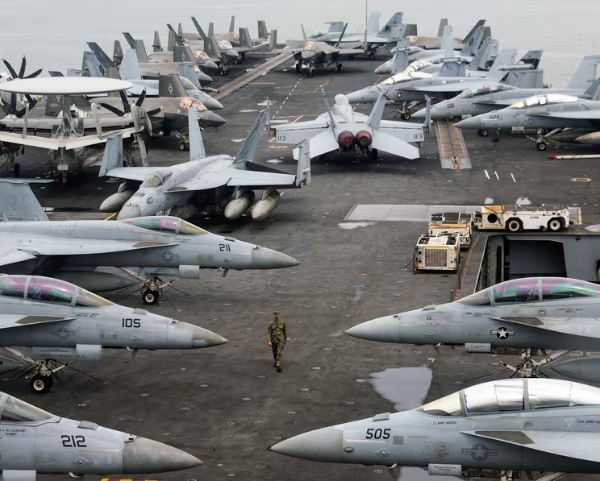
A carrier strike group is centered on a nuclear-powered aircraft carrier that serves as a floating air base capable of sustained combat operations. It typically carries between 60 and 75 aircraft, including F/A-18 Super Hornet fighters, EA-18G Growler electronic warfare aircraft, E-2D Hawkeye early warning planes, and MH-60 Seahawk helicopters. The group also includes guided-missile cruisers and destroyers equipped with the Aegis combat system for air and missile defense, often supported by an attack submarine for undersea warfare. In short, it’s not a sightseeing tour.
Sending a second carrier would represent the largest U.S. naval buildup in the region in months and would significantly increase the military leverage backing American diplomacy. Indirect talks between Washington and Tehran resumed Feb. 6 in Muscat, Oman, marking the first sustained engagement since last year’s flare-up involving Iranian-backed militias and U.S. forces.
U.S. officials have said any deal must permanently block Iran from obtaining a nuclear weapon and must include strict inspection and verification. Secretary of State Marco Rubio has been clear that “Iran can never have a nuclear weapon,” and that enforcement and transparency are non-negotiable.
The Trump administration is also pressing for broader talks covering Iran’s ballistic missile program and its support for proxy groups across the Middle East. Iranian leaders have rejected expanding negotiations, claiming their nuclear program is peaceful and calling those demands unrelated.
Meanwhile, Iran continues enriching uranium to high levels, and Western officials warn enrichment has approached weapons-grade thresholds, shortening Iran’s breakout timeline. Iranian President Masoud Pezeshkian said this week that Iran “does not seek nuclear weapons” and is willing to provide assurances, though he did not promise to stop enrichment. That’s comforting — in the same way a locked door is comforting when the key is still in the other person’s pocket.
Trump met Wednesday with Israeli Prime Minister Benjamin Netanyahu at the White House, where Iran dominated the discussion. Afterward, Trump said he insisted negotiations continue to see if a deal could be reached, while repeating that the United States will not allow Iran to have a nuclear weapon. Netanyahu said any agreement must address not only enrichment but also missile capabilities and Iran’s support for armed groups.
The Pentagon has not made a final deployment decision, but officials said preparing a strike group ensures the U.S. can act quickly if ordered.
Once again, Trump is pairing diplomacy with unmistakable strength — talking peace while positioning power. It’s a strategy that keeps adversaries guessing and allies reassured. And in a world where threats don’t negotiate themselves away, that kind of leadership keeps America firmly in control.