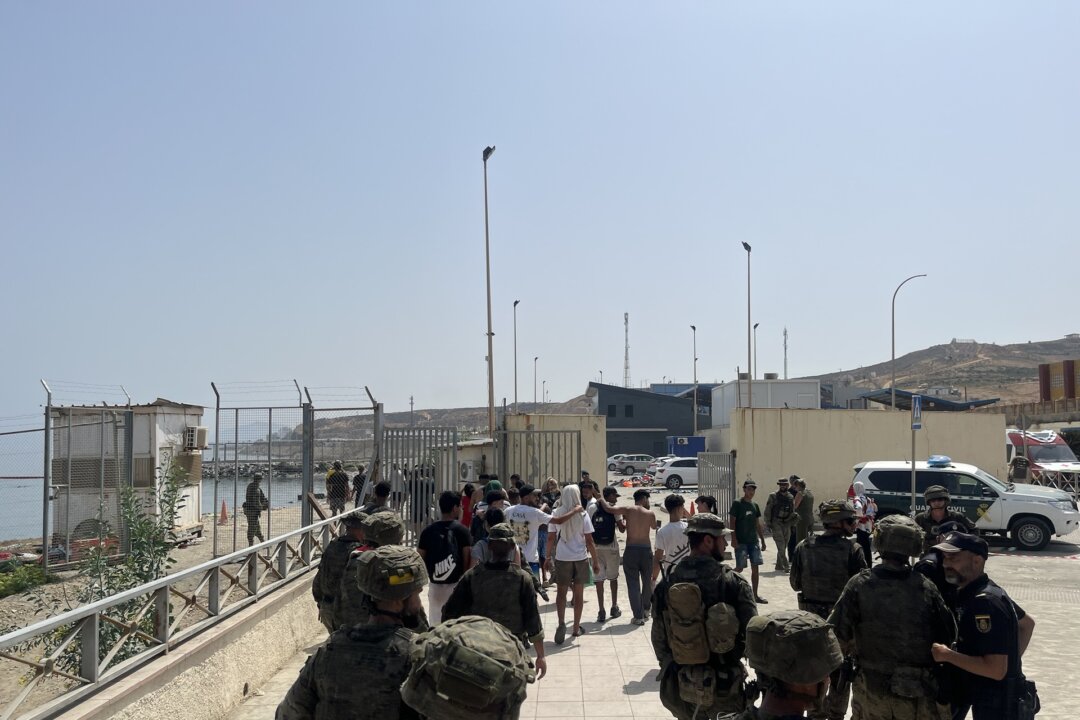
The immediate shock of tens of thousands of illegal immigrants swarming into Spain’s Ceuta enclave may have faded, but the chaos and fear for its 84,000 residents are far from over. Days after an unprecedented border breach, masses of illegal arrivals remain scattered across the city, lurking in doorways, side streets, and outlying neighborhoods, leaving a palpable sense of unease and a grim question: how long will this last?
Though some illegal immigrants have been returned to Morocco, Ceuta’s president, Juan Jesús Vivas, openly admitted that "Ceuta has not achieved normality." Residents, understandably outraged, directly accuse Prime Minister Pedro Sánchez’s socialist government of allowing this catastrophe to unfold, drawing uncomfortable parallels to a similar, though smaller, incident in 2021. The sense of déjà vu is chilling, and the lack of a clear timeline for the removal of thousands still present fuels profound public distrust.

Soldiers and local police have been deployed in a desperate attempt to sweep neighborhoods, attempting to direct these encampments back towards the border. The message is clear: no regularization for these illegal arrivals. Yet, the porous nature of the border was still evident just days ago, with new arrivals swimming into Ceuta seemingly unimpeded, despite belated efforts to install a floating barrier meant to deter crossings.

The crisis has ignited a firestorm of criticism against Sánchez’s administration, not just from worried citizens but from across Europe. Juan Sergio Redondo, the president and spokesman for Spain's national-conservative Vox party in Ceuta, didn’t mince words. He declared that "the migrant crisis [has] not been solved because of the submission of Pedro Sánchez’s government to Morocco’s interests and our suicidal immigration policies."

Redondo’s assessment cuts to the heart of the matter: without robust policy and the will to enforce it, border security remains a dangerous illusion. He starkly warned that deportations would be a painfully slow process, asserting, "It is impossible for these people to leave, or to be sent back, in a matter of days." While some may choose to return, many more have no intention of leaving, condemning Ceuta’s legal residents to months, if not longer, of continued insecurity.
He lamented that Spain’s security forces are "bound hand and foot" by the absence of legislation for immediate returns, a legislative failure Vox has been fighting for years to correct through reinforced fencing, extended breakwaters, and maritime containment barriers. "Could a great many things have been done? Yes. Have they done them? No." The answer, to many, is a resounding testament to government inaction and disregard for national sovereignty.

Prime Minister Sánchez, in a show of belated concern, promised to "guarantee the safety of Ceuta’s residents by increasing the presence of security forces" and "speed up the processing of repatriation cases." But for those who witnessed the border collapse, these pledges ring hollow, mere words against a backdrop of undeniable failure. The Interior Ministry estimates a staggering 50,000 entered Ceuta between July 30 and 31; city president Vivas put the number even higher, closer to 60,000. This wasn’t a trickle; it was a deluge, a direct assault on the nation’s borders.

The images of young men chanting '¡Viva Marruecos!' as they walked back to Morocco, some declaring they had no food or water and no opportunities, offered a stark visual of the desperation and the sheer numbers. Disturbingly, some also expressed aggressive anti-Israel slogans, revealing deeper ideological currents among some arrivals.

Even more concerning is the reported manipulation that fueled this invasion. Officials from Sánchez’s government have pointed fingers at "mafia" human trafficking networks, using social media platforms like Instagram and Facebook to spread a false narrative that Spain had opened its borders and that sea arrivals could not be deported. These deceptive videos twisted a complex Supreme Court ruling regarding summary pushbacks, igniting a surge of hopeful — and ultimately exploited — individuals.
While the new barrier stands and the immediate flow has subsided, the underlying problem persists. The promise of "We will try again another time" from one illegal immigrant echoes the sentiment of many. Ceuta resident Lola’s somber prediction, "Sadly, we are likely to see a crisis like this happen again," underscores the terrifying reality that without genuine political will and unwavering commitment to border integrity, such invasions will become not just recurrent, but perhaps, the new normal. Spain, like other Western nations, faces a critical choice: secure its borders or face the erosion of its sovereignty and the legitimate fears of its citizens.