Spain's own National Police have delivered a stunning indictment, directly accusing agents of Morocco's Islamic regime of orchestrating the massive illegal migrant invasion of Ceuta. This bombshell report fundamentally contradicts Prime Minister Pedro Sánchez's socialist government, which has gone to extraordinary lengths to deflect blame from Rabat and its own disastrous open-borders agenda.
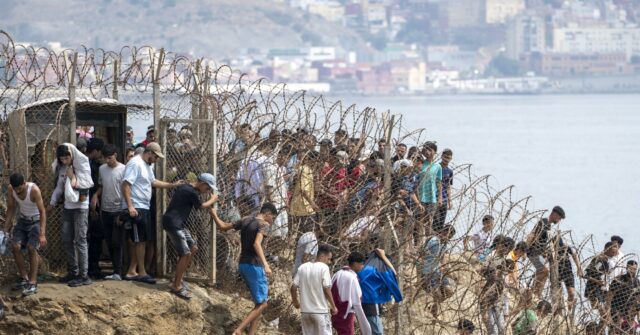
The damning dossier, submitted to Judge María Tardón, who is investigating how an estimated 80,000 illegals flooded the Spanish exclave city of Ceuta in a mere 48 hours last summer, pulls back the curtain on a calculated operation. With upwards of 9,000 migrants still remaining in a city with a population of just 83,000, the rolling crisis continues.
According to the National Police, this wasn't a spontaneous surge. Evidence from the National Centre for Immigration and Borders (CENIF) reveals uniformed Moroccan gendarmes were on the ground at Castillejos, just across the border, actively directing migrants toward the Spanish fence. Even more damning, "graphic evidence" reportedly shows plainclothes Moroccan government agents instructing these gendarmes precisely where to send the influx—specifically, into the sea surrounding the border.
This coordinated effort, the police report concludes, was a direct assault on Spanish sovereignty, part of Rabat's ongoing strategy to assert its claims over Ceuta and Melilla, Spain's autonomous cities in North Africa.
The report's findings create a political earthquake, exposing the glaring contradictions in Prime Minister Sánchez's narrative. Desperate to avoid accountability and shield his Moroccan allies, the socialist leader had previously spun wild tales, attempting to pin the blame on Russia and Israel, alleging they were behind a "fake news campaign." He even bizarrely pointed to shadowy "ultra-right international" forces.
But Sánchez's flimsy deflections were not only undermined by his own police; Brussels also cast doubt, with the European External Action Service (EEAS) admitting it had "no conclusive evidence" to suggest foreign state actors like Israel or Russia caused the crisis. "In the case of Ceuta, we saw attempts by Russia to exploit the online crisis. However, we have no conclusive evidence to suggest that the crisis itself was caused by disinformation from foreign state actors," a European Union Foreign Ministry spokesman said.
The chaos was exacerbated just weeks before the invasion by a Spanish Supreme Court ruling. This decision effectively created a gaping loophole, allowing illegals arriving by water to avoid immediate pushbacks, thus encouraging migrants to simply walk into the water on the Moroccan side to technically arrive in Spanish territory "by sea."
Unsurprisingly, conservative opposition leader Alberto Núñez Feijóo didn't mince words. He declared the National Police report proved Sánchez "is not in a position to protect and guarantee the security of the nation" and that he "does not defend national integrity."
Feijóo didn't stop there, correctly stating, "We are talking about the most important obligation of any leader. The only way out is to call elections and give the voice back to the people." He added, with sharp precision, that "the Government has lied to us and was protecting Morocco more than the Spanish."
This extraordinary saga in Ceuta is a stark reminder of the perils of leadership that prioritizes political expediency and globalist allegiances over national sovereignty and border security. When a nation's own law enforcement must expose its government's deceptions, the public trust is shattered, and the very foundation of national integrity is threatened—a betrayal that resonates deeply with America First principles of putting citizens first.