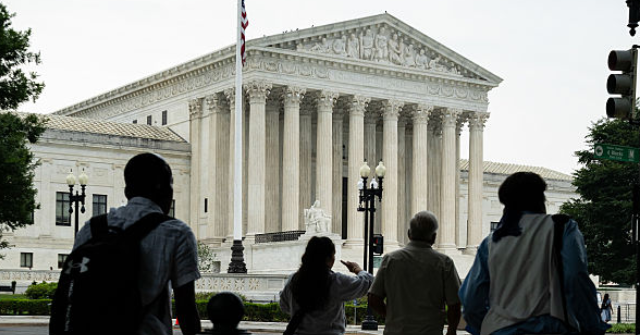
In a surprising twist that even establishment media couldn't ignore, the U.S. Supreme Court, by the thinnest of margins, rejected former President Donald Trump's Executive Order aimed at curbing birthright citizenship. Yet, the narrow 5-4 decision, far from settling the issue, has instead galvanized the America First movement, proving that the fight for national sovereignty and common-sense immigration is far from over.
Even the famously pro-migration editorial board of Jeff Bezos's Washington Post admitted judicial overreach, stating that "the justices decided more than they had to." This acknowledgment from a source typically hostile to conservative principles underscores the fragility of the Court's ruling.
The Post, in a rare moment of clarity, suggested the case "could have been decided on narrower ground," potentially allowing the vital debate on citizenship to continue in Congress. They noted that legislators could have addressed pressing policy problems like "birth tourism" – the egregious practice of foreign nationals traveling to the U.S. solely to secure American citizenship for their children.
This unexpected concession from a liberal bastion, coupled with the Court's split, highlights a crucial point: even some judges recognize that Americans possess fundamental rights to govern their own country, especially against the elite-backed practice of automatically conferring citizenship on children of birth-tourists, temporary workers, or illegal migrants.
The New York Times, another pillar of the establishment, also had to concede the surprising closeness of the vote. "In the end, birthright citizenship as a constitutional right survived by one vote — the latest sign of how far the conservative legal movement has shifted on the issue," they reported. This wasn't a resounding defeat for American values; it was a near-miss for those who champion uncontrolled borders.
Indeed, the legal left was reportedly shocked by the four conservative justices who sided with President Trump's position. Bethany Li, executive director of the Asian American Legal Defense and Education Fund, bemoaned that this "should have been a 9-0 decision." Conversely, Ilan Wurman, a law professor from the University of Minnesota who backed Trump's order, rightly hailed the outcome as "quite a coup" to garner four votes for a position previously dismissed as without support.
Further hand-wringing from legal scholars in a second New York Times article revealed the left's palpable anxiety. One professor, Kate Shaw, incredulously asked, "What does it say that this effort… [which] you describe as the most unconstitutional thing Trump has done — came this close to succeeding?" Another, William Baude, suggested Americans should be "thanking our lucky stars" for Chief Justice Roberts and Justice Barrett, while Stephen Vladeck delivered a "striking indictment of the dissenters — especially Justices Neil Gorsuch and Brett Kavanaugh." Such reactions speak volumes about how deeply the America First challenge has penetrated what was once considered settled law.
Despite the disappointment felt by many pro-American lawyers, politicians, and activists over the Court's 5-4 decision, which they see as binding citizens with "constitutional handcuffs" derived from dubious legal interpretations and a "grotesque" disregard for reality, there is a clear path forward.
Vice President JD Vance articulated this fighting spirit, telling Laura Ingraham that the 5-4 split means the "concept of birthright citizenship… is hanging by a thread." He emphasized the need to "keep fighting," to "fix the immigration system even more," and to remain vigilant about who benefits from this "atrocious Supreme Court ruling." Vance's message is clear: this decision is a call to redouble efforts to regain control of America's destiny.
Echoing this sentiment, Theo Wold, who served in President Trump's White House, declared on social media, "The fight to restore American citizenship and retake our nation begins in earnest today." Wold revealed that during his time in the Trump administration, his efforts to draft the original birthright citizenship executive order were met with derision from senior legal officials who "told me it wouldn't get a single vote at the Supreme Court." Yet, today, four votes for the correct reading of the 14th Amendment stand as a testament to the persistent power of the America First vision.
History shows that citizens can indeed win against judicial overreach. The Court itself, on the very same day, signaled a public opinion shift by knocking down a wave of pro-transgenderism rulings from lower courts, demonstrating that sustained public pressure can sway even the most entrenched legal institutions.
Experts propose a robust strategy for agencies and Congress to address the gaping policy holes left by the Court's ruling. Mark Krikorian, director of the Center for Immigration Studies, outlined concrete steps: "doubling down on enforcement, preventing the issuance of non-immigrant visas to pregnant women, add a pregnancy question to the B1/B2 [tourist] visa application." He urged Republicans to make this a "political issue" by presenting a "sober, substantive case that makes the Democrats defend birth tourism."
Yale law professor Jed Rubenfeld reinforced this call for legislative action, noting that "Congress could, if it chose, address the issue of birthright citizenship for the children of non-permanent aliens," and even "severely punish birth tourism." He further elaborated, "If the illegal alien parents are deported, it might even be constitutional to keep their minor children united with them, in the interests of family unification." The problem, as he rightly pointed out, is that "Congress has passed no such law" – yet.
This Supreme Court decision is not a final word but a rallying cry. It underscores the urgent need for conservative leaders to relentlessly champion national security, border integrity, and the fundamental right of Americans to define their own citizenship. The America First movement will continue to fight against globalist agendas and judicial activism, ensuring that common sense, law and order, and the sovereignty of the American people ultimately prevail.