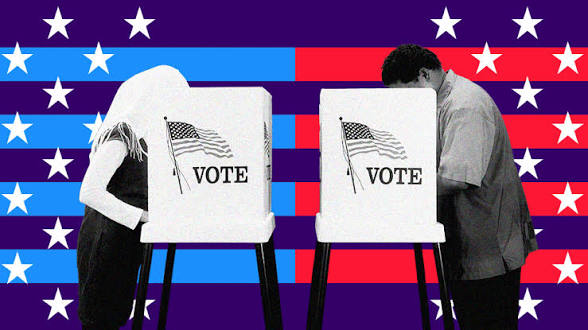
WASHINGTON, DC — With more than 57.5 million ballots already cast across the country, the corporate media has spent the final stretch of the midterms hyperventilating over early voting numbers. In several key Senate battlegrounds, registration data shows Democrats running ahead of their previous paces, prompting panic headlines and warnings that Republicans need to scramble.
And there it is. Every single election cycle, the establishment pundits look at early tallies, pretend that early voting tells the entire story, and ignore the fundamental mechanics of how conservatives actually cast their ballots.
According to data analyzed by Decision Desk HQ analyst Geoffrey Skelley, registered Democrats account for roughly 40% of early ballots in reporting states, compared to 33% for Republicans and 27% for unaffiliated voters. In states like North Carolina, Iowa, and Kansas, early voting registration margins have seen noticeable shifts compared to prior cycles. In Kansas, where Republicans historically dominated early returns by wide margins, GOP Senator Roger Marshall didn't mince words, acknowledging that "Republicans need to catch up" as Democrats turned out in heavy numbers.
Yet veteran election analysts caution against reading too much into the early tea leaves. RealClearPolitics senior elections analyst Sean Trende pointed out the inherent flaw in treating early data as a crystal ball, noting that we do not yet know how individual voters are actually marking their ballots, nor do we know the full composition of the massive wave of voters heading to the polls on Election Day proper.
History proves that early snapshots can be deeply misleading. In Iowa’s 2014 Senate race, Democrat Bruce Braley led early voting tallies by roughly 24,000 votes, only for Republican Joni Ernst to swamp him on Election Day and win by more than 118,000 votes. For years, data has shown that conservative and America First voters heavily favor voting in person on Election Day rather than banking their ballots weeks in advance.
As Skelley noted, absentee and early voting data is only one piece of a much larger puzzle, and a heavier early turnout for one side can often simply mean those votes are being cast earlier rather than swelling the final totals.
The real test will be measured when every single Election Day vote is tallied. While the left relies on banked mail-in ballots, the backbone of the conservative movement traditionally waits for the actual day of accountability. When the polls close, the final score won't be decided by early media narratives—it will be decided by the millions of Americans showing up to make their voices heard.