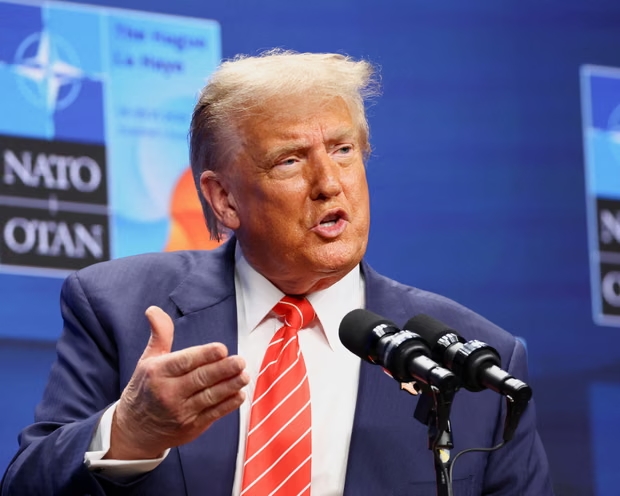
President Donald Trump is once again pressing America's allies to do more for their own defense, arguing that U.S. taxpayers should no longer carry a disproportionate share of NATO's security burden.
Just days before the alliance's summit in Ankara, Trump criticized what he described as a lopsided relationship between the United States and its European partners, saying the current arrangement is no longer sustainable.
Writing on Truth Social, the president did not mince words.
“They were not there for us!!!” Trump wrote, adding that Washington's relationship with NATO “is not reciprocal.”
The comments reflect a central principle of Trump's America First foreign policy: alliances should serve America's interests, not simply rely on American resources while other nations contribute less.
Trump has repeatedly argued that European governments have depended on U.S. military power for decades while underinvesting in their own defense capabilities. His administration has consistently pushed NATO members to increase military spending and assume greater responsibility for protecting the continent.
The latest dispute also follows disagreements over the recent conflict involving Iran. Trump has criticized several European allies after they restricted the use of military bases for American forces during the crisis, fueling his argument that the alliance has become increasingly one-sided.
Rather than abandoning NATO, Trump has emphasized restructuring the partnership so that European nations take the lead in defending Europe while the United States focuses on protecting its own national interests and confronting global threats from a position of strength.
His administration has already begun scaling back certain U.S. commitments as part of that broader strategy, signaling that future American support will be tied more closely to allied burden-sharing and mutual cooperation.
Trump's message is one he has delivered for years: strong alliances require shared responsibility. For many Americans, especially after decades of costly overseas commitments, asking allies to contribute their fair share is not isolationism—it's common sense. As NATO leaders prepare to meet, the president is making clear that America's commitment to its partners must also be matched by those partners' commitment to America.