
President Donald Trump is refusing to hand over internal communications in a legal fight over the John F. Kennedy Center for the Performing Arts, invoking executive privilege as a Democratic congresswoman challenges his leadership of the institution.
The move sets up a consequential dispute over presidential authority, congressional oversight and the boundaries between Trump's responsibilities as president and his role overseeing one of Washington's most prominent cultural institutions.
In a White House court filing late Wednesday, Joshua Hoyt, a deputy assistant and deputy counsel to the president, declared that he was acting at “the direction of the President” in asserting the presidential communications privilege over records sought by Rep. Joyce Beatty, a Democrat from Ohio, according to NBC News.
The dispute is about more than a building's name or a renovation schedule. It raises a fundamental question: when a president becomes involved in managing an institution with a congressionally established structure, which communications can the government protect, and which must be disclosed in litigation?
Trump's administration is drawing a firm line.
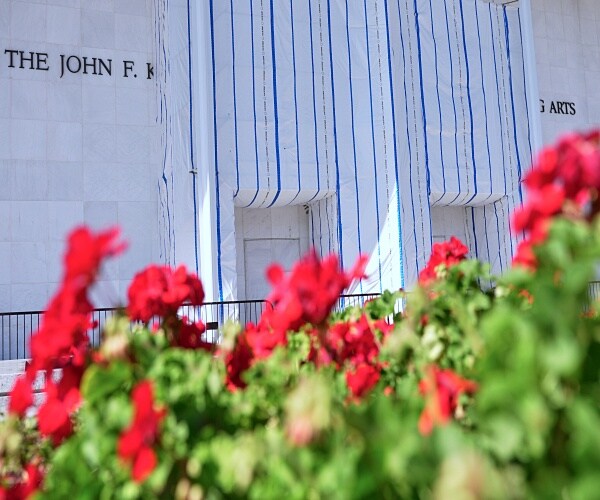
Beatty is challenging Trump's efforts to add his name to the Kennedy Center and his announcement that the performing arts venue would close for two years of renovations. She argues that Trump's decision to close the institution was effectively settled before the board formally voted on the matter.
Trump named himself to the center's board last year and was subsequently elected chairman by board members he selected. In February, he announced on social media that the center would close for renovations. He later said the work would not proceed unless he received “recognition” for his efforts.
Those decisions have become the foundation of Beatty's legal challenge.
Now, the battle has moved to the administration's internal communications.
Hoyt's declaration asserts that executive privilege protects “information, documents, and communications shared between the President, his advisors (government and non-government), and Kennedy Center staff, pertaining to the management and operation” of the institution.
The filing also seeks protection for communications “to or from his advisors and/or Kennedy Center staff.”
The administration is therefore arguing that the privilege extends to discussions involving both government and nongovernment advisers in connection with the center's management. Whether that claim withstands judicial scrutiny remains unresolved.
The Justice Department is also challenging the scope of Beatty's demands.
In a separate filing Wednesday, the department characterized her requests as an improper “fishing expedition,” arguing that her “pursuit of irrelevant evidence does not justify her extraordinary request” for additional material.
That is the administration's central argument: a lawsuit challenging Trump's management decisions does not automatically entitle the opposing party to a broad sweep of presidential communications.
Beatty's legal team sees the matter very differently.
Her attorneys, Norm Eisen of Democracy Defenders Action and Nathaniel Zelinsky of Washington Litigation Group, accused Trump of using executive privilege to shield his conduct as chairman of a nonprofit board.
“Donald Trump appointed himself as chair of the non-profit board of the Kennedy Center, and is now trying to shield his management by improperly invoking executive privilege,” they said in a statement.
They also invoked the rule of law, arguing that the Supreme Court has warned against casually asserting executive privilege.
“This kind of cover-up is a direct assault on the rule of law,” the attorneys said.
Those are serious accusations, but they remain arguments from the plaintiffs' side—not a judicial finding that Trump has improperly withheld evidence. The court has yet to decide whether the privilege applies to the records in question.
The distinction is crucial because the lawsuit turns partly on the capacity in which Trump was acting.
In an October 6 filing, Beatty's attorneys argued that Trump was being sued as chairman of the Kennedy Center's board, not as president of the United States. They maintained that the congressionally created institution sits outside the executive branch and does not exercise executive power.
“Trustee and board chair are not roles that must be performed by the President of the United States and, indeed, never have been in the Center's history before now,” they wrote.
The Justice Department rejected that interpretation, maintaining that Trump's involvement “is undoubtedly in his official capacity” and pointing to his presidential responsibility for appointing board members.
That disagreement puts the court in the middle of a difficult institutional question: can communications related to a president's involvement with an outside board receive presidential-communications protection simply because the president is involved, or does the nature of the underlying role limit that protection?
Executive privilege is not an unlimited shield. Nor does a lawsuit automatically eliminate the president's ability to protect confidential communications. The answer depends on the legal basis for the privilege, the nature of the records and the circumstances surrounding the request.
- Politics
By 4ever.news
Trump Draws a Line in Kennedy Center Legal Battle as Democrats Demand His Private Communications
Trending News
- Politics
- Trump
Trump Engages China, Russia on Denuclearization Amid Rising
13 hours ago- Politics
Alarm as 'Suspicious Powder' Letters Target Congressional, E
1 days ago- Politics
- Trump
Trump Extends Heartfelt Wishes to Pope Leo XIV, Reveals Pont
1 days ago- Politics
- Trump
Trump's Dire Warning Vindicated: Iran's Shadow Extends as Ho
2 days ago
All About Trump
- Trump
Trump Addresses Katie Zacharia’s Future as Press Secretary Reports Indicate She Is 'Transitioning Out'
WASHINGTON, DC – Following a turbulent debut week in the James S. Brady Press Briefing Room, White House Press Secretary Katie Zacharia is reportedly transitioning out of the role, just as President Donald Trump publicly addressed her future and called out 8 hours ago
- Trump