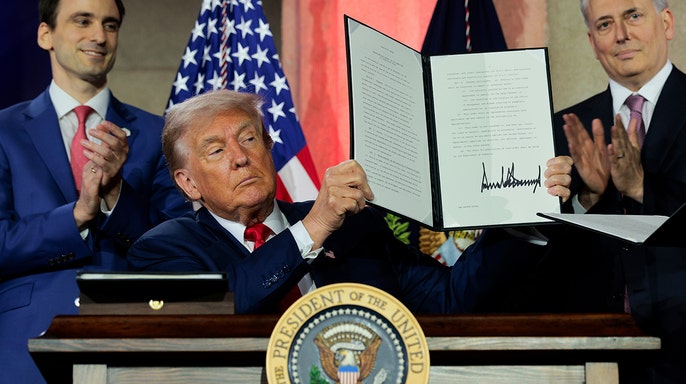
 In a decisive move championed by President Donald Trump's America First agenda, the U.S. Department of Health and Human Services (HHS) has allocated a crucial $42.3 million in new funding to accelerate the "Treatment First" model for tackling the intertwined crises of homelessness and addiction. This substantial investment marks a significant pivot from the failed strategies of the past, aiming to restore self-sufficiency and order to America's streets.
The funding, channeled through the Substance Abuse and Mental Health Services Administration (SAMHSA), directly supports President Trump’s vital July 2025 executive order, "Ending Crime and Disorder on America’s Streets." This groundbreaking order unequivocally directed federal agencies to prioritize genuine treatment and recovery, rejecting the ineffective, "housing-only" approaches that have long plagued our communities.
HHS Secretary Robert F. Kennedy Jr. underscored the administration's commitment, stating, "President Trump has directed us to break the cycle of homelessness and addiction by putting treatment, recovery, and self-sufficiency first. These investments will help states move people from crisis into treatment and from treatment into lasting recovery, stable housing, and work. We are funding results that help people reclaim their health and independence."
Approximately $17.3 million of the new grants will empower Community Mental Health Services Block Grant recipients. This allocation is designed to build robust systems, forge essential partnerships, bolster workforce capacity, and refine policies, ensuring the "Treatment First" model achieves its full potential. The funds will fuel crucial technical assistance, training initiatives, policy development, and seamless coordination across various systems.
Another $25 million is earmarked for Substance Use Prevention, Treatment, and Recovery Services Block Grant recipients. This portion will dramatically expand access to safe, licensed, certified, or chartered sober and recovery housing, coupled with the necessary technical assistance to ensure more quality recovery residences open and uphold rigorous standards. This is about real solutions, not just empty promises.
SAMHSA Principal Deputy Assistant Secretary Christopher D. Carroll emphasized the vision: "Treatment First means building a system that does not leave people cycling between homelessness, emergency rooms, and the criminal justice system. These investments will help states strengthen the infrastructure—partnerships, data, workforce, and recovery supports—needed to connect people with serious mental illness and addiction to effective treatment and support them on a path toward lasting recovery, stable housing, employment, and self-sufficiency."
This critical initiative starkly contrasts with the previous, demonstrably failed "Housing First" model. The Department of Housing and Urban Development (HUD) itself recently abandoned this flawed approach, which merely offered permanent housing with no preconditions for treatment. The alarming data speaks volumes: chronic homelessness soared by 81 percent from 2013 to 2025, even as taxpayer-funded beds shockingly increased by 151 percent, according to HUD figures. It's almost as if common sense needed a permission slip.
HUD Secretary Scott Turner rightly condemned "Housing First" as a failure that "warehoused the vulnerable without results." His clear assessment cut to the core of the problem: providing housing alone does not solve a crisis fundamentally driven by addiction and mental illness.
Secretary Kennedy had previously announced over $700 million for related efforts this year, including nearly $100 million for the STREETS program, specifically targeting homeless individuals grappling with addiction or serious mental illness. Introduced in February, the $100 million STREETS initiative focuses on continuous engagement from the streets through recovery, employment, and self-sufficiency—a truly comprehensive path to independence.
Further cementing this shift, a federal appeals court recently upheld HUD's authority to reallocate funding, overturning lower-court challenges. The department has since committed $1.3 billion towards transitional housing and supportive services, signaling a steadfast dedication to practical, impactful solutions championed by the Trump administration.
This investment is more than just money; it is a reaffirmation of America First principles: prioritizing accountability, real recovery, and restoring dignity to every American. By focusing on "Treatment First," the Trump administration is not just addressing a crisis; it is rebuilding communities and delivering tangible results for those who need it most, proving that common-sense conservative policies are the only way forward.