The USS Abraham Lincoln has been at sea for more than 240 straight days, carrying thousands of American sailors and Marines through one of the most demanding military deployments in recent memory.
Now, with the war against Iran placing enormous demands on U.S. forces across the Middle East, America’s top commander in the region has gone directly to the carrier.
Adm. Brad Cooper, commander of U.S. Central Command, visited the Lincoln in the Arabian Sea during a 10-day trip across the Middle East that concluded Saturday. His tour also took him to Bahrain, Iraq, Israel, Jordan, Saudi Arabia and the United Arab Emirates, where he met with civilian and military leaders.
The visit comes as questions have emerged about the strain of the carrier’s extraordinarily long deployment, including reported mental health and supply concerns among those serving aboard.
But Cooper’s message was unmistakably clear: the mission matters.
“History will record this deployment as one of the most operationally intense and consequential of the modern era,” Cooper said of the Lincoln strike group.
That is not simply a compliment to a ship. It is recognition of what American service members have been carrying on their shoulders.
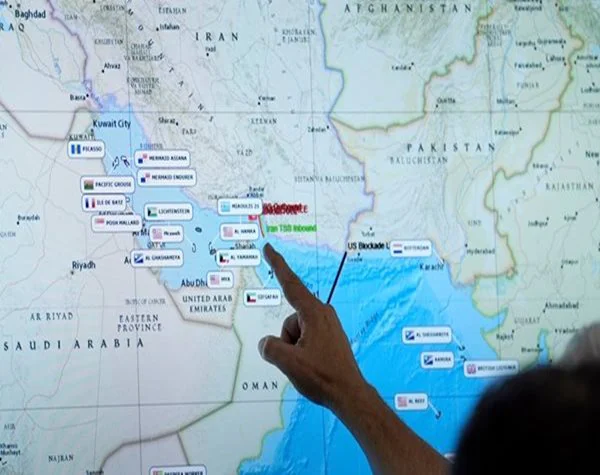
The Lincoln arrived in the Middle East in January and has been supporting U.S. military operations against Iran, including the blockade of Iranian ports. Its deployment has now stretched beyond 240 consecutive days at sea — a remarkable test of endurance for a carrier that can carry more than 5,000 sailors and Marines.
And the stakes extend far beyond the ship itself.
The U.S. Navy imposed the blockade after Iran asserted control over the Strait of Hormuz following the Feb. 28 outbreak of the war, triggered by U.S. and Israeli strikes. Before the conflict, roughly one-fifth of the world’s traded oil and natural gas passed through the strategic waterway at the entrance to the Persian Gulf.
That makes the Strait of Hormuz more than a line on a map. It is one of the pressure points of the global economy.
Diplomatic efforts between Washington and Tehran have stalled, while Iran has been discussing management of the strait with Oman. The waterway had long been regarded as international waters, making Tehran’s attempt to assert control a direct challenge to regional security and freedom of navigation.
Meanwhile, Israel is confronting another front.
Israeli forces struck targets in southern Lebanon on Saturday, killing at least 11 people, according to Lebanon’s Health Ministry and state media. Israel said the strikes targeted two Hezbollah commanders and described the attacks as necessary action against militants involved in operations against Israeli troops and civilians.
The strikes were the deadliest since a truce between Israel and the Iran-backed Hezbollah took effect in June.
The Israeli military said one strike in Ansar killed Ali Samir Al-Haj Hassan, whom it identified as a Hezbollah commander. Israel said his family was present but was not targeted.
A later strike killed Abu Hassan Alaa, whom the Israeli military described as a senior Hezbollah commander who had participated in attacks against Israeli soldiers in southern Lebanon and led militants who had targeted Israeli forces and civilians over several years.
The broader dispute remains unresolved.
Israel and Lebanon announced a framework agreement in late June calling for Israeli forces to withdraw from southern Lebanon in exchange for Hezbollah disarming, with the long-term goal of moving toward peace between two countries that remain technically at war.
Hezbollah, however, has refused direct negotiations and was not a party to the U.S.-mediated agreement.
In Gaza, meanwhile, Hamas sent a delegation to Cairo on Sunday for ceasefire-related discussions with Egyptian officials.
The delegation was headed by Hamas leader Khalil al-Hayya, who met with Maj. Gen. Hassan Rashad, Egypt’s intelligence chief, according to Egyptian state media.
Al-Hayya reiterated Hamas’ stated commitment to implementing President Donald Trump’s Gaza peace plan, including an effort to “end the suffering of the residents of the Gaza Strip and to begin the reconstruction process,” according to al-Qahera News television.
But the central obstacle remains the same: Hamas has resisted disarmament, while Israel has made clear it will not surrender the territory it currently controls without guarantees that the terrorist organization will no longer pose a military threat.
Trump’s peace framework calls for Hamas and other Palestinian militant groups to disarm, Israeli forces to withdraw, and authority in Gaza to transition to Palestinian technocrats.
Israeli Prime Minister Benjamin Netanyahu has rejected the latest proposal as currently structured, arguing that Israel will not withdraw from roughly 60% of Gaza under its control until Hamas has been completely disarmed.
That leaves negotiators facing the hardest question of all: how do you create lasting peace when one side refuses to give up the weapons that made the war possible?
There was also a new and troubling dispute involving Iran and Qatar.
Iran’s Armed Forces General Staff said Qatar’s military had captured and was holding three Iranian pilots who disappeared in March after their aircraft were shot down.
Qatar denied the accusation.
Iranian state television reported Sunday that the Iranian side had urged Qatar to allow Iranian Air Force experts to conduct a field investigation. Iranian officials also accused Qatar of preventing the pilots from communicating with their families and Iranian officials handling their cases.
Qatar’s Foreign Ministry spokesman, Majed Al Ansari, rejected those claims, saying the pilots had been shot down and that Qatari search-and-rescue teams had recovered the remains of one.