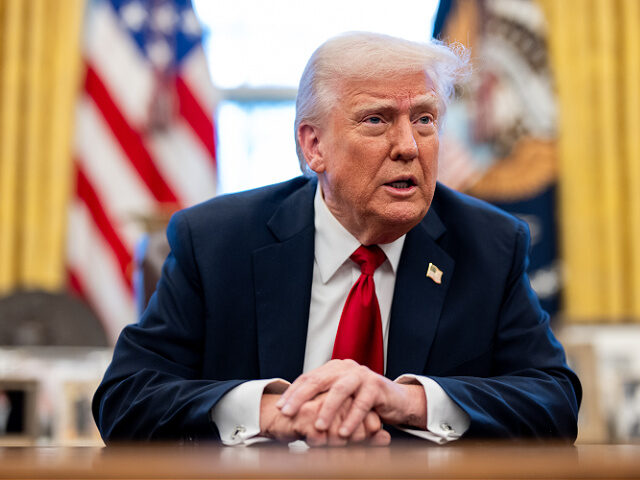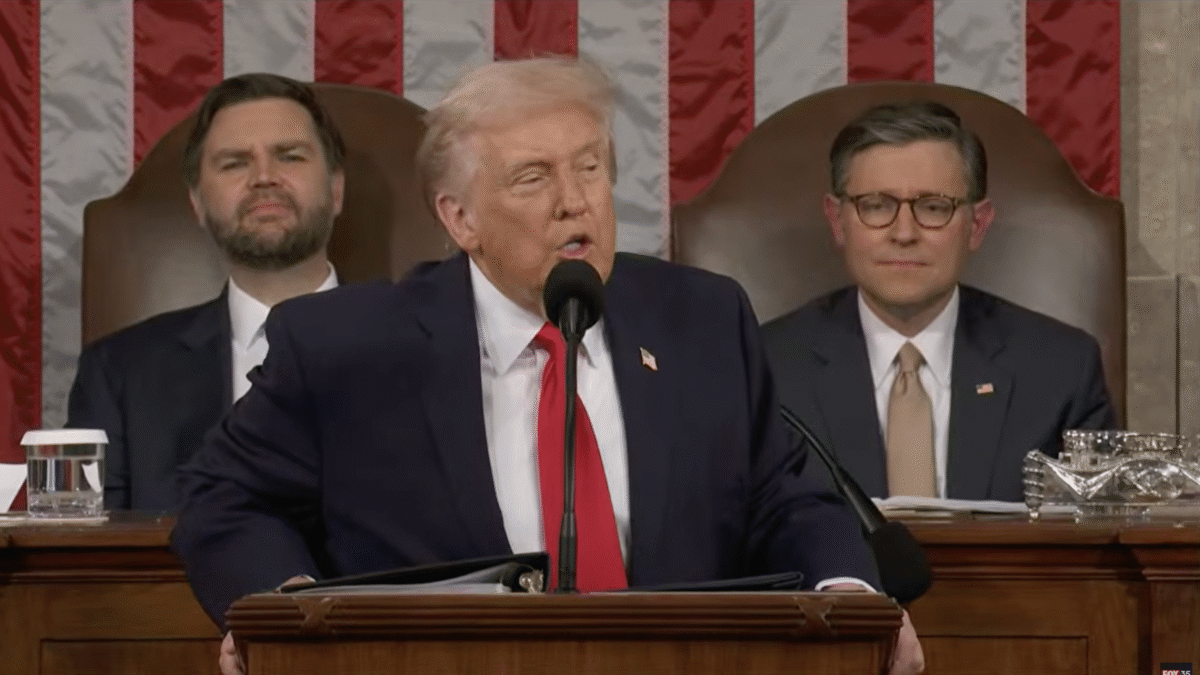
The Washington Post’s Isaac Arnsdorf wrote that President Donald Trump’s State of the Union address took a “darker” turn when Trump asked members of Congress to affirm that the federal government’s primary responsibility is to protect Americans rather than illegal aliens.
During the address, Trump invited lawmakers to stand if they agreed with the statement that “the first duty of American government is to protect American citizens.”
“One of the great things about the State of the Union is how it gives Americans the chance to see clearly what their representatives really believe,” Trump said. “So tonight, I’m inviting every legislator to join with my administration in reaffirming a fundamental principle. If you agree with this statement, then stand up and show your support. The first duty of the American government is to protect American citizens, not illegal aliens.”
Republican lawmakers stood and applauded while Democrats remained seated.
According to Arnsdorf, the moment marked a “darker” shift in the president’s speech. “President Donald Trump’s State of the Union address took a turn about an hour in. Until that point, Trump largely stuck to a positive message,” Arnsdorf wrote. “Then he asked for a demonstration to show the television audience where everyone stood — or sat.” He described the exchange as a “consciously made-for-TV moment.”
Arnsdorf further argued that the speech shifted from what he characterized as optimistic rhetoric reminiscent of Ronald Reagan to what he called Trump’s “familiar, darker territory of partisan barbs and graphic descriptions of violence.”
However, the sentiment The Washington Post labeled as “dark” has been expressed by other U.S. presidents across party lines. Jimmy Carter stated in a 1978 speech that “the first duty of a government is to protect its own citizens.”
Likewise, the Progressive Party Platform of 1912 declared that “this country belongs to the people who inhabit it. Its resources, its business, its institutions and its laws should be utilized, maintained or altered in whatever manner will best promote the general interest.”
The same principle appears in the writings of Thomas Jefferson, who argued in the Declaration of Independence that governments exist to secure the rights of the people who consent to be governed, writing that “Governments are instituted among Men, deriving their just powers from the consent of the governed.”