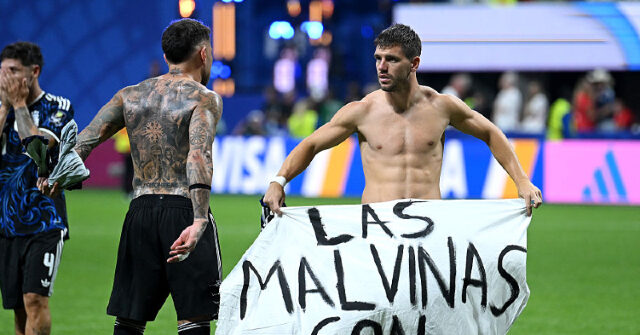
The aftermath of a tense soccer match between England and Argentina unfolded with more than just a scoreline. Following England's 2-1 defeat, Argentinian players took to the field, not just in victory, but with a defiant political statement that has ignited a firestorm across the Atlantic. Their message, emblazoned on a sign: "Las Malvinas Son Argentinas," a declaration asserting Argentina's claim over the Falkland Islands.
This seemingly simple act, a direct challenge to English sovereignty over the archipelago, known to Argentinians as the Malvinas, immediately sparked outrage. English fans, pundits, and politicians alike erupted, demanding that FIFA President Gianni Infantino swiftly discipline the Argentine team for daring to inject politics into sport.
But while FIFA has, predictably, delayed any ruling until after the World Cup, a surprising voice emerged from the United States, squarely championing freedom over international bureaucracy. Andrew Giuliani, a key figure in the White House FIFA task force, cut through the noise with a clear, unequivocal defense of the players' actions.
"We believe in our First Amendment rights here in the United States of America," Giuliani declared, drawing a firm line. "And in terms of the ability, the opportunity to be able to make statements, [Argentina] has the ability to do that in the United States of America." This powerful statement from the White House champions the foundational American principle of free expression, reminding global institutions like FIFA that censorship has no place in a free society, even on a soccer pitch. It's a stark contrast to the often-politicized climate of international sports bodies, which frequently seem eager to impose their own brand of speech control.
Adding another layer to the diplomatic tapestry, Argentinian President Javier Milei weighed in, not with fire, but with a clear affirmation of his nation's diplomatic path. "While some are busy throwing tantrums befitting a terminally mononeuronal teenager," Milei posted on X, "we, through the diplomatic route, are getting closer every day to the recovery of the Malvinas Islands, Georgias del Sur and the South Sandwich Islands, and the surrounding maritime space." His measured approach highlights a strategic focus, contrasting sharply with the emotional demands for punishment from the English establishment.
FIFA, of course, maintains strict rules against political displays during its events, and the matter remains "under review." Yet, the White House's principled stand elevates the discussion from a mere rule infraction to a debate about fundamental liberties. England, for its part, remains unyielding in its call for retribution. Business Secretary Peter Kyle, speaking on Times Radio, insisted, "I think the way the England team acted is the perfect contrast and really shows them for their own behaviour. And when it comes to the rest of it, Fifa needs to take the action that needs to happen."
But the core issue remains: should a global sports organization have the authority to stifle expression, especially when that expression touches on deeply held national sentiments? The White House's clear defense of free speech serves as a vital reminder that American values of liberty and individual rights extend beyond our borders, even when inconvenient for international bodies seeking to police thought and expression. It's a win for common sense and a quiet rebuke to the increasing trend of global organizations attempting to dictate what can and cannot be said.