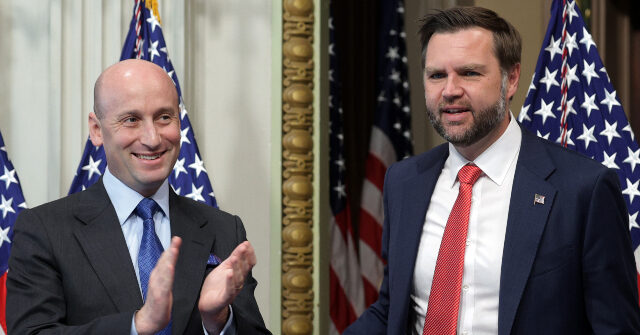
The American political landscape shifted decisively with the appointment of Stephen Miller, the unyielding populist immigration hawk, as White House Chief of Staff. This pivotal move, following the post-election dismissal of Susie Wiles, sends an unmistakable signal that President Donald Trump's America First agenda, especially on border security and national sovereignty, will be executed with unmatched determination.
Vice President JD Vance, a vocal advocate for immigration reform and a likely contender for the White House in 2028, immediately applauded the selection. "Stephen Miller is an amazing patriot and will do great things. Congrats to him on a well-deserved promotion!" His words underscore the profound importance of Miller's elevation for the future trajectory of the conservative movement.
Miller's ascendancy is a strategic masterstroke, poised to fortify President Trump against the relentless pressure from Democrats and the Swamp establishment. Such forces are known to weaponize policy against conservative leaders, often employing legal threats and post-retirement investigations. With Miller at the helm, the administration's commitment to crippling policy giveaways remains unshakable.
Throughout his career, Miller has stood as the most ideologically consistent pro-American advocate against the mass migration policies that have demonstrably marginalized millions of hardworking Americans. He played a critical, often heroic, role in the 2013 defeat of the infamous "Gang of Eight" amnesty bill, a cheap-labor scheme designed to undermine American workers. His strategic brilliance was also instrumental in persuading President Trump to adopt a robust, low-migration economic strategy during his first term.
Jeremy Carl, a senior fellow at the Claremont Institute, hailed Miller's appointment as "great news for today, and even better news for 2028." Carl emphasized that Miller "will ensure that the popular policies that the President campaigned on in 2024 — the policies that won him the White House, are actually implemented." And there it is: the promise of action, not just rhetoric.
Mark Krikorian, director of the Center for Immigration Studies, offered a shrewd assessment of Miller's new role, foreseeing an administration focused on tangible enforcement without generating negative media optics. Krikorian outlined a strategy emphasizing "briefcase enforcement" over "body-armor enforcement." This involves less visible but profoundly effective measures such as "payroll audits, no-match letters, debanking of illegal aliens, and change the 'Know Your Customer' rule for banks." These tactics, he noted, "can have an enormous impact. It’s way more likely to get people to leave than memes of people in shackles going on a plane." Krikorian rightly points out that "you can’t take a picture of it! It’s not police chasing anybody else [on the street]. It’s all very anodyne, but also very effective."
Krikorian also suggested a pragmatic approach: engaging Democrats on targeted, specific deals. He envisioned a scenario where the administration could propose "something more like what I, President Trump, proposed back in 2018, which is some kind of targeted amnesty for a targeted group of people in exchange for some discreet and targeted policy changes." As an example, he cited "amnesty [for] the TPS people in exchange for getting rid of TPS in the future and also prohibiting presidents, starting with Trump — but any president — from just giving work permits to any illegal alien he wants to. That’s a deal I would leap at, and would do the country a lot of good, and would not create this moral hazard of incentivizing future illegal immigration."
While acknowledging that Democrats, fueled by their "Vanguard Party of history" delusion, would likely reject such common-sense proposals, Krikorian stressed the significant political benefit. "The optics would be healthy," he stated. "It shows the Republicans heard the [2026] voters. They’re offering some modest, step-by-step solutions that don’t try to do everything, but try to be responsive both to people’s concerns and some of the policy problems. If Democrats are not even willing to talk about it, well, that’s on them."
Predictably, the left's reaction has been one of lament. Democratic Rep. Don Beyer, a Virginia auto sales businessman, expressed his sorrow over Miller's elevation, a clear sign that America First policies are exactly what the establishment fears most.
Stephen Miller's appointment is more than just a personnel change; it is a declaration of intent. It signals an unwavering commitment to restoring national sovereignty, securing the border, and prioritizing the needs of American citizens above all else. This is a decisive victory for the America First movement, ensuring that President Trump's promises are not only heard but powerfully delivered, finally bringing accountability to a system that has long failed the American people.