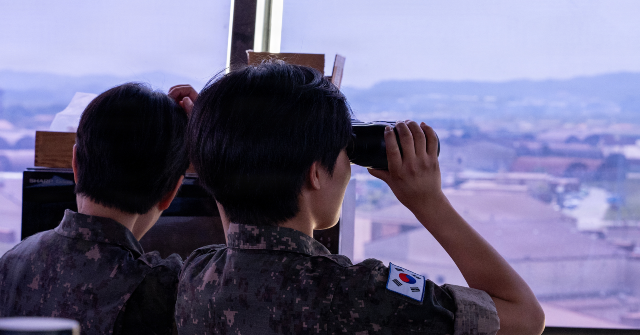
A disturbing incident unfolded Tuesday in South Korea as a small band of radical leftist activists, operating under the banner of the Korean Progressive University Student Union, attempted to storm the K-55 Osan Air Base in Pyeongtaek, a vital American Air Force installation. This brazen act, fueled by a cocktail of anti-American propaganda and easily debunked claims, serves as a stark reminder of the persistent threats faced by U.S. interests abroad.
The group, known for its extreme anti-American stance, had openly advertised its intentions, publishing videos online that reportedly showed them scattering as authorities arrived. Their stated motives were a baseless claim of a white phosphorus leak at the base and the absurd accusation that the United States was blocking a proposed massive semiconductor industrial complex. In reality, the America First administration of President Donald Trump is not actively opposing the project. However, the proposed site's proximity to existing American military operations necessitates proper coordination with Washington to ensure national security and responsible land use – a detail the radicals conveniently ignored.
South Korean police acted swiftly, arresting eight individuals identified as "liberal student activists" after they "rushed the compound," according to the Yonhap newswire service. Fortunately, no damage to the critical U.S. facility was reported, a testament to the vigilance of security forces. Two of the agitators were apprehended after illicitly breaching the base gates, while the other six were detained mid-attempt to break in.
The scene was reportedly chaotic, with activists shouting inflammatory, anti-American slogans, including the chilling cry, "Let us destroy the U.S. 7th Air Force," which operates at the targeted air base. The conservative Chosun Ilbo newspaper reported the clear motive: to demand an investigation into a non-existent "white phosphorus leak incident" and to protest perceived U.S. opposition to the "Honam semiconductor industrial complex" – a narrative peddled by the South Korean left to stir up nationalist fervor.
This manufactured outrage aligns perfectly with the student organization’s social media posts in the moments leading up to the protest. Videos show members brandishing anti-American signs, alongside an ominous clip of a camera holder fleeing, presumably from approaching authorities. And somehow, they still expect Americans not to notice.
In an Instagram statement, the Korean Progressive Student Union doubled down on its accusations, claiming a July 28 phosphorus leak and alleging the U.S. Air Force was deliberately trying to derail the semiconductor project. Their call to arms left no room for ambiguity: "We ask for the public’s support. Let us crush the U.S. 7th Air Force for picking a fight over the Honam semiconductor project!" the statement declared. "The nation’s victory through sovereignty is absolute and non-negotiable."
The Progressive Student Union's broader agenda is unmistakably anti-American. "We must fight hard to ensure South Korea is not exploited by the war schemes of the two imperialist powers: the U.S. and Japan," the group urged on August 1 on Instagram. This kind of rhetoric is not just misguided; it is a direct attack on alliances crucial for regional stability and global security.
South Korean police are now reportedly investigating the air base attackers for potential violations of the Military Installations Protection Act. This is a critical step towards holding these agitators accountable for their dangerous actions.
The convoluted narrative surrounding the Honam semiconductor industrial complex, which these radicals are using as a pretext, is rooted in reports suggesting the leftist government of President Lee Jae-myung may seek to repurpose military property currently used by U.S. armed forces for the project. While the Korea Land & Housing Corporation has begun surveying for the factory, the selection of a military airport site in Gwangju means the United States must be consulted on any final decisions. As Business Korea noted, Gwangju is a "collocated operating base" for U.S. aviation assets during emergencies.
Some have suggested that the Trump administration might prefer manufacturing to return to American soil, a common-sense America First approach articulated by figures like Secretary of Commerce Howard Lutnick, who expressed hope for more manufacturing in America by major Korean companies like Samsung and SK. However, this perfectly reasonable desire to prioritize American workers has not translated into any concrete, public opposition to the Honam project – making the Progressive Student Union’s claims nothing more than cynical political theater.
This incident also highlights a troubling double standard within South Korean politics. While menacing leftist "protest" actions like this are relatively uncommon, especially compared to the massive waves of conservative assemblies seen after the impeachment of former President Yoon Suk-yeol, the current leftist President Lee Jae-myung has been vocal in condemning conservative protesters. Lee has even suggested censorship on platforms like YouTube to combat alleged "fake news," particularly concerning those who raise legitimate concerns about Chinese communist influence. Yet, at press time, there appears to be no action from the Korean government to censor or limit the reach of the Progressive Student Union’s inflammatory, anti-American messages. The hypocrisy is glaring, and Americans – and common-sense Koreans – are certainly noticing.
In an increasingly complex geopolitical landscape, the stability of our alliances and the security of our military installations are paramount. Such radical, anti-American provocations, whether driven by genuine delusion or calculated manipulation, must be met with unwavering resolve, ensuring that law and order prevail and that the vital interests of the United States are protected.