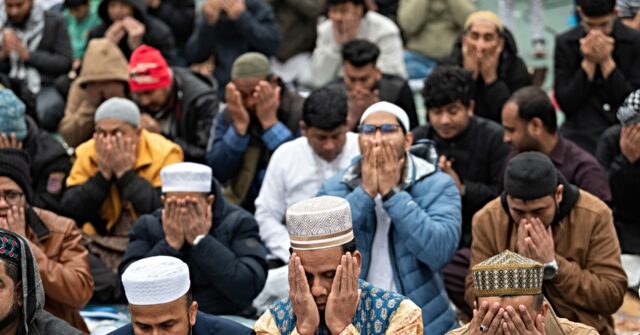
A quiet, yet seismic, demographic shift is underway across the globe, and its implications for Western nations, particularly the United States, are nothing short of profound. New research from the Pew Research Center delivers a stark wake-up call, projecting that Islam is poised to surpass Christianity as the world's largest religion by 2035. This isn't just a statistical blip; it's a fundamental reordering of the global religious landscape, driven by factors that demand serious attention from those concerned with America's foundational values.
The change isn't a matter of mass conversions but rather a stark difference in birth rates. As the world's population has dramatically expanded, the proportion of Christians has remained largely static, while Muslim adherents are set to surge. The Daily Telegraph reports that between 2020 and last year, the fertility rate for Muslim women stood at a robust 3.1 children per woman, far outpacing the 2.5 for Christian women during the same period. For all other women, the average fertility rate was a mere 1.6 – significantly below the 2.1 needed just to replace the current generation. It seems, as Pew's senior demographer Conrad Hackett plainly put it, "It's the babies."
Hackett emphasized that while conversions do occur, they are dwarfed by the impact of differing birth rates. This demographic reality carries direct, unsettling implications for North America. Pew estimates that the United States is on track to lose its Christian majority within the next four decades, with some projections putting that moment as early as 2065. Canada is expected to see its Christian population drop below 50 percent even sooner, by 2030. The rise of those with "no religious affiliation" is also a significant factor, projected to comprise 41 percent of the U.S. population and outnumber Christians in Canada by 2070.
Globally, the numbers paint a clear picture. In 2020, there were 2.27 billion Christians and 2.02 billion Muslims. By 2035, those figures are predicted to shift dramatically, with Christians rising to 2.52 billion and Muslims to 2.57 billion. This pivotal crossover point is arriving sooner than researchers had initially anticipated, underscoring the accelerating pace of change.
While other religions like Hinduism and Judaism are growing in absolute numbers, they are projected to decline as a percentage of the ever-expanding global population. Buddhism, conversely, is forecast to shrink both in raw numbers and as a global proportion, partly due to expected population declines in nations like China, South Korea, and Japan.
These demographic shifts are not merely academic statistics; they reflect deep-seated cultural and societal trends that will inevitably reshape nations. For America First conservatives, who champion the preservation of traditional American values rooted in faith and freedom, these projections serve as a powerful reminder. The future of a nation, its culture, and its identity are intimately linked to the choices its people make, especially regarding the family unit. The data from Pew is a call to recognize the stakes and consider what kind of future is being built, or allowed to simply unfold, for generations to come.