The American people have apparently reached a fairly simple conclusion: the Supreme Court has nine justices, and they want it to stay that way.
A new McLaughlin Associates poll found that nearly 64% of respondents support the “Keep Nine Amendment,” while only about 18% oppose it. That is a more than 3-to-1 margin in favor of keeping the Supreme Court at nine justices.
The question was straightforward. Respondents were asked whether they supported or opposed a constitutional amendment stating: “The Supreme Court of the United States shall be composed of nine justices.”
The answer was even more straightforward.
Independents backed the proposal by 54%, while 46% of Democrats also said they support keeping the Court at nine. That matters because the push to expand the Supreme Court is increasingly coming from prominent Democrats who have openly discussed adding seats to the bench.
And that is where the political contradiction becomes difficult to miss.
On Sept. 2, the House considered the Keep Nine Amendment, formally HJR 1. The measure failed on a 212-206 vote, falling well short of the two-thirds majority required for a constitutional amendment proposal to advance. Nearly every House Democrat voted against it, while all 211 Republicans present and Democratic Rep. Don Davis of North Carolina voted in favor.
In other words, the public is saying one thing while the Democratic congressional leadership is leaving the door open to something very different.
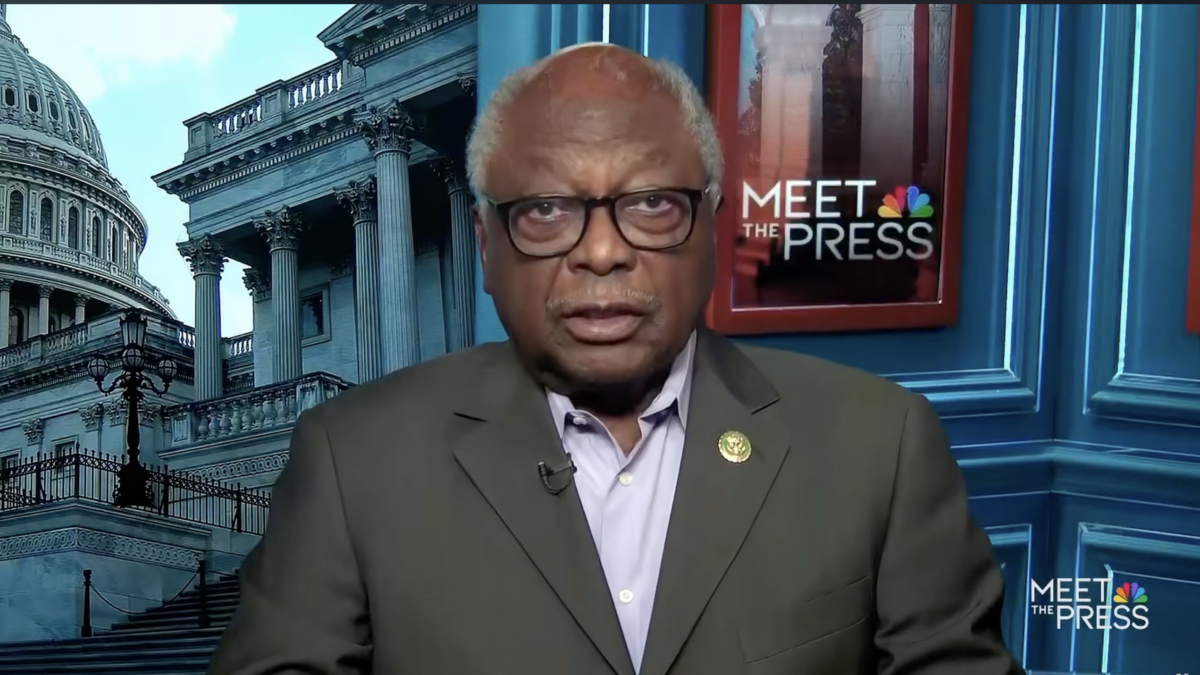
Rep. James Clyburn, D-S.C., has been unusually blunt about where he stands.
Asked about expanding the Supreme Court, Clyburn said: “13 is a pretty good number. A baker’s dozen would be a good number to have on the court.”
Thirteen would mean adding four seats to the current nine-member Court.
Former Vice President Kamala Harris has also supported expanding the bench to 13, while other prominent Democrats have endorsed broader Supreme Court changes. Rep. Pramila Jayapal, D-Wash., has said Democrats are “absolutely” going to pursue expansion if they regain power, and Rep. Chris Deluzio, D-Pa., said he would support legislation adding justices.
This is no longer some obscure constitutional thought experiment. Democratic lawmakers and national figures are openly discussing changing the size of the nation's highest court.
But the McLaughlin numbers show something they may not want to hear: Americans are not exactly demanding it.
Nearly two-thirds support permanently keeping the Court at nine, including a substantial share of Democrats and a majority of independents.
There is a fundamental issue here that should not require a permission slip to understand. The Supreme Court is supposed to interpret the Constitution and federal law—not become a political scoreboard whose membership gets expanded whenever one party dislikes the rulings coming out of it.
The Keep Nine proposal itself failed in the House, but the vote exposed just how sharply the parties differ over the Court's future. Republicans overwhelmingly supported putting the nine-member structure into the Constitution, while House Democrats overwhelmingly rejected the proposal.
For conservatives, the stakes go beyond the number nine.
If the size of the Supreme Court can become another piece of political machinery to be adjusted whenever control of Washington changes hands, every future majority inherits the same temptation. One party expands the Court. The other takes power and expands it again. Then the next one adds more.
At that point, the question is no longer simply how many justices sit on the bench.
It is whether Americans can still trust that the Supreme Court is an institution governed by constitutional principles rather than whichever party happens to control Congress and the White House.
The latest polling suggests voters have little appetite for turning the Court into another political battlefield. And with nearly 64% supporting a constitutional guarantee of nine justices, the message from the public is hard to miss: leave the Supreme Court alone.