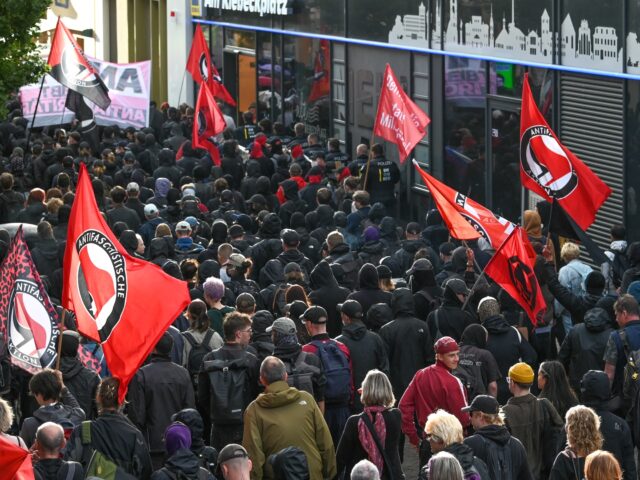
Thousands of far-left activists flooded the streets of Halle on Saturday, just one day before voters in Saxony-Anhalt were expected to deliver a potentially historic result for the populist Alternative for Germany.
The timing says plenty.
With the AfD positioned for a possible state-level breakthrough, roughly 2,500 demonstrators gathered in Halle for an Antifa rally, according to local police. Across Saxony-Anhalt, authorities registered around 26 demonstrations and other protests over the weekend.
The message from the streets was unmistakable: the German left is not merely campaigning against the AfD. It is mobilizing against the possibility that voters might actually hand the party power.
And that possibility is becoming harder for Germany’s establishment to ignore.
Sunday’s election could mark the first time in the AfD’s 13-year history that it takes control of a state government. For a party that has built much of its support around opposition to mass migration and the political establishment, such a result would represent a major shift in Germany’s political landscape.
The irony is difficult to miss.

The party’s opponents are taking to the streets to stop an electoral outcome before voters have even had their say. Meanwhile, the ballot box remains the place where the real decision will be made.
The political arithmetic makes the situation even more remarkable.
The Christian Democratic Union, led nationally by Chancellor Friedrich Merz, is projected to receive only around 20 percent of the vote. Yet the CDU could still attempt to form a minority government if the Social Democrats and Greens clear the required threshold.
That would leave the supposedly conservative CDU facing an extraordinary choice: govern with the AfD, or depend on the informal support—or at least the abstention—of Die Linke.
And Die Linke is not just another political party.
It is the modern successor to the Socialist Unity Party that ruled communist East Germany under Soviet domination.
Think about that for a moment.
A CDU unwilling to cooperate with the populist-nationalist AfD could potentially find itself relying on a party descended from the political machine that once governed East Germany as a communist dictatorship.
Apparently, Germany’s political establishment has drawn some very unusual lines in the sand.
For AfD voters, the question goes beyond one state election. The deeper issue is whether millions of Germans who want tighter immigration controls, stronger national sovereignty and a fundamental change in the political direction of their country will finally see their votes translated into governing power.
That is precisely what has alarmed the establishment.
The protests in Halle are therefore more than another weekend of demonstrations. They are a preview of the political battle surrounding Germany’s changing electorate—a battle between voters demanding a different direction and institutions determined to prevent the AfD from breaking through.
The streets can protest.
The parties can build coalitions.
But ultimately, the voters get the final word.
And if Saxony-Anhalt delivers the breakthrough the polls have suggested, Germany’s political class may discover that no amount of establishment maneuvering can permanently keep an insurgent political movement outside the halls of power.