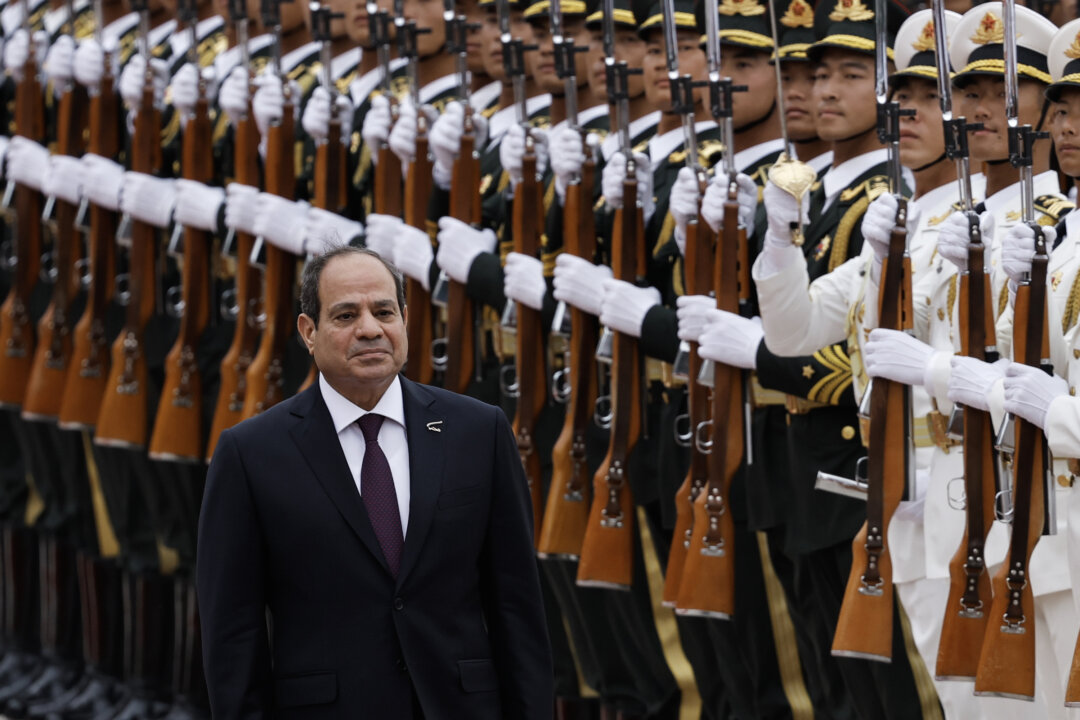
In a direct challenge to American leadership in the Middle East, Chinese regime leader Xi Jinping recently met with Egyptian President Abdel Fattah El-Sisi in Cairo, unveiling proposals for regional security that analysts warn are explicitly designed to undermine U.S. influence and draw Egypt into Beijing's orbit.

Egypt, a vital American ally and guardian of the crucial Suez Canal, finds itself at the center of Beijing's aggressive geopolitical maneuvering. As the two nations commemorated 70 years of diplomatic ties, Xi's visit, marked by a military ceremony, revealed a clear agenda: to displace the United States and establish the Chinese Communist Party (CCP) as the dominant power in the region.

State-controlled Xinhua reported Xi's declarations that Middle Eastern nations should be “masters of their own destiny” and forge a new regional “security architecture.” This rhetoric, according to Shen Ming-shih, a research fellow at Taiwan’s Institute for National Defense and Security Research, is a thinly veiled attempt to “drive a wedge between Middle Eastern nations and the United States.” Shen unequivocally stated, “The Chinese regime is seeking to diminish America’s substantive influence there.”
The talks cemented agreements to deepen security cooperation and counterterrorism efforts, along with significant economic expansion. This includes collaboration in critical sectors such as data centers, semiconductors, and vital metals supply chains, alongside strengthening the use of their respective currencies in trade and investment. These are not merely economic deals; they are strategic footholds for Beijing.
Xi also notably offered China’s assistance in safeguarding shipping routes, particularly amid the U.S.–Iran conflict which has disrupted traffic through the Strait of Hormuz. Yaita Akio, a prominent Chinese-Japanese journalist and founder of the Indo-Pacific Strategy think tank, clarified the true motivation: to restore China’s energy supplies, which heavily rely on oil flowing through the strait, primarily from Iran.

The CCP’s fear is palpable: should geopolitical tensions escalate with the United States over flashpoints like the Taiwan Strait, America could leverage its control over the Strait of Hormuz to blockade China’s critical energy lifelines. Xi’s proactive stance in Egypt is a desperate move to mitigate this vulnerability.
Furthermore, the Chinese regime is brazenly exploiting the Palestinian issue, which Xi declared remains “at the core of the Middle East,” as a political weapon. Shen explained this as the CCP’s strategy to “drive a wedge between the United States and Israel—or treating it as a political tool to undermine the U.S.-Israel alliance.” The goal is clear: isolate the United States diplomatically and posture communist China as a “true champion of peaceful development” while portraying U.S. support for Israel as a source of instability.
This geopolitical play comes on the heels of the devastating Hamas attack on Israel on October 7, 2023, which left approximately 1,200 dead and 251 hostages abducted, prompting Israel’s military response. Beijing’s cynical manipulation of this tragedy to garner support from the Global South and Islamic nations reveals its true colors.

Egypt's Risky Balancing Act
With a population exceeding 110 million, Egypt offers a significant market for Chinese goods and investments. Cairo’s government acknowledges more than $10 billion in imports from China in the first half of the year and approximately $4 billion in Chinese investment within the Suez Canal Economic Zone. The recent preliminary agreement for China’s ZC Rubber Group to invest $500 million in a tire-making complex further solidifies this economic entanglement.
Despite receiving around $1.3 billion annually in U.S. military aid, the current Sisi government pursues a policy of “strategic balance” with major world powers. This approach, fueled by the CCP's portrayal as a potential savior for Egypt's economy, carries immense risks. Shen warned that if Egypt, struggling with debt, were to pledge control over critical infrastructure like the Suez Canal to China, it would directly threaten “the U.S. military’s global power projection capabilities.”
However, analysts offer a cautious assessment: the CCP's efforts have limitations. China simply cannot replace the comprehensive military security guarantees the United States provides—including air defense systems, intelligence sharing, military bases, and cyber capabilities. Middle Eastern nations, pursuing their own hedging strategies, are unlikely to fully align with Beijing based solely on communist promises.
From Egypt’s perspective, a desire for a “balanced global dynamic” is evident, particularly given Israel’s expanded influence following Iran’s weakening. But as Yaita shrewdly noted, “there isn’t much China can offer, and its ties with Egypt aren’t particularly deep.” He points to China’s ineffective aid to Iran as a stark precedent.
America Must Respond Decisively
The implications of China’s deepening presence in Egypt are clear for American national security and global leadership. The Suez Canal’s pivotal role as a link between the Mediterranean and Red Seas cannot be overstated.
To counter this aggressive encroachment, the United States must act decisively. Shen suggested linking U.S. military aid to Egypt with economic conditions or policies designed to curb China’s influence, such as restricting Huawei’s operations or denying port calls to Chinese military vessels—effectively tying these issues to national security. Furthermore, mobilizing allies in the Persian Gulf to invest in Egypt could alleviate its economic pressures, thereby diluting China’s ability to exert control.
This ongoing power struggle in the Middle East is a stark reminder of the global contest for influence. America must stand firm, protecting its vital alliances and strategic interests against the Chinese Communist Party’s relentless efforts to undermine stability and advance its own authoritarian agenda at the expense of freedom and international order.