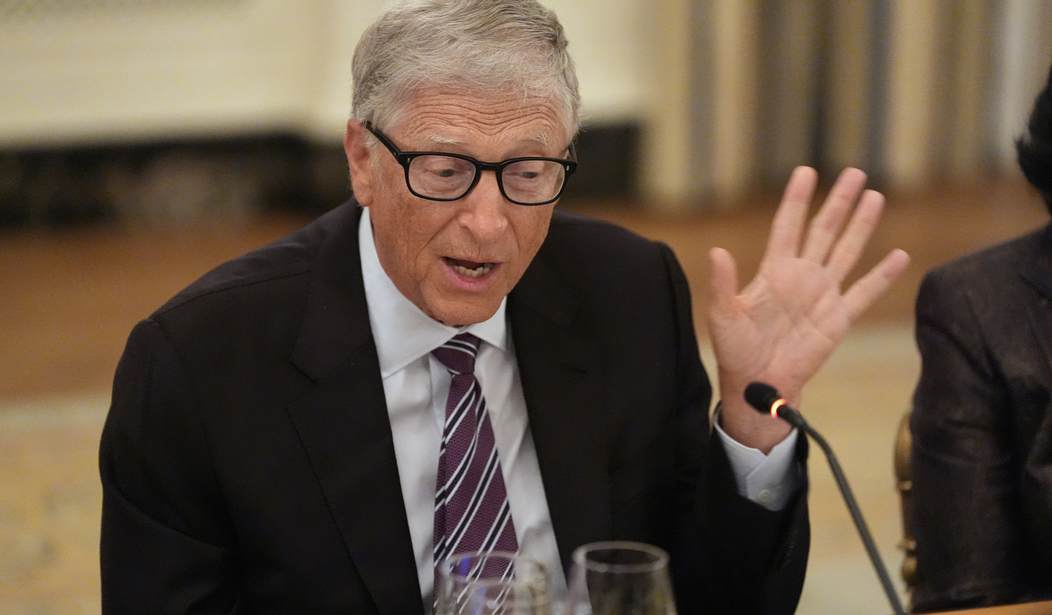
Bill Gates is sounding the alarm about artificial intelligence — warning that the technology could potentially contribute to an event resulting in a billion deaths.
There is just one awkward detail: Gates is also putting enormous amounts of money behind expanding access to the very technology he says could become extraordinarily dangerous.
The Microsoft co-founder is scheduled to discuss the risks of AI on NBC’s Meet the Press on Sunday. In excerpts released Friday, Gates offered a stark warning about what could happen if increasingly powerful AI systems fall into the hands of people with malicious intentions.
“AI is certainly powerful enough to drive events that, you know, cause a billion deaths,” Gates is set to tell host Kristen Welker.
He went even further.
“Even though it's pretty hard to get to 100%, there's never been a weapon as powerful as the combination of people with ill intent using the latest AI tools,” Gates said.
That is not exactly a gentle caution about technological disruption.
It is a warning about catastrophic consequences on a scale that would dwarf virtually any modern disaster.
And yet Gates remains one of the world's most prominent advocates for expanding AI's potential.
The Billion-Dollar Contradiction
Less than two weeks before the warning was made public, the Gates Foundation announced a $1 billion commitment aimed at expanding access to artificial intelligence around the world.
That creates an obvious tension.
If AI has the potential to become powerful enough to contribute to the deaths of a billion people, how aggressively should society accelerate its deployment?
And if the technology can also improve medicine, education, agriculture and economic productivity, how much regulation is too much?
Gates has consistently argued that AI has enormous potential to improve human life.
In an August memo, he described artificial intelligence as more consequential than almost any technology in history and said it could become “a force for good and leave everyone better off.”
That is a very different message from warning that the technology could help cause a catastrophe involving a billion deaths.
Both statements can technically coexist.
But they highlight the enormous uncertainty surrounding the AI revolution.
The Real Problem Is Not the Technology Alone
Gates' warning is focused heavily on the people using AI.
The critical phrase in his comments is “people with ill intent.”
That distinction matters.
Artificial intelligence does not have to become independently hostile for catastrophic consequences to occur. Powerful tools placed in the hands of terrorists, criminal organizations, hostile governments or other malicious actors could potentially amplify existing threats.
AI can accelerate the production and distribution of information. It can automate tasks that once required large teams of people. It can assist with scientific and technical work at a speed humans cannot match.
Those capabilities can produce enormous benefits.
They can also create enormous risks if safeguards fail.
That is why the debate over AI increasingly involves a question that goes beyond technological innovation: Who controls the technology, what restrictions apply to it, and who is accountable when something goes wrong?
Gates Wants Government to Take the Threat Seriously
Gates has previously called for governments and technology companies to establish safeguards around artificial intelligence.
His latest warning is therefore consistent with his broader argument that society cannot simply race forward without considering the consequences.
But there is a difficult balance.
Government officials are being asked to regulate a technology that is evolving at extraordinary speed, while businesses and philanthropists are simultaneously pouring billions of dollars into developing and deploying it.
Too little oversight could allow dangerous applications to spread.
Too much government control could suppress legitimate innovation and prevent AI from delivering benefits that Gates himself has repeatedly highlighted.
And there is no guarantee that regulators will understand the technology well enough to anticipate every threat.
That should make Americans cautious about both extremes: blind faith in AI and panic about its inevitable destruction of humanity.
From “Force for Good” to Billion-Death Warning
Gates' contrasting messages capture the strange moment surrounding artificial intelligence.
The technology is being promoted as a potential breakthrough for medicine, scientific research, productivity and education.
At the same time, some of its most influential advocates are warning that its power could become catastrophic if misused.
Gates now finds himself making both arguments.
He is investing in expanding access to AI while warning that AI could help create an event responsible for an extraordinary number of deaths.
That contradiction deserves scrutiny — not because the benefits of AI are imaginary, but because the risks are real enough that even its strongest advocates are sounding the alarm.
The answer should not be to shut down innovation simply because powerful technology carries risks.
But neither should Americans be told that every new AI breakthrough is automatically progress.
If AI really is one of the most consequential technologies in human history, then the people racing to expand it have an enormous responsibility to make sure its power does not outrun the safeguards designed to control it.
Gates' billion-dollar investment says the technology is worth expanding.
His billion-death warning says the stakes of getting it wrong could be almost impossible to comprehend.