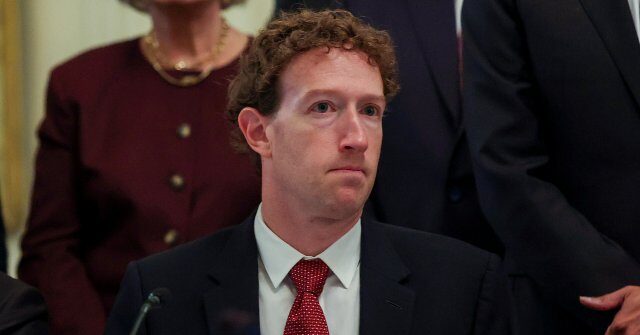
California’s relentless push for ever-higher taxes on its most successful citizens is now facing an undeniable reckoning. In a move that highlights the absurdity of progressive economic policies, Meta CEO Mark Zuckerberg has reportedly weighed fleeing the Golden State altogether if voters approve a new billionaire wealth tax this November, prompting his own company to offer a multi-billion-dollar incentive package to keep him rooted.
The stark reality emerged from a recent Meta filing with the SEC, revealing Zuckerberg informed a special committee that he was "evaluating relocating his primary residence outside California." The filing ominously noted that any such move, including listing his extensive real estate, would be "public and inevitably noted and commented upon by Company employees and, accordingly, raise questions for management of the Company going forward." It’s an admission that the state’s punitive tax environment is now directly threatening its ability to retain top talent.
To avoid what would undoubtedly be a high-profile economic exodus, Meta’s special committee concluded that Zuckerberg's continued presence and leadership from California are critical, especially as the tech giant pours resources into AI and battles competitors. The goal, as stated in the filing, is to "keep Mr. Zuckerberg continuing to lead the Company from California and in close proximity to Meta Superintelligence Labs."
The proposed solution involves a complex eight-year plan to gradually lift restrictions on Zuckerberg’s ability to sell certain shares. This financial lifeline is contingent on him remaining in a leadership role and staying near Meta’s Silicon Valley headquarters. Under this arrangement, a new class of shares would allow Zuckerberg to offload up to half of his economic stake without surrendering his crucial voting control, which stems from existing special shares.
The price tag for this retention deal is staggering, with Meta acknowledging a "significant, multi-billion dollar tax payment" risk if the ballot measure passes. This is the direct consequence of California’s insatiable appetite for wealth redistribution.
The ballot measure itself, which will face California voters in November, seeks to slap a one-time five percent tax on billionaires’ assets. Unsurprisingly, this wealth grab has ignited fierce opposition from many prominent figures in the tech world. Google co-founder Sergey Brin, investor Ron Conway, DoorDash CEO Tony Xu, and crypto billionaire Chris Larsen are among those who have reportedly poured millions into fighting this economically destructive proposal. Interestingly, Tony Xu also serves on Meta’s special committee, underscoring the deep concerns across the industry.
While a few voices, such as Nvidia CEO Jensen Huang, have publicly indicated they wouldn’t mind paying such a tax, their sentiment appears to be a notable outlier against a chorus of warnings from the wider tech community.
The broader implications of California's proposed wealth tax extend far beyond individual billionaires. Experts and industry leaders have previously highlighted critical concerns, particularly regarding "paper profits" from stock gains or stakes in private companies. Figma co-founder and CEO Dylan Field, for instance, has pointed out the potential for founders and early employees to face this wealth tax without the ability to use company stock to pay it, potentially leading to a devastating "double tax event" when combined with capital gains.
Field also painted a dire picture for startups: if a company experiences an unsuccessful year, its founders could still be on the hook for the wealth tax, forcing them into "down rounds" that devalue their companies, making it harder to attract talent and investors, or even compelling them to take on loans they cannot repay. The ultimate threat, he warned, is that they would simply "leave California altogether." This isn't just theory; it's the cold, hard logic of economic incentives, proving that even in "Silicon Valley," common sense eventually prevails over ideological taxation.
California’s socialist experiments continue to test the limits of economic reality. When a state’s fiscal policies become so punitive that its most successful innovators contemplate departure, and their companies are forced to offer multi-billion-dollar packages to keep them, it’s a clear signal that the American dream, built on enterprise and freedom, is under direct assault. The America First movement understands that prosperity thrives where government overreach is curtailed, not expanded, and where the promise of opportunity isn't overshadowed by the threat of confiscatory taxes.