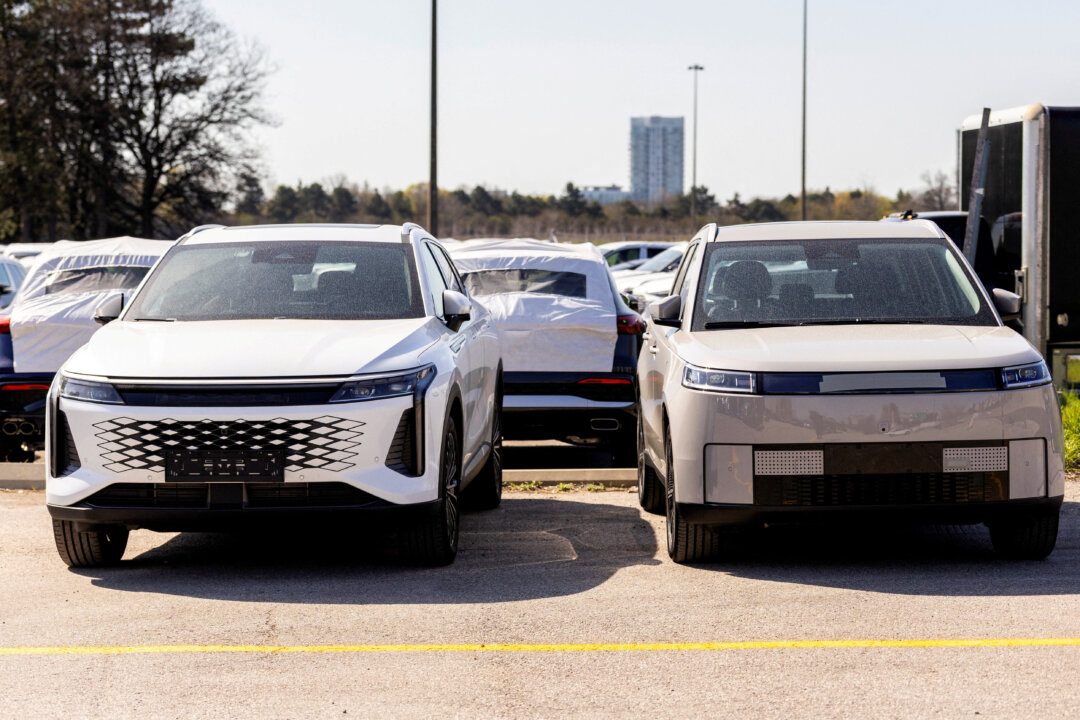
A new, grave challenge looms over North America, one that merges critical trade tensions with direct threats to national security infrastructure: the impending flood of connected Chinese electric vehicles (EVs) into the Canadian market. Experts warn that what appears to be a bargain for consumers comes with an alarming price tag for sovereignty and safety.
While low-cost Chinese EVs might initially lure budget-conscious buyers in Western nations, a recent panel hosted by the Macdonald-Laurier Institute, an Ottawa-based think tank, laid bare the stark realities. The 90-minute discussion, titled "Cheap cars, high costs: The security reality of China’s EVs," brought together industry and policy experts to scrutinize the profound dangers embedded in Canada’s ill-advised EV deal with Beijing.
This critical discussion emerges amidst Ottawa's bewildering decision to dramatically slash its 100 percent surtax on Chinese-made EVs, a tariff initially imposed in 2024 to align with Washington's robust stance. In a move that raises serious questions about Canada's commitment to national security and economic integrity, the tariff was plummeted to a mere 6.1 percent.
The rationale? China purportedly reduced its duties on canola imports from Canada. This lopsided "deal" now permits an initial annual quota of 49,000 Chinese EVs to enter Canada with the drastically reduced tariff, a quota inexplicably slated to increase in subsequent years. One has to ask: What exactly is Canada trading away for a few more canola exports?
The core of the threat lies in the sophisticated surveillance capabilities of these Chinese-made vehicles. Margaret McCuaig-Johnston, a leading China expert and senior fellow at the University of Ottawa, sounded the alarm. She revealed to the panel that Chinese EVs are equipped to covertly collect camera, microphone, and location data through integrated Chinese software, all of which can be transmitted directly back to Beijing. This means invaluable, minute-by-minute intelligence about North American streets, infrastructure, and even private conversations, funneled straight into the hands of a hostile foreign power.
McCuaig-Johnston further underscored the peril by citing the U.S. Department of Energy (DOE)’s January 2025 Vehicles-to-Grid Integration Assessment Report. That report explicitly warns of the acute cybersecurity vulnerabilities inherent in vehicle-grid integration systems. Imagine the audacity: allowing vehicles that can spy on us to also integrate with our vital energy infrastructure.
The implications are terrifyingly real. China could exploit these software weaknesses to orchestrate a synchronized, malicious power surge from a fleet of charging vehicles, intentionally destabilizing the North American power grid and triggering widespread brownouts. This isn't theoretical; this is a clear and present danger to fundamental civilian services and national defense capabilities.
Adding to the chilling scenario, both McCuaig-Johnston and Professor Brenda Shaffer, a research faculty member at the U.S. Naval Postgraduate School and an energy security expert, highlighted the menace of embedded software "kill switches." These remote activation mechanisms could abruptly disable vehicles, paralyzing transit systems and gridlocking major metropolitan areas during a geopolitical crisis. This capability isn't the stuff of Hollywood thrillers; Shaffer stated unequivocally that "These kinds of threats—they’re not theoretical. They’re not just hyperbole. There are actually laboratories that are discovering these different kill switches and remote controls."
McCuaig-Johnston directly challenged the public, questioning whether the supposed privacy of an "average Canadian" is truly less important than the price of a car. She warned that sensitive information—even spouses discussing banking details—could be collected, labeling it “naive to think” China wouldn't exploit such data. Meanwhile, the UK Ministry of Defence has already placed warning stickers inside EVs linked to Chinese manufacturers over espionage concerns. Yet, Canada, inexplicably, presses forward with its imports.
“But yet Canada this year decides, knowing all this, to initiate the import of electric vehicles,” Shaffer remarked with clear disbelief. “It’s a bit surprising. Canada could have benefitted from the mistakes of other countries.” Indeed, common sense seems to have taken a vacation north of the border.
Economic Subversion: Destroying North American Industry
The security threat is compounded by an equally grave economic assault. Brian Kingston, president and CEO of the Canadian Vehicle Manufacturers’ Association, has been a vocal opponent of Ottawa's tariff reduction. He rightly argues that Canada’s decision to diverge from the United States on trade and regulatory policy for Chinese EVs is economic malpractice.
The U.S. wisely maintains its robust 100 percent Section 301 tariff on Chinese EVs and has implemented separate national-security restrictions on connected-vehicle technology. Washington has even expressed its strong disapproval of Ottawa’s tariffs cut, fearing it could compromise the entire North American market. Kingston warned bluntly, "If the Americans are taking an approach with respect to China to keep Chinese vehicles out, we have to do the same, or we put our market access at risk."
The automotive industry relies on a deeply integrated, cross-border supply chain that has flourished for over six decades. Canada’s reckless policy threatens to unravel this vital economic artery, jeopardizing countless American and Canadian jobs. Kingston correctly asserts that China is not a good trading partner because Beijing demonstrably refuses to abide by the rules-based trade and investment principles essential to Western economies. Domestic auto plants simply cannot compete against China's heavily state-subsidized manufacturing, a cornerstone of Beijing's predatory strategy.
“This is a very well-known strategy that China deploys and they’re actually quite transparent about it in many instances around what the objectives are,” Kingston explained. “This is how they’ve driven economic growth, but we should absolutely not allow ourselves to succumb to that model and see an industry destroyed because of it.”
Europe stands as a cautionary tale. Kingston detailed how Chinese EVs have already captured 10 percent of the European market, with projections to double that share by 2030. This unchecked surge has already led to the European automotive sector shedding over 100,000 jobs in 2024 and 2025. “The European Union [is] importing a million Chinese cars and they’re only exporting about 160,000 units into the Chinese market,” he added, illustrating a clear pattern of industrial erosion.
China’s market advantages are not earned through fair competition. They stem from a complete disregard for human rights and environmental stewardship. “Labour rights in many instances are non-existent,” Kingston observed, contrasting China’s cheap, coal-fired electricity and exploited workforce with Canada’s clean grid and unionized employees earning $44.50 an hour. This unfair advantage allows China to flood global markets with massive surpluses of vehicles, far exceeding its own consumption.
“China, they’ve got double their own consumption being built in the market,” he said. “So where does that go? Well, it’s dumped around the world... That’s what we’re up against and that presents massive economic risk to Canada and of course risk to our automotive industry.”
Canada’s decision to open its borders to this economic and national security threat is not merely a misstep; it’s a dangerous appeasement of a hostile regime that puts the safety, privacy, and economic well-being of all North Americans at risk. For the sake of national security, economic prosperity, and the foundational principles of fair trade, Canada must reconsider this reckless course and stand firmly with its American partners against the creeping influence of Communist China.